 Maximilian RoosandClaude Opus 5.5
2661ba15bf
Adds a hidden `wt config plugins claude hook` subcommand that reads
Claude Code's hook payload from stdin and acts on its `hook_event_name`:
activity markers, the `EnterWorktree` approval, and `WorktreeCreate` /
`WorktreeRemove`. This is the first half of getting the Claude Code
plugin into Anthropic's plugin directory, whose validator blocks our
current `hooks/hooks.json` because its commands compute paths (`-C
"$CLAUDE_PROJECT_DIR"`) and carry inline programs (`bash -c '…$(jq
…)…'`). Once `hooks.json` runs this subcommand, every hook command is
the same literal line and the plugin no longer needs `jq`.

`hooks.json` itself is unchanged here. The marketplace serves the plugin
from `main`, so switching it before a release ships `hook` would break
worktree creation for everyone on v0.79. The switch is a separate draft
PR, to merge a few weeks after the release that ships this.

- `src/commands/config/plugins.rs`: `handle_claude_hook` dispatches on
the event and re-runs the same `wt` binary with the command a user would
type, so each action behaves exactly as the old hook command did. Its
doc comment carries the per-event contracts (#2939, #3545, #3754,
#3921).
- `approve-enter-worktree` stays, sharing its check with `hook`, for
plugin copies installed before `hook` existed: marketplace installs
don't update on their own.
- `tests/integration_tests/claude_hook.rs` covers the new subcommand
directly; the existing shell-integration tests still run the real
`hooks.json` commands.
- `plugin.json` gains the listing metadata the directory reads
(`license`, `homepage`, `repository`, `keywords`, `icon`, with
`icon.png` copied from `docs/public/logo.png`), and the plugin README
describes what each hook runs, which the directory's security scan
checks for.
- The direnv example in the tips docs builds its path with direnv's
`expand_path` instead of `$PWD`, which the directory scanner read as a
credential.

> _This was written by Claude Code on behalf of max-sixty_

---------

Co-authored-by: Claude Opus 5.5 (1M context) <noreply@anthropic.com>
 Worktrunk







September 2026: Worktrunk was released at the start of the year, and has quickly become the most popular git worktree manager. It's built with love (there's no slop!). Please let me know any frictions at all; I'm intensely focused on continuing to make Worktrunk excellent, and the biggest help is folks posting problems they perceive.
Worktrunk is a CLI for git worktree management, designed for running AI agents in parallel.
Worktrunk's three core commands make worktrees as easy as branches. Plus, Worktrunk has a bunch of quality-of-life features to simplify working with many parallel changes, including hooks to automate local workflows & copy-on-write build caches.
A quick demo:

📚 Full documentation at worktrunk.dev 📚
Context: git worktrees
AI agents like Claude Code and Codex can handle longer tasks without supervision, such that it's possible to manage 5-10+ in parallel. Git's native worktree feature gives each agent its own working directory, so they don't step on each other's changes.
But the git worktree UX is clunky. Even a task as small as starting a new
worktree requires typing the branch name three times: git worktree add -b feat ../repo.feat, then cd ../repo.feat.
Worktrunk makes git worktrees as easy as branches
Worktrees are addressed by branch name; paths are computed from a configurable template. Commands that take a branch also accept the path of the worktree it is checked out in.
Start with the core commands
Core commands:
| Task | Worktrunk | Plain git |
|---|---|---|
| Switch worktrees | wt switch feat |
cd ../repo.feat |
| Create + start Claude | wt switch -c -x claude feat |
|
| Clean up | wt remove |
|
| List with status | wt list |
git worktree list (paths only) |
Expand into the more advanced commands as needed
Workflow automation:
- Hooks — run commands on create, pre-merge, post-merge, etc
- LLM commit messages — generate commit messages from diffs
- Merge workflow — squash, rebase, merge, clean up in one command
- Interactive picker — browse worktrees with streaming CI status and diff, log, PR and comment previews
- Share build caches — ten worktrees get
target/,node_modules/, etc without building or copying them (on APFS, btrfs, and XFS) wt list --full— CI status and AI-generated summaries per branch- PR checkout —
wt switch pr:123to jump straight to a PR's branch - Dev server per worktree —
hash_porttemplate filter gives each worktree a unique port - Aliases & per-branch variables — custom
wt <name>commands and branch-scoped state for hook templates - ...and lots more
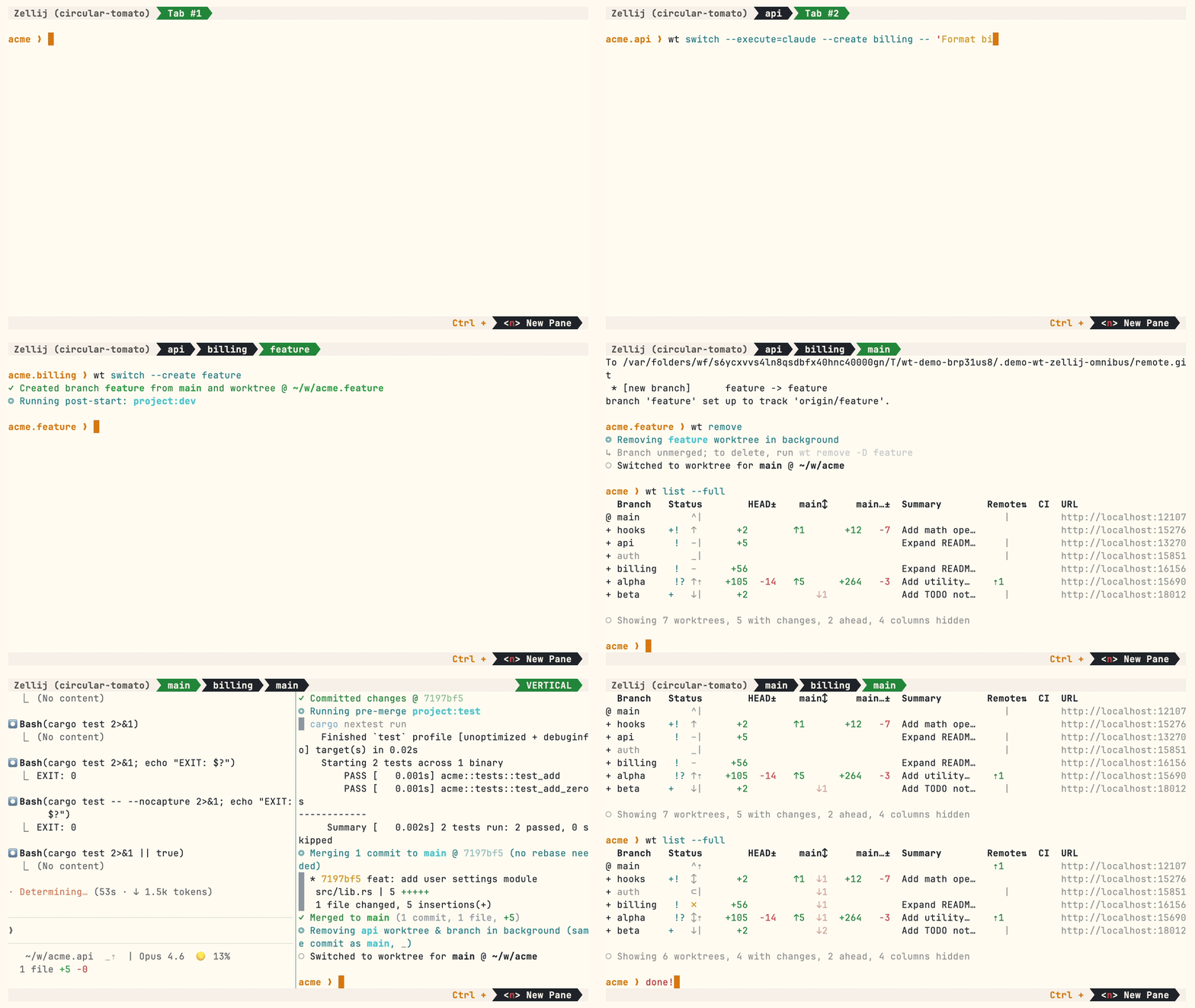
Multiple parallel agents, same simple commands:
Install
Homebrew (macOS & Linux):
brew install worktrunk && wt config shell install
Shell integration allows commands to change directories.
Cargo:
cargo install worktrunk && wt config shell install
Windows & other
Windows. wt defaults to Windows Terminal's command, so Winget additionally installs Worktrunk as git-wt to avoid the conflict:
winget install max-sixty.worktrunk
git-wt config shell install
Alternatively, disable Windows Terminal's alias (Settings → Apps → Advanced app settings → App execution aliases → "Terminal"/"Terminal Preview") to use wt directly.
Free code signing provided by SignPath.io, certificate by SignPath Foundation — policy.
Arch Linux:
sudo pacman -S worktrunk && wt config shell install
Conda / Pixi (community-maintained feedstock):
conda install -c conda-forge worktrunk && wt config shell install
Or with Pixi: pixi global install worktrunk && wt config shell install.
Quick start
Create a worktree for a new feature:
$ wt switch --create feature-auth
✓ Created branch feature-auth from main and worktree @ ~/repo.feature-auth
This creates a new branch and worktree, then switches to it. Do your work, then check all worktrees with wt list:
$ wt list
  Branch        Status      HEAD±     main↕    main…±    Remote⇅  Commit    Age  Message
@ feature-auth  +   ↑      +27   -8   ↑1       +31                4bc72dc    2h  Add authenticatio…
^ main              ^⇡                                    ⇡1      0e631ad    1d  Initial commit

○ Showing 2 worktrees, 1 with changes, 1 ahead, hidden: Path
The @ marks the current worktree. + means staged changes, ↑1 means 1 commit ahead of main, ⇡ means unpushed commits.
When done, either:
PR workflow — commit, push, open a PR, merge via GitHub/GitLab, then clean up:
wt step commit                    # commit staged changes
gh pr create                      # or glab mr create
wt remove                         # after PR is merged
Local merge — squash, rebase onto main, fast-forward merge, clean up:
$ wt merge main
◎ Generating commit message and committing changes... (2 files, +53, no squashing needed)
  Add authentication module
✓ Committed changes @ a1b2c3d
◎ Merging 1 commit to main @ a1b2c3d (no rebase needed)
  * a1b2c3d Add authentication module
   auth.rs | 51 +++++++++++++++++++++++++++++++++++++++++++++++++++
   lib.rs  |  2 ++
   2 files changed, 53 insertions(+)
✓ Merged to main (1 commit, 2 files, +53)
◎ Removing feature-auth worktree & branch in background (same commit as main, _)
○ Switched to worktree for main @ ~/repo
For parallel agents, create multiple worktrees and launch an agent in each:
wt switch -x claude -c feature-a -- 'Add user authentication'
wt switch -x claude -c feature-b -- 'Fix the pagination bug'
wt switch -x claude -c feature-c -- 'Write tests for the API'
The -x flag runs a command after switching; arguments after -- are passed to it. Configure post-start hooks to automate setup (install deps, start dev servers).
Next steps
- Learn the core commands:
wt switch,wt list,wt merge,wt remove - Set up hooks for automated setup
- Explore LLM commit messages, interactive picker, Claude Code integration, CI status & PR links
- Browse tips & patterns for recipes: aliases, dev servers, databases, agent handoffs, and more
- Extending Worktrunk — customize workflows with hooks & aliases
- Watch @DevOpsToolbox's video on Worktrunk
- Run
wt --helporwt <command> --helpfor quick CLI reference
Contributing
- ⭐ Star the repo
- Tell a friend about Worktrunk
- Open an issue — feedback, feature requests, even a small friction or imperfect user message, or a worktree pain not yet solved
- Share: X · Reddit · LinkedIn
Running the tests
cargo test
The shell integration tests need bash, zsh, fish, nushell, and pwsh, plus jq:
cargo test --test integration --features shell-integration-tests
📚 Full documentation at worktrunk.dev 📚