mirror of
https://github.com/headroomlabs-ai/headroom.git
synced 2026-11-22 15:06:14 +08:00
fix/plugin-launcher-isolated-python
240
Commits
| Author | SHA1 | Message | Date | |
|---|---|---|---|---|

|
3aafdf2dcc |
fix(router): keep source code out of the prose (Kompress) fallbacks (#4787)
## Description When the code compressor declined a block of source code, the router passed the block to Kompress. Kompress is a prose model. It drops low-salience words, and in code those words are keywords such as `for`, `in`, `if` and `import`. The result no longer parses. #4214 shows a fenced Python script that comes back with `for` and `in` removed. This PR stops that in the Python router and in the Rust live-zone dispatcher. When the code compressor declines, the code is forwarded unchanged. Closes #4214 Credit: the Python change is oxura's work from https://github.com/oxura/headroom/tree/fix/fenced-code-routing-4214-20261018 (277ca1f). Their commit is the first commit here, rebased onto `main`, and oxura is its author. The test, docs and Rust commits were added on top. oxura asked us to open this PR from our fork ([comment](https://github.com/headroomlabs-ai/headroom/issues/4214#issuecomment-6797572655)), and said they have not run this branch, so the model and native results below are ours, not theirs. ## Behaviour change to review With `enable_code_aware=False` (the default), source code now stays unchanged. Before this PR, it was sent to Kompress and lost keywords. With `enable_code_aware=True`, code that the code compressor declines also stays unchanged. Before, Kompress ran on it. A code block the code compressor does compress is unaffected. Prose, logs, JSON and tables are unaffected. Side effect: a code block that Kompress used to shrink (and break) now keeps its full size. This is the intended trade, but it means fewer tokens saved on code when `enable_code_aware=False`. ## Type of Change - [x] Bug fix (non-breaking change that fixes an issue) - [x] Documentation update - [ ] New feature - [ ] Breaking change (the default-config behaviour change above is intended, and it only stops damage to code) ## Changes Made Five commits: - `596764c3` `fix(router): keep source code out of prose fallbacks`. Author: oxura. Removes the CODE_AWARE to Kompress fallbacks in `headroom/transforms/content_router.py`. This is 277ca1f rebased onto `main`, and it differs from 277ca1f in two ways only: the two test-file conflicts are resolved, and its `wiki/proxy.md` hunk is dropped, because `AGENTS.md` says not to add content under `wiki/`. - `7705a4e6` `test(router): repin the code-to-Kompress tests and add the #4214 fence regression`. Author: Tao Hansen, with a `Co-authored-by: oxura` trailer. Five tests asserted the old fallback. They are rewritten to assert the new behaviour (code unchanged, Kompress never sees it) instead of being deleted. Adds a regression test for the script from #4214, with `enable_code_aware` both off and on. Updates `docs/content/docs/code-compression.mdx` and `docs/content/docs/how-compression-works.mdx`, which said that detected code goes to Kompress. - `6631668a` `fix(live-zone): leave source code unchanged when the code compressor declines`. Author: Tao Hansen. Same fix in `crates/headroom-core/src/transforms/live_zone.rs`: a declined `SourceCode` block is now a NoOp, not a Kompress input. Tests: `tests/live_zone_source_code_decline.rs` (single test, needs no model), and new cases in `tests/live_zone_dispatch.rs`. - `d8776283` `fix(router): turn off the code compressor's internal Kompress fallback`. Author: Tao Hansen. Follows review: the router's code compressor was still built with `fallback_to_kompress=self.config.enable_kompress` (#4719), so unknown languages, Perl and AST failures could build a `KompressCompressor` inside `CodeAwareCompressor`. The router now always sets `fallback_to_kompress=False`. The #4719 test that pinned `True` (`test_enabled_kompress_keeps_code_aware_fallback`) is repinned as `test_enabled_kompress_still_turns_off_code_aware_fallback`, and the unknown-language, Perl (by language hint, since `detect_language()` reports Perl-dominant code as unknown) and AST-failure paths are tested with spies on `is_kompress_available` and `KompressCompressor`, with `enable_kompress` both off and on. `docs/content/docs/code-compression.mdx` notes that the router always turns the option off. - `c1f8464e` `fix(router): keep passthrough code from external compressors and stale caches`. Author: Tao Hansen. Follows review: `_try_external_compressor` skips `PASSTHROUGH` blocks (code with `prefer_code_aware_for_code=False`, whole or as a mixed section), which would otherwise be offered to a prose-only external compressor as `text/plain`. The disk cache namespace now also hashes `_ROUTING_POLICY_REVISION`, so a same-version restart does not replay code that Kompress damaged before this change. Tests: two external-dispatch cases with a `text/plain` external, and one namespace test. All three fail on the previous head. I did not touch `CHANGELOG.md`. ## Testing - [x] Unit tests pass (`pytest`): see below, the failures are environment failures that also fail on `main` - [x] Linting passes (`ruff check .`, `ruff format --check .`) - [x] Type checking passes (`mypy headroom/transforms/content_router.py`) - [x] New tests added for new behaviour - [x] Manual testing performed (real model replay, below) ### Test Output macOS, Python 3.14. Head is now `c1f8464e`. ```text After the second review fix ( |
||
|
|
0d203db6b8 |
fix(copilot): keep new VS Code chats on the Local harness so they reach the proxy (#4899)
## Description

VS Code can run a Copilot chat on its "Copilot harness" (Agent Host, the
bundled Copilot SDK runtime) instead of the Local harness. That runtime
ignores `github.copilot.advanced.debug.overrideCapiUrl` /
`overrideProxyUrl`, so the chat goes straight to GitHub. Copilot's small
background calls (title, intent) still reach the proxy, so the proxy
looks connected while the main conversation never arrives. The harness
default (`chat.defaultToCopilotHarness`,
`chat.editor.preferCopilotHarness`) is tagged `experiment: startup` in
VS Code, so it can be flipped per user by rollout.

`headroom wrap vscode` now pins new chats to the Local harness.

## Type of Change

- [x] Bug fix (non-breaking change that fixes an issue)
- [ ] New feature (non-breaking change that adds functionality)
- [ ] Breaking change (fix or feature that would cause existing
functionality to change)
- [ ] Documentation update
- [ ] Performance improvement
- [ ] Code refactoring (no functional changes)

## Changes Made

- `headroom/providers/copilot/vscode.py`: the managed block also writes
`"chat.defaultToCopilotHarness": false` and
`"chat.editor.preferCopilotHarness": false`. Because they sit inside the
marker block, `headroom unwrap vscode` removes them. A harness setting
the user already set outside the block is left alone (no duplicate key).
New helper `copilot_harness_settings_enabled(path)` reports a user value
of `true`.
- `headroom/cli/wrap.py`: one line saying new chats stay on the Local
harness and existing chats keep their engine; a warning instead when the
user's own setting is `true`. `--no-configure` prints the two extra
settings.
- `docs/content/docs/vscode-copilot.mdx`: documents the harness settings
and the troubleshooting case.
- Blocks written by older versions (including ones with
`overrideAuthType`) are replaced by marker as before.

## Testing

- [x] Unit tests pass (`pytest`)
- [x] Linting passes (`ruff check .`)
- [ ] Type checking passes (`mypy headroom`)
- [x] New tests added for new functionality
- [x] Manual testing performed

### Test Output

```text
tests/test_provider_copilot_vscode_config.py + tests/test_cli/test_wrap_vscode.py: 32 passed.
Against origin/main source: 7 of those fail (block contents, old-block upgrade, user-set key [True]/[False], wrap output, --no-configure output).
ruff 0.17.4 check + format --check on the 5 changed Python files: clean.
mypy on the changed source files: 8 errors, all in headroom/cache/prefix_tracker.py and headroom/ccr/mcp_server.py, identical on origin/main; none in changed files.
```

## Real Behavior Proof

- Environment: macOS 27.2.1, Python 3.12.13, VS Code 1.145.2 with GitHub
Copilot signed in, core run from this branch, real GitHub Copilot
upstream. Real user `settings.json` (backed up and restored afterwards).
- Exact command / steps:
  1. `headroom wrap vscode -p 8795` from this branch.
2. `code chat -n -m agent "Reply with the single word OK and nothing
else."` (opens a new VS Code window and sends one Agent-mode chat).
3. Read the proxy's `/stats`, VS Code's `agenthost.log`, then `headroom
unwrap vscode`.
- Observed result:
  ```text
VS Code Copilot proxy settings updated: ~/Library/Application
Support/Code/User/settings.json
Keep using Copilot's normal model picker; the selected model is
preserved.
New chats stay on VS Code's Local harness; a chat keeps the engine it
started with, so start a new chat.

  settings.json after wrap:
  {
  	// --- Headroom Copilot proxy ---
"github.copilot.advanced.debug.overrideProxyUrl":
"http://127.0.0.1:8795/p/win-local",
"github.copilot.advanced.debug.overrideCapiUrl":
"http://127.0.0.1:8795/p/win-local",
  	"chat.defaultToCopilotHarness": false,
  	"chat.editor.preferCopilotHarness": false
  	// --- end Headroom Copilot proxy ---
  }

  proxy requests before chat: 0 {}
proxy requests after one Agent-mode chat in a new VS Code window: 4
{'gpt-4o-mini-2024-07-18': 3, 'claude-opus-5.5': 1}
  agent host turns during the chat: 0

Removed Headroom Copilot proxy settings from ~/Library/Application
Support/Code/User/settings.json
  settings.json after unwrap:
  {
  }
  ```
Separately, on the same machine with the settings edited by hand (same
VS Code, same proxy, new window each time):
`"chat.defaultToCopilotHarness": true` -> the Agent-mode chat ran in the
Agent Host (provider `copilotcli`) and 0 requests reached the proxy;
`"chat.defaultToCopilotHarness": false` +
`"chat.editor.preferCopilotHarness": false` -> Local harness, 4 requests
reached the proxy including the main `/v1/messages` call.
`"chat.temporaryDefaultToLocalHarness": true` as a user setting had no
effect, so it is not written.
- Not tested: a VS Code where Microsoft's rollout has flipped the
default (the explicit user value is expected to win, but that could not
be reproduced); an organization that enforces managed sandbox settings,
where VS Code can require the Copilot harness regardless; VS Code
profiles, workspace-level settings, Insiders/VSCodium; Windows and
Linux; the persistent `headroom start --persistent --vscode` path in the
Enterprise client.

## Runtime Rollout Safety

- Rollout-managed feature(s): none.
- Minimum rollout channel: n/a.
- Stable/default behavior changed: `headroom wrap vscode` writes two
more VS Code user settings inside its managed block. No proxy behaviour
changes.
- Kill switch / disable path: `headroom unwrap vscode` removes them; a
user who sets either key themselves keeps their value.
- Unsafe override required: no.
- Qualification impact: none expected.
- Rollback path: revert this commit; `unwrap` removes blocks of either
format.

## Review Readiness

- [x] I have performed a self-review
- [x] This PR is ready for human review

## Checklist

- [x] My code follows the project's style guidelines
- [x] I have performed a self-review of my code
- [x] I have commented my code, particularly in hard-to-understand areas
- [x] I have made corresponding changes to the documentation
- [x] My changes generate no new warnings
- [x] I have added tests that prove my fix is effective or that my
feature works
- [x] New and existing unit tests pass locally with my changes
- [x] I did **not** edit `CHANGELOG.md` — it is generated by
release-please from my Conventional Commit PR title (a CI guard enforces
this)

## Additional Notes

- This keeps users off the Copilot harness; it does not route that
harness through Headroom. Supporting it is separate work.
- Only the configured settings file is checked for a user value. A
`true` in workspace settings, another profile, or policy is not
detected.
- After `unwrap` the keys return to VS Code's default, which a rollout
may move to the Copilot harness.
- Existing chats keep the harness they started with; the wrap output
says to start a new chat.
- `e2e/copilot_live.py` and `e2e/wrap/run.py` were not run.

🤖 Generated with [Claude Code](https://claude.com/claude-code)
<!-- devin-review-badge-begin -->

---

<a href="https://app.devin.ai/review/headroomlabs-ai/headroom/pull/4899"
target="_blank"><picture><source media="(prefers-color-scheme: dark)"
srcset="https://static.devin.ai/assets/gh-devin-review-dark.svg?v=4"><img
src="https://static.devin.ai/assets/gh-devin-review-light.svg?v=4"
alt="Devin Review"></picture></a>
<!-- devin-review-badge-end -->

Co-authored-by: Claude Fable 5.2 <noreply@anthropic.com>
Co-authored-by: JD Davis <mxjerrett@gmail.com>
|
||
|
|
93331f2874 |
fix(proxy): retain final backend streaming usage (#4814)
## Description

Translated OpenAI streams (`/v1/chat/completions` through a backend such
as `anyllm` or LiteLLM) recorded the **first nonzero** usage snapshot
instead of the last one.

`_absorb` in `_stream_openai_via_backend` wrote a counter only when the
accumulator was still falsy:

```python
if key in usage and not stream_state.get(key):
    stream_state[key] = usage[key]
```

A provider that reports climbing cumulative snapshots on successive
content chunks therefore had every later frame thrown away. Replaying
the two frames from the issue through the real proxy path, `/stats`
recorded 10 input / 1 output tokens and `/metrics` recorded 2 cache
reads — while the client received both frames intact. The bug is in
accounting after delivery, not a dropped upstream event.

Closes #4263

## Type of Change

- [x] Bug fix (non-breaking change that fixes an issue)

## Changes Made

- `_parse_sse_usage_from_buffer` (openai branch): absent counters no
longer default to `0`. A frame that omits a field was previously
indistinguishable from one reporting an explicit zero, which is a
prerequisite for "absent keeps the last value".
- `_absorb`: assigns unconditionally, so the latest cumulative snapshot
wins. An absent field keeps its earlier value; an explicit zero still
replaces it.
- Removed `_parse_completion_tokens_from_sse_chunk`. It existed to catch
completion-only frames, but the buffered SSE parser already handles
those, and its `not stream_state["output_tokens"]` guard latched the
output count a second time.
- Replaced that helper's unit tests with eight regressions driving the
real `_stream_openai_via_backend` path through stream finalization, in
Chat and Responses shapes.
- `docs/content/docs/proxy.mdx`: one paragraph on the `POST
/v1/chat/completions` page documenting the accounting rule, in the
published docs site.

Net: -100/+113 lines, of which most deletions are the removed helper and
its implementation-only tests.

## Testing

- [x] Unit tests pass (`pytest`)
- [x] Linting passes (`ruff check .`)
- [x] Type checking passes (`mypy headroom`)
- [x] New tests added for new functionality
- [x] Manual testing performed

### Test Output

```text
$ python -m pytest tests/test_streaming_usage_parser.py -q
........                                                                 [100%]
8 passed in 1.01s

$ ruff check headroom/proxy/handlers/streaming.py tests/test_streaming_usage_parser.py
All checks passed!

$ ruff format --check headroom/proxy/handlers/streaming.py tests/test_streaming_usage_parser.py
2 files already formatted

$ mypy headroom/proxy/handlers/streaming.py
Success: no issues found in 1 source file
```

Regression set — the new tests against the unfixed handler (`git stash`
of `streaming.py` only):

```text
$ python -m pytest tests/test_streaming_usage_parser.py -q
FAILED ...[latest-snapshot-chat]      assert (10, 1, 2, 3) == (13, 5, 9, 1)
FAILED ...[latest-snapshot-responses]
FAILED ...[partial-chat]              assert (10, 1, 2, 3) == (10, 5, 2, 3)
FAILED ...[partial-responses]
FAILED ...[explicit-zero-chat]        assert (10, 1, 2, 3) == (0, 0, 0, 0)
FAILED ...[explicit-zero-responses]
6 failed, 2 passed in 1.07s
```

Six fail before the fix, all eight pass after — matching the issue
exactly.

Wider streaming and parser suites:

```text
$ python -m pytest tests/test_streaming_usage_parser.py tests/test_streaming_sse_malformed_events.py \
    tests/test_provider_billed_input.py tests/test_proxy_cache_ttl_metrics.py tests/test_proxy_handler_helpers.py \
    tests/test_proxy_streaming_request_logger.py tests/test_route_advice.py tests/test_h2_stream_reset_retry.py \
    tests/test_proxy_streaming_resilience.py tests/test_proxy_streaming_ratelimit_headers.py -q
3 failed, 607 passed in 10.21s
```

The three failures are
`tests/test_proxy_cache_ttl_metrics.py::test_stats_endpoint_reports_*`,
which raise `SystemExit: 78` from `_check_rust_core()` in `server.py`.
They are environmental (unbuilt Rust core in this checkout) and fail
identically on unmodified `upstream/main` with this branch stashed —
unrelated to this change.

## Real Behavior Proof

- Environment: Windows, Python 3.13.11, this branch, `PYTHONPATH` set to
the checkout.
- Exact command / steps: replayed the issue's two usage snapshots as a
Chat stream through `_stream_openai_via_backend` with a stub backend,
then read the resulting `RequestOutcome`.
- Observed result: the corrected counts from the issue; previously 10 /
1 / 2.

```text
provider_input_tokens=13 (expect 13)
output_tokens        =5 (expect 5)
cache_read_tokens    =9 (expect 9)
```

- Not tested: a live `anyllm`/LiteLLM upstream over real HTTP (no
credentials in this environment). The replay drives the identical
handler and parser path the proxy uses; the frames are byte-for-byte the
issue's.

## Runtime Rollout Safety

- Rollout-managed feature(s): none.
- Minimum rollout channel: n/a.
- Stable/default behavior changed: token accounting for translated
OpenAI streams now records the final snapshot. This is the fix; counts
move up from truncated to complete.
- Kill switch / disable path: none beyond reverting this commit.
- Unsafe override required: none.
- Qualification impact: none.
- Rollback path: `git revert`.

## Review Readiness

- [x] I have performed a self-review
- [x] This PR is ready for human review

## Checklist

- [x] My code follows the project's style guidelines
- [x] I have performed a self-review of my code
- [x] I have commented my code, particularly in hard-to-understand areas
- [x] I have made corresponding changes to the documentation
- [x] My changes generate no new warnings
- [x] I have added tests that prove my fix is effective or that my
feature works
- [x] New and existing unit tests pass locally with my changes
- [x] I did **not** edit `CHANGELOG.md`

## Additional Notes

Authorship is credited to @oxura, who diagnosed this in #4263 and wrote
the original patch on their fork; they were holding it back on the
ten-open-PR limit. This PR carries their change rebased onto current
`upstream/main` (their branch was cut from `fbf7bc32`, and
`streaming.py` has since drifted ~200 lines), with the commit message
and tests adapted to the current tree. Their `Authored-by` trailer is on
the commit.

One hunk from their patch was redirected: they documented the rule in
`wiki/proxy.md`, which `AGENTS.md:38` says is unpublished and must not
receive new content, so the paragraph now lives on the `POST
/v1/chat/completions` page in `docs/content/docs/proxy.mdx`. Thanks to
Devin Review for flagging it.

Co-authored-by: oxura <grozafroza44@gmail.com>
Co-authored-by: JerrettDavis <mxjerrett@gmail.com>
|
||
|
NAZIYAandJerrettDavis
|
6b41b6e451 |
feat(proxy): add cli and settings knob for ccr_inject_system_instructions (#4642)
<!-- maintainer-current-main --> ## Maintainer latest-main checkpoint Published `d13ba17dff65a5b31253ef3cf0775ffc2504d8da` contains current upstream main `e4a60ed72f6ef5b28569f8bfbe2163cfda32c948`. 150 CLI/settings/Gemini tests passed. Earlier live behavior proofs below retain their commit/platform scope; contributor runtime logic is unchanged. The common shard-2 failure was independently confirmed on main's hosted job 127069149772 and locally (four failures, six passes): the Gemini memory fixture mocked an unused body reader and provided no request stream. The maintainer test-only follow-up now constructs a real FastAPI/ASGI Request carrying JSON bytes and exercises the actual body reader. All six test-function ASTs/assertions are unchanged, and all 10 parameterized Gemini cases pass. Touched-file Ruff/format and whitespace checks pass. This fixes the inherited fixture instead of asking contributors to run CI or weakening the memory/content assertions. Fresh exact-head hosted qualification is requested. Nothing merged. <!-- /maintainer-current-main --> ## Description Closes #4636. `ccr_inject_system_instructions` (which instructs models how to retrieve compressed context when CCR markers are present) previously existed as a field on `ProxyConfig` but could only be toggled programmatically via the Python API. Operators deploying `headroom proxy` as a container or standalone service had no CLI flag, environment variable, or settings store entry to enable it without wrapping the process in custom Python code. This PR exposes `ccr_inject_system_instructions` as: 1. CLI flag: `--ccr-inject-system-instructions` 2. Environment variable: `HEADROOM_CCR_INJECT_SYSTEM_INSTRUCTIONS` 3. Curated settings store field: `ccr_inject_system_instructions` in `settings_store.SETTINGS` 4. Server environment configuration: loaded in `_proxy_config_from_env()` The default remains `False` preserving exact existing behavior. ## Type of Change - [x] New feature (non-breaking change that adds functionality) ## Changes Made - `headroom/cli/proxy.py`: Add `@click.option("--ccr-inject-system-instructions", is_flag=True, envvar="HEADROOM_CCR_INJECT_SYSTEM_INSTRUCTIONS", ...)`, add parameter to `proxy()`, and thread it into `ProxyConfig`. - `headroom/settings_store.py`: Add `SettingField("HEADROOM_CCR_INJECT_SYSTEM_INSTRUCTIONS", "ccr_inject_system_instructions", ...)` to `SETTINGS` registry so it is validated, saved to `settings.json`, and surfaced on `/settings`. - `headroom/proxy/server.py`: Read `HEADROOM_CCR_INJECT_SYSTEM_INSTRUCTIONS` in `_proxy_config_from_env()` for multi-worker and container deployments. - `docs/content/docs/proxy.mdx`: Document `--ccr-inject-system-instructions` and `HEADROOM_CCR_INJECT_SYSTEM_INSTRUCTIONS` in the CCR configuration table. - `tests/test_cli_proxy_env.py`: Add test cases verifying `--ccr-inject-system-instructions`, `HEADROOM_CCR_INJECT_SYSTEM_INSTRUCTIONS`, `settings.json`, and `_proxy_config_from_env()` correctly populate `ProxyConfig.ccr_inject_system_instructions`. ## Testing - [x] Unit tests pass (`pytest tests/test_proxy/test_settings_store.py tests/test_cli_proxy_env.py`) - [x] Linting passes (`ruff check`) - [x] Formatting passes (`ruff format --check`) - [x] New tests added for new functionality - [x] Manual testing performed ### Test Output ```text $ pytest tests/test_proxy/test_settings_store.py -q 40 passed, 1 warning in 2.18s $ pytest tests/test_cli_proxy_env.py -k "test_ccr_inject_system_instructions or test_settings_file_reaches_ccr_inject_system_instructions or test_proxy_config_from_env_reads_ccr_inject_system_instructions" -q 5 passed, 91 deselected in 3.42s $ ruff check headroom/cli/proxy.py headroom/settings_store.py headroom/proxy/server.py tests/test_cli_proxy_env.py All checks passed! $ ruff format --check headroom/cli/proxy.py headroom/settings_store.py headroom/proxy/server.py tests/test_cli_proxy_env.py 4 files already formatted ``` ## Real Behavior Proof - Environment: Windows 11 x86_64, Python 3.14.5, Click CliRunner test harness and settings store test harness. - Exact command / steps: Executed `runner.invoke(main, ["proxy", "--ccr-inject-system-instructions"])`, verified captured ProxyConfig; tested env var `HEADROOM_CCR_INJECT_SYSTEM_INSTRUCTIONS=1`, verified ProxyConfig; tested `settings.json` with `{"ccr_inject_system_instructions": true}`, verified ProxyConfig; tested `_proxy_config_from_env()`. - Observed result: In all test cases, ProxyConfig.ccr_inject_system_instructions resolved to True when enabled and False by default, matching the behavior of sibling knobs like HEADROOM_CCR_INLINE_RESOLVE and HEADROOM_CCR_BUFFERED_CHAT_STREAMING. - Not tested: Live Kubernetes deployment or multi-node container cluster. ## Runtime Rollout Safety - Rollout-managed feature(s): none, opt-in configuration knob - Minimum rollout channel: n/a - Stable/default behavior changed: no, default remains False - Kill switch / disable path: omit the flag or unset HEADROOM_CCR_INJECT_SYSTEM_INSTRUCTIONS - Unsafe override required: no - Qualification impact: none while disabled - Rollback path: git revert this commit ## Review Readiness - [x] I have performed a self-review - [x] This PR is ready for human review ## Checklist - [x] My code follows the project's style guidelines - [x] I have performed a self-review of my code - [x] I have commented my code, particularly in hard-to-understand areas - [x] I have made corresponding changes to the documentation - [x] My changes generate no new warnings - [x] I have added tests that prove my fix is effective or that my feature works - [x] New and existing unit tests pass locally with my changes - [x] I did **not** edit `CHANGELOG.md` — it is generated by release-please from my Conventional Commit PR title (a CI guard enforces this) ## Additional Notes Follows the exact pattern established by `--ccr-inline-resolve` and `--ccr-buffered-chat-streaming` (#4631). <!-- devin-review-badge-begin --> --- <a href="https://app.devin.ai/review/headroomlabs-ai/headroom/pull/4642" target="_blank"><picture><source media="(prefers-color-scheme: dark)" srcset="https://static.devin.ai/assets/gh-devin-review-dark.svg?v=4"><img src="https://static.devin.ai/assets/gh-devin-review-light.svg?v=4" alt="Devin Review"></picture></a> <!-- devin-review-badge-end --> ## Maintainer runtime and integration qualification Published `9c0b0a10d63227554350a3ba2cb936e09cea1286` includes upstream main `ee975d49c0b742e34b09df50a01c7b5680e85cdc` with a clean merge and no contributor logic changes. Main is actively advancing, so final qualification must check the then-current main again. Windows/Python 3.12.13: `python -m pytest tests/test_cli_proxy_env.py tests/test_proxy/test_settings_store.py -q` reports **140 passed** with the existing development native extension. Touched-file Ruff, format and whitespace checks pass; no fresh native build claimed. Real CLI proof (no replaced run_server or provider transport): launch the actual Click entry point `from headroom.cli import main; main()` in six isolated subprocesses with `proxy --mode token --no-optimize --no-cache --no-rate-limit --no-ccr-proactive-expansion --no-memory-tools --no-memory-context --disable-kompress --anthropic-api-url http://127.0.0.1:<fixture-port>`. Each process has an isolated workspace/settings file, offline/beacon opt-out and a real CompressionStore entry created before launch; GET `/v1/retrieve/{hash}` confirms ownership. Send `/v1/messages` with that stored hash in a historical tool-result marker, through the actual TCP proxy to a local HTTP Anthropic-shaped provider fixture, and inspect the received upstream JSON. Observed: all six calls return HTTP 200. Default: no `Compressed Context Available` instructions. CLI flag, environment `HEADROOM_CCR_INJECT_SYSTEM_INSTRUCTIONS=1`, and a settings file with `{"ccr_inject_system_instructions":true}` each produce the instructions upstream. `--no-ccr` and `--lossless`, both requested alongside the flag, produce neither instructions nor a retrieval tool despite the owned historical marker. This verifies the disabled-CCR finding is addressed on the real request path. The documented warm-prefix/cache-mode skip remains an intentional limitation; this run uses token mode. Not tested: live cloud models, Kubernetes/multiple nodes, every provider wire shape, warm-cache replay or a fresh native build. The local HTTP fixture is synthetic; request/configuration/ownership paths and TCP transport are real. Hosted CI must finish on the final head; nothing merged. ### Maintainer current-main requalification Exact head `b38e5a5937cf09c3b5127f3f066e0384db235955`, upstream main `ea59ac3eef3a3dc02076e9fe4bb30d572ca9c1a9`. Clean integration with upstream/main |
||
|
JD DavisandCopilot
|
e9301f34c1 |
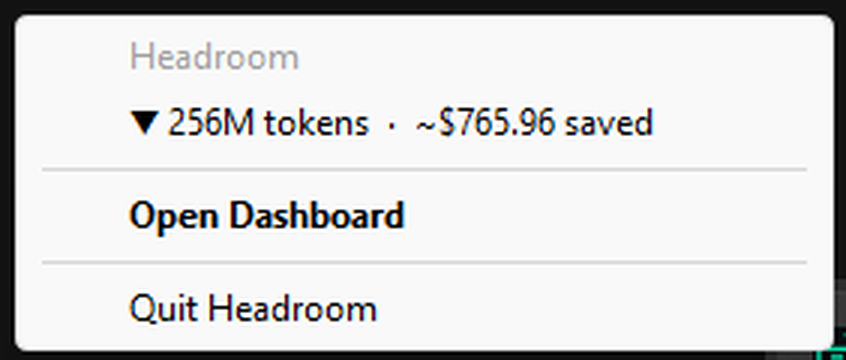
feat(tray): opt-in system tray icon with savings counter, dashboard and update alert (#4726)
## Description
Adds an **opt-in system tray icon** for Headroom while it runs (Windows
first; macOS/Linux planned). The icon is the Headroom logomark and its
right-click menu shows a compact savings counter (tokens and estimated $
saved), opens the dashboard, alerts when an update is available, and
lets you quit.
Closes #
## Type of Change
- [ ] Bug fix (non-breaking change that fixes an issue)
- [x] New feature (non-breaking change that adds functionality)
- [ ] Breaking change (fix or feature that would cause existing
functionality to change)
- [x] Documentation update
- [ ] Performance improvement
- [ ] Code refactoring (no functional changes)
## Changes Made
- New `headroom/tray/` package: `core.py` (GUI-free stats
polling/formatting), `icon.py` (logomark drawn with Pillow, no binary
assets in the wheel), `app.py` (pystray app), `launcher.py` (spawns the
tray as a child of the proxy).
- `headroom proxy --tray` starts the tray with the proxy; `headroom tray
--port N` attaches to a running proxy.
- Menu: live `▼ tokens · ~$ saved` counter (from `/stats` →
`persistent_savings.lifetime`, polled every 5s), Open Dashboard, "Update
available" (only when newer; reuses `headroom.update_check`, honours
`HEADROOM_UPDATE_CHECK=off`; one-time notification), Quit.
- Icon states: normal, orange dot when an update exists, grey when the
proxy is offline.
- New optional extra `headroom-ai[tray]` (`pystray`, `pillow`).
Unsupported platform / missing extra: `--tray` prints why and the proxy
starts normally.
- Docs: `docs/content/docs/system-tray.mdx` + nav entry; screenshots in
`docs/public/assets/tray/`.
## Testing
- [x] Unit tests pass (`pytest`)
- [x] Linting passes (`ruff check .`)
- [x] Type checking passes (`mypy headroom`)
- [x] New tests added for new functionality
- [x] Manual testing performed
### Test Output
```text
> python -m ruff check headroom\tray headroom\cli tests\test_tray_core.py
All checks passed!
> python -m mypy headroom\tray headroom\cli\tray.py
Success: no issues found in 7 source files
> python -m pytest tests\test_tray_core.py tests\cli tests\test_offline_egress_chokepoint.py tests\test_proxy\test_settings_store.py -q
293 passed, 2 skipped
```
(Scoped runs; I did not run the full suite or `mypy headroom` over the
whole package.)
## Real Behavior Proof
- Environment: Windows 11, Python 3.13.13, 3840x2160 display, `pystray`
+ `pillow` 12.3.0, branch based on `upstream/main` @
|
||
|
JD DavisandCopilot
|
ba26fd7d92 |
docs(install): add Windows auto-start and warm-join happy path (#4725)
## Description Documents the Windows happy path for persistent auto-start and warm-join. Behavior already exists upstream (boot + 5-minute health tasks, S4U-to-session fallback from #4627, per-port `wrap` reuse/recovery); the docs had no end-to-end Windows walkthrough. Closes # ## Type of Change - [x] Documentation update ## Changes Made - Add "Windows happy path: auto-start and warm-join" to `docs/content/docs/persistent-installs.mdx`. ## Testing - [ ] Unit tests pass (`pytest`) - [ ] Linting passes (`ruff check .`) - [ ] Type checking passes (`mypy headroom`) - [ ] New tests added for new functionality - [x] Manual testing performed ### Test Output ```text Docs-only; no automated tests apply. ``` ## Real Behavior Proof - Environment: Windows 11, non-elevated user, headroom-ai 0.43.1 runtime; persistent-task profiles `local-agents` (9010), `local-copilot` (9012). - Exact command / steps: `headroom install status --profile local-agents`; `headroom wrap claude --port 9010 -- --version` (joined the running proxy, no second proxy); 3 concurrent `headroom wrap codex --port 9555 -- --version` on a cold port (one "Starting Headroom proxy", others joined); confirmed S4U `schtasks /Create` returns "Access is denied" for this user, matching the documented fallback. - Observed result: proxy healthy and reused; Codex traffic observed in proxy log; one proxy per port. - Not tested: S4U/logged-off recovery (denied on this account); `headroom install apply` against 0.44 from a clean machine. ## Runtime Rollout Safety - Rollout-managed feature(s): none - Minimum rollout channel: n/a - Stable/default behavior changed: no - Kill switch / disable path: n/a - Unsafe override required: no - Qualification impact: none - Rollback path: revert docs commit ## Review Readiness - [x] I have performed a self-review - [x] This PR is ready for human review <!-- devin-review-badge-begin --> --- <a href="https://app.devin.ai/review/headroomlabs-ai/headroom/pull/4725" target="_blank"><picture><source media="(prefers-color-scheme: dark)" srcset="https://static.devin.ai/assets/gh-devin-review-dark.svg?v=4"><img src="https://static.devin.ai/assets/gh-devin-review-light.svg?v=4" alt="Devin Review"></picture></a> <!-- devin-review-badge-end --> --------- Co-authored-by: Copilot <223556219+Copilot@users.noreply.github.com> |
||
|
|
66e0086952 |
feat(opencode): add repeatable --extra-model flag for custom wrap-time models (#2364)
## Description
`headroom wrap opencode` injects a hardcoded model list
(`HEADROOM_OPENCODE_MODELS`) into the `headroom` provider block of
`opencode.json`. There's no way to add custom models (for example a
free-tier DeepSeek) at wrap time. Hand-patching `opencode.json` is the
only workaround, and the next wrap overwrites it.
This PR adds a repeatable `--extra-model` flag and a
`HEADROOM_OPENCODE_EXTRA_MODELS` env var. Both take
`id[=name[=context_window[=output_limit]]]` specs. Extra models are
merged into the injected provider block alongside the built-ins, and
flag specs win over env specs on id collision. `name` defaults to the
id, `context_window` to 200000, and `output_limit` to `min(16384,
context_window)`.
Fields are separated by `=` rather than `:` because model ids routinely
contain `:`. Ollama ids are `name:tag` (`qwen2.5-coder:7b`), and
OpenRouter free-tier ids end in `:free`. With a `:` separator those were
silently cut down to a different id (Devin review, 2026-10-03).
The PR also fixes the wrap/unwrap lifecycle the flag depends on. A wrap
that starts without an `opencode.json` used to write the file with no
backup and no record of what Headroom put in it, so `headroom unwrap
opencode` left the injected models and the proxy base URL behind while
reporting that OpenCode was no longer routed through Headroom, and a
re-wrap under `--openai-api-url` kept an extra model Headroom had
injected but no longer advertised. Wrap now records what it owns in
`opencode.json.headroom-managed.json`, and unwrap uses that record: it
removes the model ids and the base URL Headroom wrote, keeps everything
else in the file, drops an extra model that is no longer requested, and
deletes the config file when Headroom created it and nothing else is
left in it.
Closes #2359
## Type of Change
- [x] Bug fix (non-breaking change which fixes an issue)
- [x] New feature (non-breaking change which adds functionality)
- [ ] Breaking change (fix or feature that would cause existing
functionality to not work as expected)
- [x] Documentation update
- [ ] Refactoring (no functional changes)
## Changes Made
- `headroom/providers/opencode/config.py`:
- New `parse_extra_model_spec()`, which splits on `=` with an optional
fourth `output_limit` field and raises `ValueError` on an empty id or a
non-integer / non-positive limit.
- New `extra_models_from_env()`, which reads comma-separated specs from
`HEADROOM_OPENCODE_EXTRA_MODELS`.
- An `extra_models` parameter threaded through
`headroom_provider_entry()`, `_render_provider_block()` and
`inject_opencode_provider_config()`.
- With `keep_user_entries` (#3125's `--openai-api-url` gate),
`--extra-model` entries win over a kept user entry with the same id.
- New managed-state sidecar (`opencode.json.headroom-managed.json`)
recording the model ids and base URL Headroom injected and whether
Headroom created the config file. `inject_opencode_provider_config()`
writes it on every injection; `record_opencode_config_origin()` marks a
config that Headroom creates because none existed.
- `remove_managed_opencode_provider()` drops the recorded model ids, the
recorded base URL, and the provider block once nothing else is left in
it. Entries the user added or edited are preserved.
- `_drop_stale_managed_models()` prunes an extra model Headroom injected
but no longer advertises, including an extra that overrode a built-in id
and is dropped again, so a re-wrap without the flag restores the
built-in defaults rather than keeping the old override.
- `snapshot_opencode_config_if_unwrapped()` no longer snapshots a config
Headroom wrote itself as pre-wrap content.
- `headroom/providers/opencode/runtime.py`: extras also reach the
launch-time `OPENCODE_CONFIG_CONTENT`.
- `headroom/cli/wrap.py`:
- A repeatable `--extra-model` option on `wrap opencode`. Env and flag
specs are parsed up front, and a malformed spec raises
`click.BadParameter`. The merged dict goes to both
`inject_opencode_provider_config` call sites (prepare-only and launch)
and to the launch env. Also adds a help text and docstring example.
- `wrap opencode` records the config origin before the first config
mutation.
- `unwrap opencode` undoes the recorded provider entries when there is
no pre-wrap backup, keeps the rest of the file, and removes a config
Headroom created once nothing Headroom-owned is left in it.
- `docs/content/docs/opencode.mdx`: new "Adding models" subsection
(format, defaults, Ollama/OpenRouter example, built-in id override, the
env var's no-comma limitation) and an env-var table row. The subsection
and the "How It Works Under The Hood" unwrap step now describe the
managed-state record and the automatic cleanup it enables.
- Tests:
- Spec parsing: full spec with output, defaults, the output cap at small
contexts, colon-bearing ids (`qwen2.5-coder:7b`,
`deepseek/deepseek-chat:free`, a name containing `:`), and invalid specs
including a bad output limit.
- Env parsing, provider-entry merge, and end-to-end inject. Also
@JerrettDavis's collision test across both `keep_user_entries` values.
- CLI: the flag reaches `opencode.json`, the env var persists, both
reach `OPENCODE_CONFIG_CONTENT` on launch, the flag wins over a kept
user entry under `--openai-api-url`, and a malformed spec exits with a
usage error.
- Managed state: the sidecar records the injected ids and base URL, a
config the user already had is not marked as Headroom-created, a re-wrap
does not snapshot Headroom's own config, a dropped extra model is pruned
(including an override of a built-in id, which returns to the built-in
defaults), a user model and a user-edited model survive, and the
provider removal keeps unrelated user entries.
- Lifecycle: a fresh wrap followed by an unwrap removes the config file
again (with and without the MCP entry), user content added after a fresh
wrap survives the unwrap, a re-wrap without the extra model drops the
stale one, and a directly injected provider entry is undone by the
unwrap callback as well.
- A user setting that is false, zero or an empty string is content, not
an empty section: such a setting survives the unwrap instead of costing
the user the whole file.
## Testing
- [x] Unit tests pass locally
- [x] Lint/format/type checks pass locally
- [x] New tests added for new functionality
The new parsing tests fail against the previous `:`-based parser:
```text
FAILED tests/test_providers_opencode_config.py::test_parse_extra_model_spec_keeps_colons_in_ids[qwen2.5-coder:7b-...]
FAILED tests/test_providers_opencode_config.py::test_parse_extra_model_spec_keeps_colons_in_ids[deepseek/deepseek-chat:free=DeepSeek Free-...]
FAILED tests/test_providers_opencode_config.py::test_parse_extra_model_spec_full
...
================ 21 failed, 2 passed, 103 deselected in 0.86s =================
```
With this branch (head
|
||
|
|
d6df127d57 |
feat(compress): accept Gemini and Bedrock Converse bodies on the gateway turn (#4679)
## Description
`/v1/compress` in gateway mode (a request with a `gateway` block) now
accepts two more native request bodies:
- Gemini `generateContent`
- Bedrock Converse
It compresses their text slots and returns `body` in the same native
shape. This lets a gateway like LiteLLM compress native Gemini and
Bedrock passthrough traffic, which it couldn't before.
`config.mode: "ccr"` is rejected for these shapes with a 400. Every
other mode is marker-free for them.
(Was stacked on #4617, which has merged; the branch now carries current
`main`.)
## Type of Change
- [ ] Bug fix (non-breaking change that fixes an issue)
- [x] New feature (non-breaking change that adds functionality)
- [ ] Breaking change (fix or feature that would cause existing
functionality to change)
- [x] Documentation update
- [ ] Performance improvement
- [ ] Code refactoring (no functional changes)
## Changes Made
### How
This works the same way `gateway_responses` does for Codex: it builds a
view instead of translating the body.
- Every compressible text slot becomes one chat-shaped pseudo message.
- Compressed text is written back by its path in the body.
- Everything else stays byte-identical: `thoughtSignature`, thought
parts, `functionCall`, `inlineData`, `toolUse`, `cachePoint`,
`reasoningContent`, `tools`/`toolConfig`.
- Tool calls appear in the view, so tool-name rules still apply. `Read`
stays verbatim, for example.
- A JSON slot is only written back if it still parses to the same JSON
type.
- If the compressed list doesn't line up with the slots, the original
transcript is forwarded and a warning is logged.
### CCR on native bodies (review fix)
A native body can't carry `headroom_retrieve`. Its `tools`/`toolConfig`
are forwarded untouched, and `create_ccr_tool_definition` only builds
chat, Anthropic and Responses shapes. It also never gets a re-drive. So
a CCR marker in a native body points at content the model can never
fetch. Before this fix, `config.mode: "ccr"` on a Gemini or Converse
gateway turn did exactly that: log output came back as a marker with
`ccr_hashes: [<hash>]` and `obligations: []`.
- `handle_compress` now answers `ccr` on a native view with `400
invalid_request`. The message names the shape, explains why, and lists
the supported modes.
- The check runs where the mode is chosen, right after `attach_view` has
recorded the shape. That is before any compression, session work or CCR
store write.
- **The rejection does not depend on `gateway.can_redrive`.** Even a
gateway that can re-drive has no way to put the retrieval tool into a
native request, so there is no capability under which native `ccr`
works.
- **Without a `gateway` block nothing changes.** A Gemini body is
already a 400 (no `messages`). A Converse body goes through the plain
messages path, where its untyped blocks are opaque: 0 tokens saved, no
markers in any mode, `ccr` included (checked). So the rule is
consistent: reject `ccr` wherever Headroom reads a native shape.
- The bypass header still returns the body untouched with no
compression, in any mode.
- I checked every other mode on the same marker-producing input
(default, `lossless`, `lossy_inline`, `lossless_then_lossy`): no marker
and no hash in any of them. These modes build pipelines with
`ccr_inject_marker=False, ccr_enabled=False`. Stale-Read notices are
hashless in marker-free modes since #4678.
- **Second defect, same family:** with `HEADROOM_DEDUPE=1`, cross-turn
dedup wrote `[↑NL same as msg 4]` into a Converse tool result. That `4`
counts view messages (system blocks, tool calls, result slots), not the
caller's `messages`, so it named the wrong message. Native views now set
`cross_turn_dedup_recoverable=False`, as `lossless` mode already did.
- The `not self.native_shape` guards on CCR arming and re-drive in
`GatewayTurn.finish` stay as defence in depth.
### Caller contract
**Gemini**
- Send top-level `contents` as a list, with no `messages` or `input`.
- `systemInstruction`/`system_instruction`, `tools` and
`generationConfig` are optional and pass through.
**Converse**
- Send `messages` where every message has role `user` or `assistant`,
and every content block has no `type` key.
- At least one block must use a Converse key: `text`, `toolUse`,
`toolResult`, `cachePoint`, and so on.
- `system` is optional, as a list of blocks.
**Both shapes**
- `config.mode`: omit it (marker-free default), or use `lossless`,
`lossy_inline` or `lossless_then_lossy`. `ccr` is a 400.
- Only gateway turns get a view. Without a `gateway` block the endpoint
behaves exactly as before. A client-sent `_headroom_native_view` key is
dropped, and `BODY_CONTROL_KEYS` strips the real one before the body is
returned.
- `config.frozen_message_count` and `config.protect_recent` count native
messages: Gemini `contents` entries and Converse `messages`.
`session.frozen_message_count` comes back in native units. The
`/v1/usage` reply's `frozen_message_count` still counts view messages,
and the docs say so.
- No re-drive is ever armed, so `obligations` never contains `redrive`,
and request hooks run stream-safe-only. Tool compaction and output
steering are skipped.
- Relayed usage can be:
- Gemini `usageMetadata`, where `promptTokenCount` already includes
`cachedContentTokenCount`.
- Converse `usage`, where `inputTokens` excludes `cacheReadInputTokens`
and `cacheWriteInputTokens`.
- The whole provider response that carries either.
- Every gateway answer, fail-open ones included, carries `wire_shape`:
`gemini`, `converse`, `openai_responses` or `messages`. A caller that
sent a native body and gets anything else, or no field at all, is
talking to an older Headroom and should forward its original body.
- Top-level `messages` in the answer is the Converse list for Converse
and the chat-shaped view for Gemini.
## Testing
- [x] Unit tests pass (`pytest`)
- [x] Linting passes (`ruff check .`)
- [x] Type checking passes (`mypy headroom`): no new errors; the 8
reported are in `ccr/mcp_server.py` and `cache/prefix_tracker.py` and
are identical on `main`
- [x] New tests added for new functionality
- [x] Manual testing performed (local replay, below)
New in `tests/gateway/test_native_shapes.py`:
- `test_ccr_mode_is_rejected_for_native_bodies[gemini|converse]`: 400,
`invalid_request`, message asserted.
- `test_other_modes_forward_native_bodies_without_ccr_markers`: 4 modes
x 2 shapes, on log output large enough to produce a marker. Checks no
hash, no marker, the shape echoed, non-message keys byte-identical and
the native list mapped back.
- `test_ccr_still_works_on_a_chat_gateway_turn`: the same log output in
a chat body with `ccr` still carries a marker. This proves the input
above is marker-producing, and that chat `ccr` didn't regress.
- `test_native_bodies_get_no_dedup_pointer_into_view_messages`.
- `test_native_turns_are_never_asked_to_redrive` now runs in the default
mode, because `ccr` is a 400.
### Test Output
```text
# before the fix (new tests only, rest of the file passing)
FAILED tests/gateway/test_native_shapes.py::test_ccr_mode_is_rejected_for_native_bodies[gemini]
FAILED tests/gateway/test_native_shapes.py::test_ccr_mode_is_rejected_for_native_bodies[converse]
FAILED tests/gateway/test_native_shapes.py::test_native_bodies_get_no_dedup_pointer_into_view_messages
3 failed, 25 passed
# after
tests/gateway/test_native_shapes.py: 28 passed
# tests/gateway tests/test_gateway_turn_unit.py tests/test_compress_api.py
# tests/test_proxy_compress_endpoint.py tests/test_compress_session_mode.py
# tests/test_compress_session_shared.py tests/test_compress_passthrough.py tests/test_compress_failure.py
1 failed, 507 passed, 4 skipped
# the one failure, test_lossy_inline_emits_no_ccr_markers[1-json_minifier], fails identically on main
|
||
|
|
491afe98b1 |
fix(proxy): reject a private x-headroom-base-url on chat and responses with 400 (#4857)
## Description
When the upstream guard rejected an `x-headroom-base-url` override (an
address on a private, loopback, link-local or otherwise non-public
network, or a host outside `HEADROOM_ALLOWED_BASE_URLS` in allowlist
mode), `_resolve_openai_upstream_base` logged a warning and returned
`None`. `/v1/chat/completions` and `/v1/responses` then sent the request
— the prompt and the client's `Authorization`, meant for the gateway the
client named — to the configured `OPENAI_API_URL` instead. Every other
route that reads the header (`headroom/providers/proxy_routes.py`:
Anthropic messages, Gemini, models, embeddings, audio, passthrough)
refuses with `400 Rejected unsafe upstream base URL`.
The OpenAI chat and responses handlers now refuse the same way.
## Type of Change
- [x] Bug fix (non-breaking change that fixes an issue)
- [x] Breaking change (fix or feature that would cause existing
functionality to change)
- [x] Documentation update
## Changes Made
- `headroom/proxy/handlers/openai.py`: `_resolve_openai_upstream_base`
raises `HTTPException(400, "Rejected unsafe upstream base URL")` instead
of returning `None` when the guard rejects the override (malformed /
non-http(s) values are unchanged: still ignored).
- `docs/content/docs/security-model.mdx`: one behaviour for all routes
(the page previously documented the two different outcomes).
-
`tests/test_upstream_guard.py::test_openai_routes_refuse_a_private_override_instead_of_using_the_default[chat|responses]`:
real app, configured OpenAI target is a local recording server; asserts
400 and that the configured target is never contacted.
**Sibling PRs that touch the same code** (merge order note):
`fix/upstream-guard-off-loop` adds `_resolve_openai_upstream_base_async`
next to this function; whichever merges second must make the async
resolver raise the same 400 (that PR's rejection branch is the one place
to change). `fix/upstream-idna-pin-once` touches the call sites only.
Suggested order: idna-pin-once, off-loop, then this PR rebased.
## Testing
- [x] Unit tests pass (`pytest`)
- [x] Linting passes (`ruff check .`)
- [x] Type checking passes (`mypy headroom`)
- [x] New tests added for new functionality
- [x] Manual testing performed
### Test Output
```text
# New test on origin/main (
|
||
|
|
5d44855c6f |
fix(proxy): withhold per-project savings and quota stats from /stats network callers (#4859)
## Description `GET /stats` removes `recent_requests` / `request_logs` for a caller that is not loopback, not a trusted dashboard CIDR peer and has not presented the proxy token. The same payload still carried `savings.per_project`, `persistent_savings.projects` (project names and per-project spend) and the provider quota sections (`get_quota_registry().get_all_stats()`, e.g. account login and plan). For that same caller `/stats-lifetime` already drops `projects` and `/quota` is refused, so `/stats` was the one route that still handed them out. `/stats` and `/stats?cached=1` now drop those fields under the same rule (`_request_can_view_stats_metadata`). The nested `savings` / `persistent_savings` dicts are rebuilt rather than edited in place, so the shared cached snapshot still serves loopback callers in full. Token-authenticated callers keep seeing everything, as documented in "What the proxy token unlocks"; that docs table now lists the extra fields. Closes # ## Type of Change - [x] Bug fix (non-breaking change that fixes an issue) - [ ] New feature (non-breaking change that adds functionality) - [ ] Breaking change (fix or feature that would cause existing functionality to change) - [x] Documentation update - [ ] Performance improvement - [ ] Code refactoring (no functional changes) ## Changes Made - `headroom/proxy/server.py` (`/stats`): for callers without stats-metadata access, also pop every quota tracker key and drop `savings.per_project` and `persistent_savings.projects`; docstring updated. - `docs/content/docs/security-model.mdx`: the `/stats` row of "What the proxy token unlocks" lists per-project savings and the quota sections. - `tests/test_proxy_stats_network_gating.py`: network caller on `/stats` and `/stats?cached=1` gets no project name / quota data; loopback still gets them after a network caller primed the cached snapshot; a token holder still gets them. ## Testing - [x] Unit tests pass (`pytest`) - [x] Linting passes (`ruff check .`) - [x] Type checking passes (`mypy headroom`) - [x] New tests added for new functionality - [x] Manual testing performed ### Test Output ```text $ pytest -q tests/test_proxy_stats_network_gating.py 5 passed in 18.60s # with the server.py change stashed (origin/main code) FAILED tests/test_proxy_stats_network_gating.py::test_stats_withholds_project_names_and_quota_stats_from_network_callers[/stats] FAILED tests/test_proxy_stats_network_gating.py::test_stats_withholds_project_names_and_quota_stats_from_network_callers[/stats?cached=1] 2 failed, 3 passed in 7.10s $ pytest -q tests/test_proxy_loopback_gating.py tests/test_proxy_stats_recent_requests.py tests/test_stats_output_reduction_gate.py tests/test_proxy_stats_network_gating.py 174 passed, 5 warnings in 44.87s ruff check / format --check (0.17.3): All checks passed, 2 files already formatted mypy headroom/proxy/server.py: Success: no issues found in 1 source file ``` ## Real Behavior Proof - Environment: macOS, Python 3.12, `create_app(ProxyConfig(stateless=True, ...))` under FastAPI `TestClient`, one recorded request for a project. - Exact command / steps: `GET /stats` once as a network peer (`203.0.113.9`, Host `203.0.113.5`) and once as loopback; print whether `savings.per_project` and `persistent_savings.projects` are present. - Observed result: - origin/main: network caller gets `savings.per_project` and `persistent_savings.projects` with every project name. - this branch: network caller gets `savings.per_project: None` and no `persistent_savings.projects`; loopback still gets both in full. - Not tested: a real Copilot/Codex quota tracker (the test registers a stand-in tracker). ## Runtime Rollout Safety - Rollout-managed feature(s): none - Minimum rollout channel: n/a - Stable/default behavior changed: yes, for network callers without dashboard-CIDR or token access only: `/stats` no longer includes per-project savings or quota sections. Loopback dashboards, CIDR peers and token holders are unchanged. - Kill switch / disable path: configure `HEADROOM_PROXY_TRUSTED_DASHBOARD_CLIENT_CIDRS` or present the proxy token, as for `/stats-lifetime` and `/quota`. - Unsafe override required: no - Qualification impact: none - Rollback path: revert this commit. ## Review Readiness - [x] I have performed a self-review - [x] This PR is ready for human review ## Checklist - [x] My code follows the project's style guidelines - [x] I have performed a self-review of my code - [x] I have commented my code, particularly in hard-to-understand areas - [x] I have made corresponding changes to the documentation - [x] My changes generate no new warnings - [x] I have added tests that prove my fix is effective or that my feature works - [x] New and existing unit tests pass locally with my changes - [x] I did **not** edit `CHANGELOG.md` — it is generated by release-please from my Conventional Commit PR title (a CI guard enforces this) ## Additional Notes Fix adapted from a proposal by HetCreep. `persistent_savings.storage_path` (a local filesystem path) is still in the network payload; left as is to keep this change to the fields the sibling routes already withhold. 🤖 Generated with [Claude Code](https://claude.com/claude-code) <!-- devin-review-badge-begin --> --- <a href="https://app.devin.ai/review/headroomlabs-ai/headroom/pull/4859" target="_blank"><picture><source media="(prefers-color-scheme: dark)" srcset="https://static.devin.ai/assets/gh-devin-review-dark.svg?v=4"><img src="https://static.devin.ai/assets/gh-devin-review-light.svg?v=4" alt="Devin Review"></picture></a> <!-- devin-review-badge-end --> Co-authored-by: Claude Opus 5.5 <noreply@anthropic.com> Co-authored-by: JerrettDavis <mxjerrett@gmail.com> |
||
|
|
6d8121cfd4 |
fix(proxy): send operator extra headers only to a designated origin (#4858)
## Description `upstream_trust.is_trusted_upstream` decides whether operator-configured extra headers (`OPENAI_TARGET_API_HEADERS` / `ANTHROPIC_TARGET_API_HEADERS`, stored as secrets) may be merged for a client-chosen `x-headroom-base-url`. It compared hostnames only, so `http://<designated host>` or `https://<designated host>:<other port>` also received those headers, over cleartext in the http case. It also used one trusted set for every provider, so a chat/responses request with `x-headroom-base-url: https://api.anthropic.com` received the OpenAI extras, and `/v1/messages` pointed at `https://api.openai.com` or the configured OpenAI gateway received the Anthropic extras. Trust is now decided per provider, on the origin (scheme, host, port). The OpenAI extras go only to the OpenAI target / `api.openai.com`; the Anthropic extras only to the Anthropic target, the oMLX target or `api.anthropic.com`; `HEADROOM_UPSTREAM_ALLOWED_HOSTS` entries count for both. Origin rules: - a bare designation (`api.openai.com`, or a scheme-less configured URL) means `https` on port 443; - configured provider API URLs (`OPENAI_TARGET_API_URL`, `ANTHROPIC_TARGET_API_URL`, oMLX, Gemini/Vertex/Cloud Code/Bedrock) designate their own origin, e.g. `http://omlx.internal:8888`; - `HEADROOM_UPSTREAM_ALLOWED_HOSTS` entries may be a bare host, `host:port` (https) or a full URL (`http://gateway.internal:4000`). ## Type of Change - [x] Bug fix (non-breaking change that fixes an issue) - [x] Breaking change (fix or feature that would cause existing functionality to change) - [x] Documentation update ## Changes Made - `headroom/proxy/upstream_trust.py`: `_origin()`, `trusted_upstream_origins()`, `is_trusted_upstream` matches on origin; malformed ports and bracketed hosts are refused instead of raising; the withheld-headers warning is keyed and logged by origin (`host=http://gateway.internal:4000`) so a listed bare host reached over http still warns; the now-unused host-only helpers `trusted_upstream_hosts` / `_env_allowed_hosts` are removed (only one test used them). - `merge_extra_headers` / `is_trusted_upstream` take `provider`; the OpenAI chat and responses handlers pass `"openai"`, the Anthropic handler (`_build_outbound_anthropic_headers`) passes `"anthropic"`. Without `provider` the union of all targets is used, as before. - Docs: `configuration.mdx` (designation rules, example, upgrade note), `security-model.mdx`, `pipeline-extensions.mdx`. - Tests: new `tests/test_upstream_trust_origin.py` (8 cases, through `merge_extra_headers` and `is_trusted_upstream`); `tests/test_proxy/test_omlx_routing.py` asserts through `is_trusted_upstream` instead of the removed helper. **Sibling PRs:** `fix/upstream-idna-pin-once`, `fix/upstream-guard-off-loop` and `fix/openai-base-url-reject` change how `handlers/openai.py` resolves the URL passed to `merge_extra_headers`; this PR only changes `upstream_trust.py`, so there is no textual overlap and it can merge in any order. ## Testing - [x] Unit tests pass (`pytest`) - [x] Linting passes (`ruff check .`) - [x] Type checking passes (`mypy headroom`) - [x] New tests added for new functionality - [x] Manual testing performed ### Test Output ```text # New tests on origin/main ( |
||
|
|
ab1d0292df |
fix(proxy): refuse HTTP requests from untrusted browser origins (#4853)
## Description The provider routes (`/v1/messages`, `/anthropic/v1/messages`, `/v1/chat/completions`, `/v1/responses`, Bedrock/Vertex routes and the catch-all passthrough) add operator-held credentials to what they forward: `*_extra_headers`, the Copilot token (`apply_copilot_api_auth`), and the provider env key on the litellm/anyllm backends when the request carries none. Loopback callers skip `HEADROOM_PROXY_TOKEN`, and a page open in the user's browser reaches the proxy as a loopback caller. It can send a JSON body as `Content-Type: text/plain`, which needs no CORS preflight, and the proxy parses and forwards it. CORS only stops the page from reading the answer, not the proxy from sending the request. Only the WebSocket routes checked `Origin`. The security gate now applies the WebSocket Origin rule to every HTTP request, before routing. A request is refused with 403 when it carries an `Origin` that is not: - a loopback page (`http(s)://127.0.0.1|localhost|[::1]` on any port; this is the dashboard), - an origin listed in `HEADROOM_WS_ORIGINS` / `HEADROOM_CORS_ORIGINS` (the same list `_is_allowed_websocket_origin` honours), - for a non-loopback caller only, the proxy's own address (a remote dashboard behind `HEADROOM_PROXY_TRUSTED_DASHBOARD_CLIENT_CIDRS`). A loopback caller gets no same-origin pass, since a non-loopback `Host` with a loopback peer means a page's hostname was pointed at 127.0.0.1. A cross-site subresource load (`<img>`, `<script>`) sends no `Origin` on GET, so `Sec-Fetch-Site: cross-site` is refused too, except for a top-level navigation. Requests without `Origin` (Claude Code, Codex, Copilot's extension host, SDKs, curl) are unaffected. Because the check sits in the gate, it covers every backend, including the litellm/anyllm env-key fallback, without changing how a keyless request from a local tool is authenticated. ## Type of Change - [x] Bug fix (non-breaking change that fixes an issue) - [ ] New feature (non-breaking change that adds functionality) - [ ] Breaking change (fix or feature that would cause existing functionality to change) - [x] Documentation update - [ ] Performance improvement - [ ] Code refactoring (no functional changes) ## Changes Made - `headroom/proxy/server.py`: `_is_refused_browser_request(request)` and a step 0 in `_security_gate` that answers 403 before the token check and routing. The 403 comes with the usual security headers and a hint naming `HEADROOM_WS_ORIGINS`, and an `event=proxy_browser_origin_rejected` log line records the escaped Origin. An origin listed in either `HEADROOM_WS_ORIGINS` or `HEADROOM_CORS_ORIGINS` is accepted, even when both are set. - `tests/test_proxy_browser_origin.py`: text/plain POSTs to `/v1/messages` and `/v1/chat/completions` from a loopback peer with a foreign / `null` / look-alike Origin never reach the upstream; without Origin, from a loopback page, and from a configured origin they still forward with the operator header; cross-site subresource GET refused; cross-site navigation still served; loopback peer with a re-pointed hostname refused. - `tests/test_proxy_loopback_gating.py`: two existing tests that sent a foreign `Origin` to `/stats` and `/metrics` now expect the gate's 403 (they already asserted refusal / no metadata; the gate now refuses earlier). - `docs/content/docs/security-model.mdx`: describes the rule, and lists the setups that need an explicit origin: a reverse proxy on the same host, and app-scheme desktop shells. ## Testing - [x] Unit tests pass (`pytest`) - [x] Linting passes (`ruff check .`) - [x] Type checking passes (`mypy headroom`) - [x] New tests added for new functionality - [x] Manual testing performed ### Test Output ```text # new test file on origin/main (before the fix) $ pytest tests/test_proxy_browser_origin.py FAILED ...test_foreign_page_request_is_refused_before_the_upstream[browser_headers0-/v1/chat/completions] FAILED ...test_foreign_page_request_is_refused_before_the_upstream[browser_headers0-/v1/messages] FAILED ...test_foreign_page_request_is_refused_before_the_upstream[browser_headers1-/v1/chat/completions] FAILED ...test_foreign_page_request_is_refused_before_the_upstream[browser_headers1-/v1/messages] FAILED ...test_foreign_page_request_is_refused_before_the_upstream[browser_headers2-/v1/chat/completions] FAILED ...test_foreign_page_request_is_refused_before_the_upstream[browser_headers2-/v1/messages] FAILED ...test_configured_origin_still_forwards FAILED ...test_cross_site_subresource_without_origin_is_refused ========================= 8 failed, 5 passed in 11.06s ========================= # with the fix $ pytest tests/test_proxy_browser_origin.py tests/test_proxy_loopback_gating.py tests/test_proxy_cors.py ======================= 175 passed, 5 warnings in 34.36s ======================= # wider sweep: tests/test_proxy*.py tests/test_proxy/ tests/test_header_isolation.py # tests/test_upstream_credential_scoping.py tests/test_openai_codex_routing.py # tests/test_dashboard_* tests/test_copilot* (-k "not playwright") = 12 failed, 2368 passed, 114 skipped, 30 deselected in 483.68s = # the 12 failures (tests/test_proxy_uds.py x11, one test_proxy_compress_endpoint lossy-inline case) # fail identically on origin/main in this environment $ ruff check headroom/proxy/server.py tests/test_proxy_browser_origin.py tests/test_proxy_loopback_gating.py All checks passed! $ mypy headroom/proxy/server.py --ignore-missing-imports Success: no issues found in 1 source file ``` ## Real Behavior Proof - Environment: macOS, Python 3.12. `headroom proxy --host 127.0.0.1 --no-optimize --anthropic-api-url http://127.0.0.1:<L> --anthropic-extra-headers '{"x-api-key":"OPERATOR_KEY_SENTINEL"}'`, no proxy token, with a small HTTP listener on `<L>` that logs each request's `x-api-key` and prompt. One run on origin/main, one on this branch. - Exact command / steps: three `curl -X POST http://127.0.0.1:<port>/v1/messages -H 'Content-Type: text/plain' --data '<messages JSON>'`, with `Origin: http://page.example`, with `Origin: http://127.0.0.1:<port>`, and with no Origin. - Observed result: ```text == origin/main Origin: http://page.example -> HTTP 200 Origin: http://127.0.0.1:18961 -> HTTP 200 (no Origin) -> HTTP 200 listener saw: {"path": "/v1/messages", "x-api-key": "OPERATOR_KEY_SENTINEL", "prompt": "request-1 (Origin: http://page.example)"} {"path": "/v1/messages", "x-api-key": "OPERATOR_KEY_SENTINEL", "prompt": "request-2 (Origin: http://127.0.0.1:18961)"} {"path": "/v1/messages", "x-api-key": "OPERATOR_KEY_SENTINEL", "prompt": "request-3 (X-No-Origin: 1)"} == this branch Origin: http://page.example -> HTTP 403 Origin: http://127.0.0.1:18962 -> HTTP 200 (no Origin) -> HTTP 200 listener saw: {"path": "/v1/messages", "x-api-key": "OPERATOR_KEY_SENTINEL", "prompt": "request-2 (Origin: http://127.0.0.1:18962)"} {"path": "/v1/messages", "x-api-key": "OPERATOR_KEY_SENTINEL", "prompt": "request-3 (X-No-Origin: 1)"} ``` Dashboard on the same branch: `GET /dashboard` as a cross-site navigation -> 200; same-origin `POST /settings` -> 200; same-origin `GET /stats` -> 200. - Not tested: a real Copilot upstream (the refusal happens before any handler, so it is the same for every route). ## Runtime Rollout Safety - Rollout-managed feature(s): none - Minimum rollout channel: n/a - Stable/default behavior changed: HTTP requests carrying an `Origin` that is neither loopback, configured, nor (for a remote caller) the proxy's own address now get 403. A browser app on another origin that calls the proxy directly must be listed in `HEADROOM_WS_ORIGINS` (or `HEADROOM_CORS_ORIGINS`, which also governs CORS). Electron/webview renderers that send `Origin: null` or an app scheme are refused unless listed. - Kill switch / disable path: list the origin in `HEADROOM_WS_ORIGINS`. - Unsafe override required: no - Qualification impact: none - Rollback path: revert this commit ## Review Readiness - [x] I have performed a self-review - [x] This PR is ready for human review ## Checklist - [x] My code follows the project's style guidelines - [x] I have performed a self-review of my code - [x] I have commented my code, particularly in hard-to-understand areas - [x] I have made corresponding changes to the documentation - [x] My changes generate no new warnings - [x] I have added tests that prove my fix is effective or that my feature works - [x] New and existing unit tests pass locally with my changes - [x] I did **not** edit `CHANGELOG.md` — it is generated by release-please from my Conventional Commit PR title (a CI guard enforces this) ## Additional Notes A companion PR (#4846) stops a `*` entry in `HEADROOM_WS_ORIGINS` / `HEADROOM_CORS_ORIGINS` from accepting every Origin. Both PRs share `_is_allowed_websocket_origin`, so once both land `*` is ignored on HTTP too; until then, `HEADROOM_CORS_ORIGINS=*` keeps HTTP open to every Origin, as it keeps the WebSocket routes today. 🤖 Generated with [Claude Code](https://claude.com/claude-code) --------- Co-authored-by: Claude Opus 5.5 <noreply@anthropic.com> Co-authored-by: JerrettDavis <mxjerrett@gmail.com> |
||
|
|
70ba72138d |
fix(mcp): check Host and Origin on the Streamable HTTP transport (#4852)
## Description `headroom mcp serve --transport http` built the MCP SDK's `StreamableHTTPSessionManager` without `security_settings`. With no settings, the SDK's transport security middleware turns its Host/Origin validation off, so the server answered whatever `Host` and `Origin` a request carried. A page whose hostname is pointed at 127.0.0.1 could then reach the loopback MCP server from the user's browser and call its tools (retrieve, compress, stats). The session manager now gets `TransportSecuritySettings` derived from the bind the operator asked for: - loopback bind (`127.0.0.1`, `localhost`, `::1`) or wildcard bind (`0.0.0.0`, `::`): `Host` must be `127.0.0.1:<port>`, `localhost:<port>` or `[::1]:<port>`; - any other bind address: `Host` must be that address and port; - `HEADROOM_MCP_ALLOWED_HOSTS` (comma-separated `name:port`) adds names for clients that reach the server through a hostname or a reverse proxy. A wildcard bind without it logs a warning saying so. `Origin`, when present, must be `http(s)://` one of the allowed hosts. MCP clients that send no `Origin` are unaffected. ## Type of Change - [x] Bug fix (non-breaking change that fixes an issue) - [ ] New feature (non-breaking change that adds functionality) - [ ] Breaking change (fix or feature that would cause existing functionality to change) - [x] Documentation update - [ ] Performance improvement - [ ] Code refactoring (no functional changes) ## Changes Made - `headroom/ccr/mcp_http.py`: new `transport_security_settings(host, port)`; `create_streamable_http_session_manager` takes `host`/`port` (defaulting to the CLI defaults `127.0.0.1:8788`) and passes the settings; `serve_streamable_http` threads its bind through. - `tests/test_ccr_mcp_http.py`: the existing round-trip test now addresses the server by its bind; new tests for a foreign `Host` (421) and a foreign `Origin` (403), and for `HEADROOM_MCP_ALLOWED_HOSTS` on a wildcard bind. - `docs/content/docs/mcp.mdx`: one paragraph on the Host rule and `HEADROOM_MCP_ALLOWED_HOSTS`. ## Testing - [x] Unit tests pass (`pytest`) - [x] Linting passes (`ruff check .`) - [x] Type checking passes (`mypy headroom`) - [x] New tests added for new functionality - [x] Manual testing performed ### Test Output ```text # mcp 2.3.0 (the pinned range is >=2.2.0,<3.0.0) $ pytest tests/test_ccr_mcp_http.py ============================== 4 passed in 1.29s =============================== # same request on origin/main vs this branch (in-process ASGI, mcp 2.3.0) == origin/main Host=page.example:8788 Origin=http://page.example:8788 -> HTTP 200 session=yes Host=127.0.0.1:8788 Origin=https://page.example -> HTTP 200 session=yes Host=127.0.0.1:8788 Origin=- -> HTTP 200 session=yes == this branch Host=page.example:8788 Origin=http://page.example:8788 -> HTTP 421 session=no Host=127.0.0.1:8788 Origin=https://page.example -> HTTP 403 session=no Host=127.0.0.1:8788 Origin=- -> HTTP 200 session=yes $ ruff check headroom/ccr/mcp_http.py tests/test_ccr_mcp_http.py All checks passed! $ mypy headroom/ccr/mcp_http.py --ignore-missing-imports Success: no issues found in 1 source file ``` The new tests call `create_streamable_http_session_manager(..., host=, port=)`, which does not exist on main, so on main they fail with a `TypeError`; the probe above is the behavioural before/after. ## Real Behavior Proof - Environment: macOS, Python 3.12, mcp 2.3.0, `headroom mcp serve --transport http --host 127.0.0.1 --port 18931`. - Exact command / steps: `curl -X POST http://127.0.0.1:18931/mcp` with an `initialize` body, `Content-Type: application/json`, `Accept: application/json, text/event-stream`, and (a) `Host: page.example:18931` + `Origin: http://page.example:18931`, (b) `Origin: https://page.example`, (c) no Origin. - Observed result: ```text Host: page.example:18931 / Origin: http://page.example:18931 -> 421 Host: 127.0.0.1:18931 / Origin: https://page.example -> 403 Host: 127.0.0.1:18931 / (no Origin) -> 200 server log: WARNING: Invalid Host header: page.example:18931 WARNING: Invalid Origin header: https://page.example ``` - Not tested: a real remote client through `HEADROOM_MCP_ALLOWED_HOSTS` (covered by the unit test). ## Runtime Rollout Safety - Rollout-managed feature(s): none - Minimum rollout channel: n/a - Stable/default behavior changed: the HTTP transport now refuses a `Host` that is not the bind address (421) and a foreign browser `Origin` (403). The stdio transport (the default) is untouched. Someone serving on `0.0.0.0` and connecting remotely by hostname or IP must list that name in `HEADROOM_MCP_ALLOWED_HOSTS`; the server logs a warning on such a bind. - Kill switch / disable path: `HEADROOM_MCP_ALLOWED_HOSTS=name:port,...` - Unsafe override required: no - Qualification impact: none - Rollback path: revert this commit ## Review Readiness - [x] I have performed a self-review - [x] This PR is ready for human review ## Checklist - [x] My code follows the project's style guidelines - [x] I have performed a self-review of my code - [x] I have commented my code, particularly in hard-to-understand areas - [x] I have made corresponding changes to the documentation - [x] My changes generate no new warnings - [x] I have added tests that prove my fix is effective or that my feature works - [x] New and existing unit tests pass locally with my changes - [x] I did **not** edit `CHANGELOG.md` — it is generated by release-please from my Conventional Commit PR title (a CI guard enforces this) ## Additional Notes Fix adapted from a proposal by Anton Dzyatkovskiy. 🤖 Generated with [Claude Code](https://claude.com/claude-code) <!-- devin-review-badge-begin --> --- <a href="https://app.devin.ai/review/headroomlabs-ai/headroom/pull/4852" target="_blank"><picture><source media="(prefers-color-scheme: dark)" srcset="https://static.devin.ai/assets/gh-devin-review-dark.svg?v=4"><img src="https://static.devin.ai/assets/gh-devin-review-light.svg?v=4" alt="Devin Review"></picture></a> <!-- devin-review-badge-end --> --------- Co-authored-by: Claude Opus 5.5 <noreply@anthropic.com> Co-authored-by: JerrettDavis <mxjerrett@gmail.com> |
||
|
|
c21b0813bd |
fix(compress): stop adding markers the caller did not ask for (#4678)
`/v1/compress` returns a body that someone else's client forwards
unchanged, so anything Headroom adds there reaches the provider. Two
things got added that the caller never asked for.

## Stale-Read retrieval hashes in marker-free modes

Read lifecycle replaces a Read that a later edit made stale with a short
notice. That notice always ended in `Retrieve original: hash=…` and
wrote the original to the CCR store, even in the default and
`lossy_inline` modes. The docs call those modes marker-free, and their
callers have no retrieval tool, so the hash pointed nowhere.

- Marker-free modes keep the notice ("re-read the file for current
content") but drop the hash and skip the store write.
- Lossless routers (proxy `--lossless`,
`ContentRouterConfig(lossless=True)`) skip read lifecycle entirely,
because the notice drops the file's bytes.
- Read maturation now recognises the hashless notice. Otherwise it would
replace the notice with a marker whose hash points at the notice itself.

## Cache breakpoints the client didn't send

On the session path, `normalize_message_cache_control` fell back to
placing `{"type": "ephemeral"}` on the last block message when the
client marked nothing. A caller that chose not to cache got billed cache
writes. `/v1/compress` now passes `place_unmarked=False`: if the client
marked no message, markers are stripped and none are placed. Proxy
handlers keep today's behaviour, and client markers in a misaligned list
still go through the old path.

## Tests

Each new test fails on main.

- `test_marker_free_modes_mark_a_stale_read_without_a_retrieval_hash`,
for the default mode and `lossy_inline`
- `test_lossless_router_keeps_a_stale_read`
- `test_session_turns_add_no_marker_the_caller_did_not_send`
- `test_respects_lifecycle_markers`, extended to the hashless notice

The related suites (gateway, transforms, read maturation, prefix
tracker, cache_control, compress endpoint and session) pass: 1371 passed
and 9 skipped before the review fixes, then 222 of 222 on the touched
files after them. Lint is clean on CI's ruff 0.17.0, and mypy is clean
on the touched modules.

## Not in this PR

- Read maturation (`handlers/anthropic.py`) is not gated on `--lossless`
or `--no-ccr` either. It's the same kind of bug on the proxy path, so it
belongs in a separate fix.
- The "lossless densify only" pipeline in `compress.py` sets
`ccr_enabled=False` without `lossless=True`, so read lifecycle still
runs there.

🤖 Generated with [Claude Code](https://claude.com/claude-code)

<!-- devin-review-badge-begin -->

---

<a href="https://app.devin.ai/review/headroomlabs-ai/headroom/pull/4678"
target="_blank"><picture><source media="(prefers-color-scheme: dark)"
srcset="https://static.devin.ai/assets/gh-devin-review-dark.svg?v=4"><img
src="https://static.devin.ai/assets/gh-devin-review-light.svg?v=4"
alt="Devin Review"></picture></a>
<!-- devin-review-badge-end -->

## Real Behavior Proof

Maintainer qualification on Windows, Python 3.12.13, using an actual
Uvicorn server bound to an owned loopback socket and HTTPX over real
HTTP. The normal `/v1/compress` endpoint and compression pipeline ran
with offline mode and Kompress disabled; no handler, compression stage,
HTTP response or store was mocked. Workspace, configuration, savings and
TOIN paths were isolated. All 243 native inputs and the reused artifact
SHA-256
`5be63a4f31d3e38e7427d28380ecb977616e3f6a3dd6a1c59af5ff6361a05978` were
verified; this was not a fresh native build.

- Exact command / steps: the committed probe is `python -m pytest -q -s
tests/test_compress_runtime_http.py`. The qualifying run used the
maintainer loopback-only launcher with an explicit verified native path
and SHA-256, followed by the four focused
session/API/maturation/lifecycle suites. All 138 tests passed. The probe
starts the actual server, GETs `/health`, and sends nine POSTs to
`/v1/compress`: a Read followed by Edit in default, lossy-inline and
lossless modes, then three session turns without caller cache markers
and three turns with a caller marker. It stops and joins the server in
`finally`.
- Observed result: health and all nine compression requests returned
HTTP 200. Default and lossy-inline emitted stale notices with no
retrieval hash or CCR hashes, saving 3,576 tokens per request. Lossless
preserved the original Read bytes. All three unmarked session turns
returned zero cache markers; all three marked controls retained exactly
one. Session compression saved 7,350 / 15,901 / 25,958 tokens. Server
shutdown joined successfully.
- Before-fix control: the same real-server requests with all six
affected production modules replaced by current main
`200c838c7393d20ae56a0c338f832ed27133c398` failed five assertions:
default and lossy-inline included retrieval hashes, and each unmarked
session turn added a cache marker. Lossless and the three marked
controls passed on main and are not claimed as reproduced regressions.
Candidate source was restored byte-for-byte.
- Not tested: provider forwarding or billing, a live model, deployment
behavior, or the separate proxy read-maturation scope already listed
above. External startup connection attempts were blocked by the
qualifying launcher; this is not a zero-attempt network claim. No author
readiness or self-review declaration is added by this maintainer
evidence.

---------

Co-authored-by: Claude Opus 5.5 <noreply@anthropic.com>
Co-authored-by: JerrettDavis <mxjerrett@gmail.com>
|
||
|
ParideboyandJD Davis
|
c05fbdddc8 |
fix(proxy): let an extension declare its install() fail-closed (#4737) (#4773)
## Description

`plugins/headroom-oauth2/SPEC.md:67` promised that a missing or invalid
config at
startup makes `install()` raise and the proxy **fail closed** ("won't
start
mis-auth'd"), and its `CHANGELOG.md:25` said "Fails closed on
misconfiguration".

`install()` does raise. But the loader that calls it, `install_all()` in
`headroom/proxy/extensions.py`, wrapped every `install(app, config)` in
`except Exception`, logged a warning, and continued. So with `oauth2`
enabled and
a bad config the proxy started **without** `OAuth2Middleware` — and
since that
middleware is what replaces the client's `Authorization` with the minted
bearer,
the proxy relayed the client's own `Authorization` header upstream
unchanged.
The only signals were a log warning and one stderr line.

Skip-and-continue is the right default and stays the default: an
optional plugin
must not brick the proxy, and a licence-gate failure should leave the
feature
absent rather than fatal. It is the wrong rule for an extension that
*is* the
upstream credential. That is a per-extension property, so the extension
declares
it:

```python
def install(app, config): ...
install.fail_closed = True
```

`install_all` re-raises instead of swallowing when the failing `install`
carries
the marker, so `create_app` raises and the process never serves.
Everything
unmarked keeps today's behaviour exactly, including extensions installed
before
the failing one (none after it run). Reading the marker off the loaded
callable
costs the extension one line and core no per-name allowlist; an older
core that
does not know the marker ignores it and behaves as before — the plugin
documents
that.

Closes #4737

## Type of Change

- [x] Bug fix (non-breaking change that fixes an issue)
- [ ] New feature (non-breaking change that adds functionality)
- [ ] Breaking change
- [ ] Documentation update
- [ ] Performance improvement
- [ ] Code refactoring (no functional changes)

## Changes Made

- `headroom/proxy/extensions.py`: new `fail_closed` marker on the
`install`
callable; `install_all` re-raises a marked extension's failure (chained
from
the original exception) instead of logging and skipping. Module
docstring
gains a "Failing closed" section covering when the marker is
appropriate.
- `headroom/proxy/server.py`: the comment at the `install_all` call site
said the
process never fails on an extension install; it now names the exception.
- `plugins/headroom-oauth2/src/headroom_oauth2/__init__.py`: set
`install.fail_closed = True`, with a comment on why skipping would be
worse
  than not starting.
- `plugins/headroom-oauth2`: `SPEC.md` failure-mode row now matches
reality (plus
a paragraph on the marker and old cores), `README.md` gains a
**Startup** note,
  `CHANGELOG.md` 0.2.0 entry, version bumped in `pyproject.toml` +
  `__version__`.
- `docs/content/docs/oauth2-upstream.mdx`: one line under **Notes**.
- `CHANGELOG.md` is **not** touched — release-please owns it.

## Testing

- [x] Unit tests pass (`pytest`)
- [x] Linting passes (`ruff check .`)
- [x] Type checking passes (`mypy headroom`)
- [x] New tests added for new functionality
- [x] Manual testing performed

### Test Output

```
$ pytest tests/test_proxy_extensions.py -q
6 passed

$ PYTHONPATH=.:plugins/headroom-oauth2/src pytest plugins/headroom-oauth2/tests/test_oauth2.py -q
41 passed in 10.81s

$ ruff check headroom/proxy/extensions.py headroom/proxy/server.py \
    tests/test_proxy_extensions.py plugins/headroom-oauth2/
All checks passed!

$ ruff format --check <same files>
11 files already formatted

$ mypy headroom   # 19 pre-existing errors in unrelated modules (astgrep, mcp_server,
                  # model_metadata) from this Windows/mypy version; none in extensions.py
```

Both new tests fail without the fix, for the right reason:

```
$ git stash push -- headroom/proxy/extensions.py
$ pytest tests/test_proxy_extensions.py plugins/headroom-oauth2/tests/test_oauth2.py -q
FAILED tests/test_proxy_extensions.py::test_install_all_aborts_startup_when_fail_closed_extension_fails
FAILED plugins/headroom-oauth2/tests/test_oauth2.py::test_install_all_aborts_startup_on_bad_config
2 failed, 45 passed
```

## Real Behavior Proof

- Environment: Windows 11, Python 3.13.11, this PR's branch checked out,
`PYTHONPATH` pointing at the checkout and `plugins/headroom-oauth2/src`
(no
package install needed). No proxy request was sent; the extension's own
`OAuth2Middleware` behaviour is already covered by its existing ASGI
tests.
- Exact command / steps: the reporter's own script shape — real
`install_all`,
real `headroom_oauth2.install`, config from `os.environ`, `discover()`
replaced
  by a one-entry list — plus a second script that goes through the real
  `create_app(ProxyConfig(proxy_extensions=["oauth2"]))`.

  ```python
os.environ["HEADROOM_OAUTH2_TOKEN_URL"] = "http://idp.example.com/token"
  os.environ["HEADROOM_OAUTH2_CLIENT_ID"] = "c"
  os.environ["HEADROOM_OAUTH2_CLIENT_SECRET"] = "s"
  ext.discover = lambda: iter([("oauth2", headroom_oauth2.install)])
  create_app(ProxyConfig(optimize=False, cache_enabled=False,
rate_limit_enabled=False, cost_tracking_enabled=False,
                         proxy_extensions=["oauth2"]))
  ```

- Observed result: `create_app` raises, and with a valid config installs
the
  middleware. After the patch:

  ```
ok misconfigured: create_app raised RuntimeError: proxy extension
'oauth2' failed
      to install and is marked fail_closed, so the proxy will no...
ok valid config: app.user_middleware = ['ActivityMiddleware',
'WebSocketAuthMiddleware',
'BaseHTTPMiddleware', 'RequestBodyLimitMiddleware', 'OAuth2Middleware',
'BaseHTTPMiddleware', 'CORSMiddleware',
'WebSocketProjectPrefixMiddleware']
  ```

  With the plugin's own message preserved as `__cause__`:

  ```
install_all raised: RuntimeError: proxy extension 'oauth2' failed to
install and is
marked fail_closed, so the proxy will not start: headroom-oauth2
misconfigured:
token_url must be https (loopback http allowed for tests; set
allow_insecure=True /
  HEADROOM_OAUTH2_ALLOW_INSECURE=1 to override)
__cause__: RuntimeError headroom-oauth2 misconfigured: token_url must be
https (...)
  proxy would NOT start (create_app raises before uvicorn serves)
  ```

  Before the patch (same script, `extensions.py` + plugin stashed):

  ```
[headroom] proxy extensions SKIPPED: oauth2 (install failed - running
without them; see logs)
  FAIL: create_app returned; proxy would start without the middleware
  ```

  which is exactly the issue's reported behaviour.

- Not tested: a real `headroom proxy` process start through uvicorn with
a
live IdP, and the request path at the wire level (the client's
`Authorization`
reaching an upstream). A multi-worker start (`--workers N`) was not
exercised
either; `create_app_from_env` goes through the same `create_app`, so
each
  worker that cannot install the extension should exit.
  `tests/test_proxy_extension_ordering.py` and two
`test_scope_and_proxy_token.py` cases fail on this machine with or
without the
patch (they need the compiled Rust core, which is not built here) —
verified
  pre-existing by stashing the patch.

## Runtime Rollout Safety

- Rollout-managed feature(s): none. No flag, no staged rollout.
- Minimum rollout channel: any; the marker is inert unless an extension
sets it.
- Stable/default behavior changed: **no** for core — an unmarked
extension that
  raises is still skipped with the same warning and stderr line. For
`headroom-oauth2` 0.2.0, yes and deliberately: a bad config now stops
startup.
- Kill switch / disable path: drop `--proxy-extension oauth2` /
`HEADROOM_PROXY_EXTENSIONS`, or fix the config. Both need no code
change.
- Unsafe override required: no. `HEADROOM_OAUTH2_ALLOW_INSECURE=1` still
lets an
  operator opt into a non-loopback `http` token URL explicitly.
- Qualification impact: none beyond `headroom-oauth2` 0.2.0's own notes.
- Rollback path: revert the commit, or pin `headroom-oauth2<0.2.0` (its
marker is
ignored by any core, so downgrading the plugin alone restores old
behaviour).

## Review Readiness

- [x] I have performed a self-review
- [x] This PR is ready for human review

## Checklist

- [x] My code follows the project's style guidelines
- [x] I have performed a self-review of my code
- [x] I have commented my code, particularly in hard-to-understand areas
- [x] I have made corresponding changes to the documentation
- [x] My changes generate no new warnings
- [x] I have added tests that prove my fix is effective or that my
feature works
- [x] New and existing unit tests pass locally with my changes
- [x] I did **not** edit `CHANGELOG.md`

## Additional Notes

Two decisions a reviewer may want to weigh in on:

1. **Marker vs. core allowlist.** Reading `fail_closed` off the entry
point means
core guarantees nothing about *which* extensions are security-critical,
and a
malicious/broken plugin can also opt into aborting startup. The
alternative was
   a hard-coded list of vetted names in core, which makes every new
security-critical extension a core change. Happy to switch if
maintainers
   prefer that trade.
2. **Not covered here:** a `fail_closed` extension that is *not
discovered at
all* (typo in the name, package not installed) is still only a warning,
and
that has the same fail-open effect. Closing it needs a way to know the
intended
marker for a name that cannot be loaded — the allowlist in (1), or an
env
opt-in — so I left it out of scope and mention it here rather than
inventing a
   mechanism.

Co-authored-by: JD Davis <mxjerrett@gmail.com>
|
||
|
brcebnandJD Davis
|
9624d40d5e |
docs(claude): keep Remote Control behind Headroom via an HTTPS_PROXY route (#1779) (#4575)
## Description Claude Code v2.1.196+ disables Remote Control (`/remote-control`, `/rc`: a local session mirrored to claude.ai/code and the Claude mobile apps) whenever `ANTHROPIC_BASE_URL` names a host other than `api.anthropic.com`. The check is client-side and compares the host only, so every standard Headroom setup (`ANTHROPIC_BASE_URL=http://127.0.0.1:8787`) loses Remote Control, and the only documented fix so far is "run Claude without Headroom for those sessions". The troubleshooting page already named the route that remains: leave `ANTHROPIC_BASE_URL` unset and reach Headroom through an `HTTPS_PROXY` front end with a local CA trusted through `NODE_EXTRA_CA_CERTS` (the enterprise proxy path Claude Code supports). It was left as an open item on #1779. This PR ships that route, tested end to end with a real Claude Code session steered from the Claude iOS app while every request went through Headroom. How it works: ```text Claude Code --HTTPS_PROXY--> mitmdump 127.0.0.1:8790 api.anthropic.com /v1/messages* -> Headroom 127.0.0.1:8787 -> api.anthropic.com api.anthropic.com other paths -> api.anthropic.com (unchanged) any other host (claude.ai, OAuth) -> raw CONNECT tunnel, never decrypted ``` - `ANTHROPIC_BASE_URL` is unset, so the gate passes and subscription auth is untouched. - mitmproxy decrypts `api.anthropic.com` only (`--allow-hosts`). The Remote Control bridge (`claude.ai`) is never decrypted. - Only the Messages API goes to Headroom. Feature flags, telemetry and the rest of the API keep going straight to Anthropic. One trap found while setting it up, and handled here: the Headroom proxy is often started by the `headroom init hook ensure` hook, so it inherits Claude Code's environment (the running proxy had `CLAUDECODE=1`). Its httpx client honours `HTTPS_PROXY`, so its upstream calls would come back through mitmproxy and loop. The docs tell users to prefix the hook with `env -u HTTPS_PROXY -u HTTP_PROXY -u NODE_EXTRA_CA_CERTS`. As a second guard, the addon marks the requests it redirects (`x-rc-proxy-hop`) and sends a marked request straight to Anthropic. The marker deliberately avoids the `x-headroom-` prefix: Headroom strips those headers before forwarding upstream (`_strip_internal_headers`), which would erase the marker. My first local version used `x-headroom-rc` and the new test catches exactly that. Refs #1779 ## Type of Change - [ ] Bug fix (non-breaking change which fixes an issue) - [x] New feature (non-breaking change which adds functionality) - [ ] Breaking change (fix or feature that would cause existing functionality to change) - [x] Documentation update - [ ] Performance improvement - [ ] Code refactoring (no functional changes) ## Changes Made - `examples/claude_code_remote_control/route_to_headroom.py`: the mitmproxy addon (redirect `/v1/messages*` to Headroom, loop guard, SSE streaming, `HEADROOM_RC_UPSTREAM` override). mitmproxy is imported only for type checking, so it is not a Headroom dependency. - `examples/claude_code_remote_control/README.md`: setup (macOS / Linux), Claude Code settings, starting Headroom without the proxy variables, verification, caveats, rollback. - `docs/content/docs/troubleshooting.mdx`: the Remote Control section offers this route next to "launch Claude without Headroom", and the "What remains" paragraph now points to it. - `examples/README.md`: index entry. - `tests/test_issue_1779_https_proxy_route.py`: routing rules pinned with stand-in flow objects. No Headroom runtime code changes, no new dependency. ## Testing - [x] Unit tests pass (`pytest`) — the new file plus the existing #1779 gate tests - [x] Linting passes (`ruff check .`) — on the changed Python files, ruff 0.17.0 (the pinned version) - [ ] Type checking passes (`mypy headroom`) — N/A, no change under `headroom/` - [x] New tests added for new functionality - [x] Manual testing performed ### Test Output ```text $ python -m pytest -q tests/test_issue_1779_https_proxy_route.py tests/test_issue_1779_remote_control_gate.py 64 passed in 0.77s # Loop-guard test with the marker renamed to x-headroom-rc (proves it catches the trap): FAILED tests/test_issue_1779_https_proxy_route.py::test_hop_marker_survives_headroom_header_stripping 1 failed, 9 passed $ ruff check <changed files> && ruff format --check <changed files> All checks passed! ``` Smoke test of the addon in a real `mitmdump` (12.3.1) with Headroom running on 8787: ```text POST https://api.anthropic.com/v1/messages -> "server connect 127.0.0.1:8787", "Streaming response from 127.0.0.1" GET https://api.anthropic.com/v1/models -> "server connect api.anthropic.com:443" (not redirected) GET https://claude.ai/ (no custom CA given) -> TLS handshake succeeds, i.e. tunnelled, not intercepted ``` ## Real Behavior Proof - Environment: macOS (Darwin 27), Claude Code 2.1.312 (native install, claude.ai Max subscription), Headroom 0.37.0 (`headroom proxy --mode token --backend anthropic`, started by the `headroom init hook ensure` hooks), mitmproxy 12.3.1 run as a LaunchAgent. - Exact command / steps: `~/.claude/settings.json` `env` = `HTTPS_PROXY=http://127.0.0.1:8790`, `NO_PROXY=localhost,127.0.0.1,::1`, `NODE_EXTRA_CA_CERTS=~/.mitmproxy/mitmproxy-ca-cert.pem`, `ANTHROPIC_BASE_URL` removed, `remoteControlAtStartup: true`, both headroom hook commands prefixed with `env -u HTTPS_PROXY -u HTTP_PROXY -u NODE_EXTRA_CA_CERTS`. Started a new `claude` session. - Observed result: `/status` shows the proxy; answers stream normally; the mitmdump log shows one `127.0.0.1:8787` request per turn and no repeats; the session shows up in the Claude iOS app (Code tab) and answers messages sent from the phone; Headroom's savings keep counting those requests. - Not tested: Linux and Windows (the README gives the Linux equivalent but it was not run), the VS Code extension and Claude Desktop sessions, `headroom wrap claude` (which sets `ANTHROPIC_BASE_URL` itself, so it is not compatible with this route). ## Runtime Rollout Safety - Rollout-managed feature(s): none - Minimum rollout channel: N/A - Stable/default behavior changed: no, opt-in recipe; nothing changes for existing users - Kill switch / disable path: restore `ANTHROPIC_BASE_URL`, remove the three variables, stop mitmdump - Unsafe override required: no - Qualification impact: none - Rollback path: revert the commit (docs, example and test only) ## Review Readiness - [x] I performed a self-review - [ ] PR is ready for human review ## Checklist - [x] My code follows the project's style guidelines - [x] I have performed a self-review of my code - [x] I have commented my code, particularly in hard-to-understand areas - [x] I have made corresponding changes to the documentation - [x] My changes generate no new warnings - [x] I have added tests that prove my fix is effective or that my feature works - [x] New and existing unit tests pass locally with my changes - [x] I did **not** edit `CHANGELOG.md` ## Additional Notes - Possible follow-up, not in this PR: `remote_control_gate_message` / `remote_control_gate_short_message` still only suggest running Claude without Headroom. They could link to this section. I left them untouched to keep this PR docs-only and avoid changing strings the #1779 / #3426 tests pin. - Security trade-off, stated in the README: the user trusts a locally generated CA for `api.anthropic.com` only; the CA key stays on the machine (`~/.mitmproxy`). Everything else is tunnelled. ### Maintainer current-main requalification Exact head `b9d7a8a9e72a87ebdc69e1cbcb9e00df3265a22a`, upstream main `e4a60ed72f6ef5b28569f8bfbe2163cfda32c948`. Mechanically updated from current upstream main. The addon, host/path selection, hop-loop guard, header handling and streaming behavior are unchanged. The maintainer documentation fix addresses the new Devin note: remove ANTHROPIC_BASE_URL from all active settings scopes, explicitly including project .claude/settings.json and .claude/settings.local.json, while retaining other entries/hooks. Source inspection confirms project-scoped headroom init claude writes the variable to settings.local.json, so removing only the user/shell setting is insufficient. The setup and caveat now cover that case. Both issue-1779 suites pass (64 tests), plus ten shared Gemini fixture cases after the test-only repair for independently verified main failures. Changed Python Ruff/format and whitespace checks pass. No new runtime dependency or contributor routing logic was introduced. The author's existing macOS/native Claude/Remote Control/mitmproxy end-to-end evidence and exclusions were read; these independent Windows checks cover routing contracts and documentation accuracy, not a live macOS/Linux/Windows Remote Control session or a fresh native build. Author readiness attestations remain unchanged; nothing merged. Exact-head hosted checks are being handled by maintainers. No new finding in the reviewed scope; formal approval awaits exact-head hosted qualification; nothing merged. ### Maintainer current-main requalification Exact head `c5e1ea2afcbd7e4c91a75869706c6f68f08f7e3a`, upstream main `c01cf07d943d816cfd9d97e6838ed4e38f1ff9a4`. Final main synchronization with upstream |
||
|
Mansurshakh JaparovandJD Davis
|
0f3b0d8a21 |
fix(memory): resolve pi cwd before injecting project tools (#4618)
## Description Closes #4442. pi's system `<cwd>` block now resolves the memory project. If project scope is still unresolved with the `empty` fallback, the Anthropic handler no longer advertises unusable memory tools, including tools recorded earlier in the session. ## Type of Change - [x] Bug fix (non-breaking change that fixes an issue) - [ ] New feature (non-breaking change that adds functionality) - [ ] Breaking change (fix or feature that would cause existing functionality to change) - [x] Documentation update - [ ] Performance improvement - [ ] Code refactoring (no functional changes) ## Changes Made - Parse pi cwd only in system text. Keep main's line parser, header/CLI precedence and limited user-message fallback. - Reuse `is_project_unresolved` for context and sticky-tool replay. Client tools and global/user storage behavior stay intact. - Add initialized-handler scope regressions, replace source-inspection/forwarding-only checks, and document project scope in the published memory page. ## Testing - [x] Unit tests pass (`pytest`) — related suite and the normal critical gate, not the entire Python suite locally. - [x] Linting passes (`ruff check .`) — hosted lint passed on 5ace63e2; local filesystem limitation below. - [x] Type checking passes (`mypy headroom`) — normal full hook with its existing `--ignore-missing-imports` setting. - [x] New tests added for the scope regression - [x] Manual testing performed ### Test Output ```text # 16 related test files 329 passed, 12 skipped, 1 warning in 43.07s # ordinary pre-push: make ci-precheck 178 passed, 5 skipped, 1 warning in 10.87s ✅ ci-precheck PASSED — safe to push. uv run ruff format --check . 1860 files already formatted ``` Normal commit hooks (Ruff, formatter, full mypy, commitlint) and the complete pre-push path passed: Rust fmt/clippy/workspace tests, native build/import verification, critical Python tests and commitlint. The existing Starlette test-client warning was not filtered. Local whole-tree Ruff reports EXE002 on five **unchanged** OAuth plugin files: my `fuseblk` checkout exposes them as executable despite Git modes `100644`; `chmod` returns zero without changing the mode. The uncached check agrees. I did not change those files, add shebangs or ignore the rule. Hosted Ruff, formatting and full mypy passed on 5ace63e2; the local filesystem limitation remains. The first full CI caught a missing scope predicate on the existing lifecycle test double. Fixed in [ |
||
|
Parideboy
|
a385ea8e60 |
fix(benchmarks): drop the duplicate protect_recent=0 table from the proof harness (#4754)
## Description `benchmarks/index_proof_table.py` printed two tables, "default (protect_recent=4)" and "full corpus (protect_recent=0)". The committed `benchmarks/results/index_proof_table.txt` showed them identical in every row and in the total, so the second run and its label carried no information — and the comment above them claimed the default "shields almost every tool result", which the output contradicts. They cannot ever differ. `ContentRouter` applies `protect_recent` only to content detected as `SOURCE_CODE`: ```python is_code = detection.content_type == ContentType.SOURCE_CODE if protect_recent > 0 and messages_from_end <= protect_recent and is_code: ``` Every scenario in this harness is a JSON tool payload. All ten payloads detect as `JSON_ARRAY` under **both** backends (pure-Python and `HEADROOM_DETECT_BACKEND=rust`), so the guard never fires at any `protect_recent` value. This is not a stale committed artifact that a rerun would fix. Of the three options on the issue, this takes the first: one table with the limitation stated, rather than a duplicate or a behavior change to the compressor. Closes #4732 ## Type of Change - [x] Bug fix (non-breaking change that fixes an issue) - [x] Documentation update ## Changes Made - `benchmarks/index_proof_table.py`: print one table (the default config) and replace the misleading comment with the actual reason the `protect_recent` comparison is a no-op for JSON payloads. - `benchmarks/results/index_proof_table.txt`: regenerated. The table body is unchanged; the duplicate second table is gone. - `tests/test_index_proof_table.py`: new output-level tests asserting the harness prints exactly one table and that the docs Markdown block states the config it was measured under. Both fail on the base revision and pass with this change. - `tests/test_transforms_content_router.py`: new `test_protect_recent_does_not_shield_non_code_tool_payloads` pins the router reason the two tables could never differ. - `headroom/compress.py`: `CompressConfig.protect_recent` docstring said "Don't compress the last N messages"; it guards recent **code** only. - `docs/content/docs/context-management.mdx`, `docs/content/docs/proxy.mdx`, `docs/content/docs/index.mdx`, `README.md`: same overstatement corrected. The published table now names the configuration it was measured under. ## Testing - [x] Unit tests pass (`pytest`) - [x] Linting passes (`ruff check .`) - [ ] Type checking passes (`mypy headroom`) - [x] New tests added for new functionality - [x] Manual testing performed ### Test Output ```text $ uv run pytest tests/test_index_proof_table.py tests/test_transforms_content_router.py -q 109 passed, 1 warning in 14.83s $ uv run ruff check benchmarks/index_proof_table.py headroom/compress.py \ tests/test_index_proof_table.py tests/test_transforms_content_router.py All checks passed! $ uv run ruff format --check tests/test_index_proof_table.py 1 file already formatted ``` Base-revision check for the new output tests (harness restored to `318e8e08`): ```text $ uv run pytest tests/test_index_proof_table.py -q FAILED tests/test_index_proof_table.py::test_proof_table_prints_exactly_one_table FAILED tests/test_index_proof_table.py::test_proof_markdown_block_is_the_default_config 2 failed in 5.15s ``` ## Real Behavior Proof - Environment: Windows 11, Python 3.13.11, `uv` venv at the branch head `9b7e2f95` (rebased onto `acb58a0c`); content detection ran on the pure-Python backend (no ONNX Runtime 1.24+), and every payload was re-checked under `HEADROOM_DETECT_BACKEND=rust`. - Exact command / steps: `uv run python benchmarks/index_proof_table.py` on the base revision, then the same command on this branch, then `git diff` against the committed `benchmarks/results/index_proof_table.txt`. - Observed result: base revision printed two tables identical in all four rows and in the total (178,024 → 104,261, 41%). This branch prints one table with the same numbers, and its output matches the committed result file byte for byte once the first line is excluded (that line names whichever detector backend the host has). - Not tested: whether the committed numbers would change under the native detector — also left open on the issue. They do not: both backends classify all ten payloads as `JSON_ARRAY`, so detection routes them identically. ## Runtime Rollout Safety - Rollout-managed feature(s): none. Only a benchmark script, its committed output, tests, and docs change. - Minimum rollout channel: stable, no gating. - Stable/default behavior changed: no. `ContentRouter`, `CompressConfig`, and `compress()` behavior are untouched; only a docstring and documentation prose changed. The published table's numbers are identical to before. - Kill switch / disable path: not applicable. `benchmarks/index_proof_table.py` is a manual, offline script with no runtime surface. - Unsafe override required: no. - Qualification impact: none. Serialization, caching, and compression output are unchanged; the new tests are offline and stubbed. - Rollback path: revert this commit. The harness returns to printing the duplicate table; no state or migration is involved. ## Review Readiness - [x] I have performed a self-review - [x] This PR is ready for human review ## Checklist - [x] My code follows the project's style guidelines - [x] I have performed a self-review of my code - [x] I have commented my code, particularly in hard-to-understand areas - [x] I have made corresponding changes to the documentation - [x] My changes generate no new warnings - [x] I have added tests that prove my fix is effective or that my feature works - [x] New and existing unit tests pass locally with my changes - [x] I did **not** edit `CHANGELOG.md` — it is generated by release-please from my Conventional Commit PR title (a CI guard enforces this) ## Additional Notes `mypy headroom` left unchecked: the touched Python files add no type surface beyond a benchmark script and a test module, and mypy was not run locally. Review feedback addressed: the initial version of this PR added only a router-level test, which passes on the base revision and so could not catch the duplicate table returning. The two output-level tests in `tests/test_index_proof_table.py` replace that gap, and the base-revision failure above is their proof. The `context-management.mdx` file-read claim was also too broad — read protection releases confidently non-code data (JSON, CSV/tabular, build/test logs, git diffs, HTML, search output), so the wording now says so. `CHANGELOG.md` is untouched, per CONTRIBUTING. The branch was rebased onto `acb58a0c` (4 upstream commits: #4727, #4728, #4735, #4743) with no file overlap. Re-verified after the rebase: 109 focused tests pass, `ruff check`/`format --check` clean. `benchmarks/index_proof_table.py` is byte-identical between `318e8e08` and `acb58a0c`, so the base-revision failure above still applies unchanged. |
||
|
SD
|
8f04221b2d |
fix(proxy): turn off the image stage when --compressor leaves out image (#4723)
## Description `headroom proxy --compressor` / `HEADROOM_COMPRESSORS` lists `image` and says unselected built-ins are disabled. The selection only sets `ContentRouterConfig.enable_image_optimizer`, which the proxy does not consult. The Anthropic and OpenAI handlers gate their image stage on `ProxyConfig.image_optimize`, and nothing set it from a selection. So `--compressor smart_crusher` still sent every screenshot through the image stage. This PR makes the image gate honor the selection. `ImageCompressionDecision`, which both handlers already call, reads `config.compressors` on each request and skips the image stage with a new reason, `image_not_selected`, when a selection leaves out `image`. The operator's `image_optimize` is never written, and `image_optimize=False` still wins. This is Gap 1 from #4613, agreed with the reporter there. Gap 2 (Windows self-update while a proxy is running) will be a separate PR. Refs #4613 ## Type of Change - [x] Bug fix (non-breaking change that fixes an issue) - [ ] New feature (non-breaking change that adds functionality) - [ ] Breaking change (fix or feature that would cause existing functionality to change) - [x] Documentation update - [ ] Performance improvement - [ ] Code refactoring (no functional changes) ## Changes Made - `headroom/proxy/image_compression_policy.py`: - `image_compressor_selected(compressors)` follows the same rules as `_apply_compressor_selection`: no selection, an empty one or `*` keeps images; otherwise `image` must be named. - `decide_image_compression` takes `image_selected` (default `True`) and adds `image_not_selected`, which comes after `image_optimize_disabled` and before `no_messages`. - `headroom/proxy/image_compression_decision.py`: `decide` passes the selection from `config.compressors` and exposes `image_selected` next to the other inputs it saw. The new reason appears in `image_skip_reason`. - `tests/test_compressor_selection_image_stage.py`: sends a screenshot request through the real proxy app with only the upstream faked. It runs on two routes: Anthropic in token mode, and OpenAI chat in cache mode, which still compresses images in cache mode. The cases are: - a selection without `image` never enters the image stage; - a selection with `image`, `*`, and no selection each enter it once; - a config reused across two proxies follows the current selection; - `image_optimize=False` with `image` selected still skips the stage. - `tests/test_image_compression_decision.py`: covers the new reason, its precedence, the wildcard and blank selections, and a config with no `compressors` attribute. - `docs/content/docs/proxy.mdx`: the `--compressor` row says that leaving out `image` also turns off the image stage. ## Testing - [x] Unit tests pass (`pytest`) - [x] Linting passes (`ruff check .`) - [ ] Type checking passes (`mypy headroom`): see Additional Notes - [x] New tests added for new functionality - [x] Manual testing performed ### Test Output The new tests against `main`'s source ( |
||
|
gglucassandClaude Opus 5.5
|
3ba422361e |
fix(cache): save prefix-tracker state when the exit signal arrives (#4715)
## Description Follow-up to #4299. With `HEADROOM_PREFIX_STATE_FILE` set, the proxy saves its prefix trackers in `HeadroomProxy.shutdown()`, the last lifespan step. uvicorn runs the lifespan shutdown only after it has waited up to `timeout_graceful_shutdown=10` for in-flight requests. So a supervisor that SIGKILLs sooner loses the save whenever a request is open at the stop, and the next start re-writes every warm conversation's cache. Extra Headroom stops the proxy with SIGTERM and SIGKILLs 2s later; a systemd `TimeoutStopSec` or a container stop timeout under 10s does the same. This saves the trackers as the signal arrives. Measured with one request in flight: main wrote the state file 10.2s after SIGTERM, this branch 0.02s after it. No existing issue; found while turning the state file on in Extra Headroom. ## Type of Change - [x] Bug fix (non-breaking change that fixes an issue) - [ ] New feature (non-breaking change that adds functionality) - [ ] Breaking change (fix or feature that would cause existing functionality to change) - [ ] Documentation update - [ ] Performance improvement - [ ] Code refactoring (no functional changes) ## Changes Made - `_save_prefix_state_on_exit_signal` (`headroom/proxy/server.py`), called from `HeadroomProxy.startup()` right after `load_state`, only when the state file is set. It wraps the SIGINT, SIGTERM and SIGBREAK handlers already installed (uvicorn's: the lifespan runs inside its `capture_signals`). The wrapper schedules one `save_state` on the event loop with `call_soon_threadsafe`, then calls the wrapped handler, so uvicorn's shutdown is unchanged. - The save never runs inside the signal handler, so it cannot read a tracker that a paused coroutine was midway through updating. A signal with no Python handler (`SIG_DFL`) is left alone, and off the main thread (TestClient's lifespan) nothing is installed. - `shutdown()` hands the signals back right after its own save: the helper returns an undo that restores each handler that is still its wrapper (one another owner installed since is left alone) and turns the wrapper into a pass-through, so a lifespan run without uvicorn (an embedding app, tests) never leaves a wrapper bound to a closed loop. - The shutdown save stays. It runs later and overwrites the snapshot with the newer state when the process lives that long; `write_text` is atomic, so a SIGKILL during that second write leaves the first snapshot. - Docs: the `HEADROOM_PREFIX_STATE_FILE` row in `docs/content/docs/configuration.mdx` says when it is saved. - Tests (`tests/test_prefix_tracker_restart.py`): the signal-time save lands on the loop after uvicorn's handler got the signal, and only once for two signals; `SIG_DFL` is left alone; no handler is installed off the main thread; after two `HeadroomProxy.startup()`/`shutdown()` lifespans on separate loops SIGTERM reaches the app's own handler; a wrapper left behind by overlapping lifespans passes through after its loop closed; undo leaves a handler installed later alone; undo off the main thread only disarms the wrapper. Those four fail on |
||
|
|
2649835a51 |
feat(wrap): make the Serena code-memory MCP opt-in (#4509)
## What changes `headroom wrap claude|codex|grok|opencode` no longer registers Serena by default. | | Before | After | |---|---|---| | Default | Serena registered | No code-memory MCP | | Opt in | (default) | `--code-memory serena` or `HEADROOM_CODE_MEMORY=serena` (deprecated `--serena` still works) | | Opt out | `--code-memory none` / `--no-serena` | Still accepted | | Upgrading user, Serena installed by Headroom | Kept | Removed on next wrap, with the message "Serena is now off by default; pass --code-memory serena to keep it" | | Upgrading user, Serena added by hand | Kept | Kept, no message (shown only with `--verbose` or an explicit opt-out) | OpenCode now accepts `--code-memory` and uses the same setup path as the other agents. Its `--no-serena` flag is hidden and deprecated. ## Why Measured on 2026-10-27, Serena started exactly as `wrap` registers it: - It adds 22 tools, about 5.9K tokens of tool definitions on every request where tools aren't deferred. Its server instruction tells the model to call `initial_instructions`, which costs another 2K tokens. - Each launch takes about 6 s cold via `uvx`, plus a background `serena project index` that starts language servers. It also writes a `.serena/` folder into the user's repo. - Serena was registered in 6 of our own Claude Code sessions and called 0 times. Separately, an offline replay of about 108K tool calls found that symbol-level reads have little to recover for Claude Code. ## Not in this PR - `headroom.integrations.strands` still defaults `enable_serena_mcp=True`. It's public integration API, so it needs a deprecation step instead of a silent flip. - The opt-in `--serena-instructions` block in CLAUDE.md/AGENTS.md is never removed, by unwrap or anything else. Users who opted into it keep instructions that point at tools no longer registered. This predates this PR and will be fixed separately. - For Claude Code, Serena entries are per project, so removal happens the next time `wrap` or `unwrap` runs in each project. The docs say so. ## Tests - `pytest tests/test_wrap_code_memory.py tests/test_cli tests/test_mcp_registry`: 1368 passed. 5 failed, and those 5 fail the same way on `main` in my local venv: `test_mcp_reconcile.py::test_ordinary_install_does_not_adopt_serena` and 4 in `test_wrap_persistent.py`, all from an environment/install mismatch. - New tests: - The default wrap removes a Serena entry Headroom installed and prints how to keep it. - The default wrap leaves a hand-added Serena alone and prints nothing. - `--serena --no-serena` resolves to none. - `wrap opencode --code-memory serena` registers Serena with the `agent` context. - `ruff check`, `ruff format --check` and `mypy` are clean on the changed files. 🤖 Generated with [Claude Code](https://claude.com/claude-code) ## Real Behavior Proof - **Environment:** macOS (Darwin 27.2), Python 3.12.13, Claude Code 2.1.318, real `claude` CLI doing every `claude mcp add`/`remove`. A temporary `HOME`, so `~/.claude.json` starts empty, and a fresh git repo per case. - **Builds:** "before" = `main` at `12864fc8`; "after" = this PR at `56557dc9`. - **Command:** `headroom wrap claude --no-proxy [flags] -- --version`. Wrap does its full MCP setup, then launches Claude Code, which prints its version and exits, so no model call is made. `state` is read from `~/.claude.json` (user scope and this project's local scope) and the project's `.mcp.json` after each run. ``` == 1. Upgrade: Serena installed by Headroom (project/local scope) $ headroom wrap claude --no-proxy -- --version (cwd=projA, build=12864fc8) exit=0 wrap| Serena MCP: registered (restart Claude Code if it was already running) wrap| scoped to this project — pass --code-memory-scope user to register it for every Claude Code session wrap| 2.1.318 (Claude Code) state| user: ['headroom'] | local(projA): ['serena'] | .mcp.json: - $ headroom wrap claude --no-proxy -- --version (cwd=projA, build=56557dc9) exit=0 wrap| Removed previously-installed Serena MCP (Serena is now off by default; pass --code-memory serena to keep it) wrap| 2.1.318 (Claude Code) state| user: ['headroom'] | local(projA): - | .mcp.json: - == 2. Upgrade: Serena added by hand (claude mcp add) state| user: ['headroom'] | local(projB): ['serena'] | .mcp.json: - $ headroom wrap claude --no-proxy -- --version (cwd=projB, build=56557dc9) exit=0 wrap| 2.1.318 (Claude Code) state| user: ['headroom'] | local(projB): ['serena'] | .mcp.json: - $ headroom wrap claude --no-proxy --code-memory none -- --version (cwd=projB, build=56557dc9) exit=0 wrap| Serena MCP is present but user-managed — leaving it in place (Headroom only removes entries it installed) wrap| 2.1.318 (Claude Code) state| user: ['headroom'] | local(projB): ['serena'] | .mcp.json: - == 3. Explicit opt-in, then rollback to the default $ headroom wrap claude --no-proxy --code-memory serena -- --version (cwd=projC, build=56557dc9) exit=0 wrap| Serena MCP: registered (restart Claude Code if it was already running) wrap| scoped to this project — pass --code-memory-scope user to register it for every Claude Code session wrap| 2.1.318 (Claude Code) state| user: ['headroom'] | local(projC): ['serena'] | .mcp.json: - $ headroom wrap claude --no-proxy -- --version (cwd=projC, build=56557dc9) exit=0 wrap| Removed previously-installed Serena MCP (Serena is now off by default; pass --code-memory serena to keep it) wrap| 2.1.318 (Claude Code) state| user: ['headroom'] | local(projC): - | .mcp.json: - $ headroom wrap claude --no-proxy -- --version (cwd=projC, build=56557dc9) exit=0 wrap| Serena MCP: registered (restart Claude Code if it was already running) wrap| scoped to this project — pass --code-memory-scope user to register it for every Claude Code session wrap| 2.1.318 (Claude Code) state| user: ['headroom'] | local(projC): ['serena'] | .mcp.json: - $ headroom wrap claude --no-proxy --serena -- --version (cwd=projC, build=56557dc9) exit=0 wrap| 2.1.318 (Claude Code) state| user: ['headroom'] | local(projC): ['serena'] | .mcp.json: - == 4. User scope: installed by Headroom with --code-memory-scope user $ headroom wrap claude --no-proxy --code-memory-scope user -- --version (cwd=projD, build=12864fc8) exit=0 wrap| Serena MCP: registered (restart Claude Code if it was already running) wrap| registered for every Claude Code session on this machine (--code-memory-scope user) wrap| 2.1.318 (Claude Code) state| user: ['headroom', 'serena'] | local(projD): - | .mcp.json: - $ headroom wrap claude --no-proxy -- --version (cwd=projD, build=56557dc9) exit=0 wrap| Removed previously-installed Serena MCP (Serena is now off by default; pass --code-memory serena to keep it) wrap| 2.1.318 (Claude Code) state| user: ['headroom'] | local(projD): - | .mcp.json: - == 5. User scope opt-in on the PR build $ headroom wrap claude --no-proxy --code-memory serena --code-memory-scope user -- --version (cwd=projE, build=56557dc9) exit=0 wrap| Serena MCP: registered (restart Claude Code if it was already running) wrap| registered for every Claude Code session on this machine (--code-memory-scope user) wrap| 2.1.318 (Claude Code) state| user: ['headroom', 'serena'] | local(projE): - | .mcp.json: - $ headroom wrap claude --no-proxy -- --version (cwd=projE, build=56557dc9) exit=0 wrap| Removed previously-installed Serena MCP (Serena is now off by default; pass --code-memory serena to keep it) wrap| 2.1.318 (Claude Code) state| user: ['headroom'] | local(projE): - | .mcp.json: - ``` What this shows: 1. A Serena entry Headroom installed on `main` is removed on the first wrap after upgrading, with the "off by default" message. This holds for both scopes (cases 1 and 4). 2. A hand-added Serena entry is kept, and the default wrap prints nothing. `--code-memory none` keeps it and says it's user-managed (case 2). 3. Opting in works with `--code-memory serena`, `HEADROOM_CODE_MEMORY=serena` and the deprecated `--serena`, at project scope and user scope (cases 3 and 5). Running the default afterwards rolls it back. 4. Project scope here means Claude Code's `local` scope, which is where wrap registers. Wrap never writes `.mcp.json`. Not tested live: `wrap codex|grok|opencode` (unit tests only), Windows, and an interactive Claude session that calls Serena tools. <!-- devin-review-badge-begin --> --- <a href="https://app.devin.ai/review/headroomlabs-ai/headroom/pull/4509" target="_blank"><picture><source media="(prefers-color-scheme: dark)" srcset="https://static.devin.ai/assets/gh-devin-review-dark.svg?v=4"><img src="https://static.devin.ai/assets/gh-devin-review-light.svg?v=4" alt="Devin Review"></picture></a> <!-- devin-review-badge-end --> ## Maintainer post-merge qualification Published `983b6bb15119a3ecb8f6e20bf014b8bed123e95d` includes upstream main `e4a60ed72f6ef5b28569f8bfbe2163cfda32c948`. 19 selector/Serena tests pass,1optional skip; Ruff/format/diff pass. Clean main sync; contributor selector/ownership code unchanged. Existing real upgrade/configuration/launch proof requirement remains; jCodeMunch proposal is unrelated to this source delta. Contributor correctness logic was not rewritten. Existing Changes Requested decision retained without duplicate findings. Scoped Windows validation uses the existing development native extension, not a fresh build. Hosted qualification is handled by maintainers; nothing merged. ### Maintainer current-main requalification Exact head `e8e3011187a2ffdfbb6c9932db26b22ec911ab39`, upstream main `ecbaf86d78cf52d185fbffa306157b9a4cc1b906`. Mechanically updated from upstream/main |
||
|
|
bb8d18a56a |
feat(wrap): add headroom wrap droid for Factory Droid (#4143)
## Description Add `headroom wrap droid` so Factory subscription traffic, including Droid Core, can be compressed on the existing Factory plan. Droid ignores `ANTHROPIC_BASE_URL` / `OPENAI_BASE_URL` for Factory-served models. It honors `FACTORY_API_BASE_URL`. This wrapper points that at the local proxy and gives the proxy a Factory upstream (`--factory-api-url` / `FACTORY_TARGET_API_URL`, default `https://api.factory.ai`). With a Factory upstream configured the proxy registers: - `POST /api/llm/a/v1/messages` — compressed with the existing Anthropic pipeline and forwarded to `{factory}/api/llm/a/v1/messages`. A client-sent `x-headroom-base-url` is ignored. `x-headroom-*` headers are stripped. Operator Anthropic extra headers are withheld from the untrusted Factory host. - Every other `/api/*` path — forwarded verbatim to Factory, except Hermes Studio's scoped prefixes and requests that name their own `x-headroom-base-url`. Nothing outside `/api/` is sent to Factory. `select_passthrough_base_url` and `upstream_trust` are untouched, so a leftover Codex, Claude, or Copilot config pointed at a Factory-mode proxy keeps its own upstream and credentials. That is the deliberate difference from https://github.com/headroomlabs-ai/headroom/pull/2352, which is still open and which this does not close. #2352 sends every unrouted request on a Factory-mode proxy to Factory. `wrap droid` writes no Droid config. It threads `factory_api_url` through the existing proxy-reuse logic. With `--no-proxy` it refuses unless `/health` shows a Headroom proxy serving the same Factory upstream. OpenAI-shaped `/api/llm/o/*` traffic is forwarded uncompressed. Those routes are deferred. This commit is `74c889fb` rebased onto current `main` (`0dd8e0b5`). The only conflicts were `docs/content/docs/meta.json` (kept both the new `hermes` page and `droid`) and the `--no-proxy` branch in `headroom/cli/wrap.py` (kept upstream's OpenAI upstream check and the Factory check). Refs #2351 ## Type of Change - [ ] Bug fix (non-breaking change that fixes an issue) - [x] New feature (non-breaking change that adds functionality) - [ ] Breaking change (fix or feature that would cause existing functionality to change) - [ ] Documentation update - [ ] Performance improvement - [ ] Code refactoring (no functional changes) ## Changes Made - `headroom wrap droid` sets `FACTORY_API_BASE_URL` to the local proxy and resolves the Factory upstream from `--factory-api-url`, then `FACTORY_API_BASE_URL`, then `https://api.factory.ai`. Loopback, credential, query, and fragment URLs are rejected. - Factory inference and `/api/*` passthrough routes are registered only when a Factory upstream is configured. The default proxy is unchanged. - `/health` reports `factory_api_url`. - Docs: `docs/content/docs/droid.mdx`. ## Testing - [x] Unit tests pass (`pytest`) - [ ] Linting passes (`ruff check .`) - [ ] Type checking passes (`mypy headroom`) - [x] New tests added for new functionality - [x] Manual testing performed ### Test Output Rebased tree `/home/hermes/workspace/headroom-rebase` at `0dd8e0b5`, importing that tree via `PYTHONPATH` and the existing venv at `/home/hermes/workspace/headroom/.venv` (Python 3.11.16). ```text tests/test_cli/test_wrap_droid.py ............................ [ 31%] tests/test_provider_droid_runtime.py ................................ [ 66%] ``` 60 passed. Those are the wrap launch-env tests and the Factory runtime tests. `tests/test_proxy/test_factory_decoy_proof.py` did not complete in this worktree. The proxy refuses to start because `headroom._core` is not built here (`ModuleNotFoundError`, exit 78). Setting `HEADROOM_REQUIRE_RUST_CORE=false` still did not finish within 180s. The decoy proof (decoy upstream stays silent, Factory stand-in receives the inference request, spoofed `x-headroom-*` headers, REST passthrough, `--no-proxy` refusals) was written for this change and passed in the pre-rebase review session. It was not re-run to a green result after this rebase. `ruff` and `mypy` were not re-run after the rebase. ## Real Behavior Proof - Environment: Linux, Python 3.11.16, rebased commit `0dd8e0b5` on top of `upstream/main` `8c1beb20`. No Factory token. No call to `api.factory.ai`. - Exact command / steps: `PYTHONPATH=/home/hermes/workspace/headroom-rebase /home/hermes/workspace/headroom/.venv/bin/python -m pytest tests/test_cli/test_wrap_droid.py tests/test_provider_droid_runtime.py` - Observed result: 60 passed. - Not tested: a live Factory subscription, `droid` itself, the socket decoy proof on this rebased commit (blocked locally by the missing Rust extension), `ruff`, `mypy`, and CI on GitHub. ## Runtime Rollout Safety - Rollout-managed feature(s): none. Factory routes register only when `factory_api_url` / `--factory-api-url` is set. - Minimum rollout channel: stable. Default proxy behavior is unchanged. - Stable/default behavior changed: no, unless a Factory upstream is configured. - Kill switch / disable path: do not pass `--factory-api-url` and do not set `FACTORY_TARGET_API_URL`. `wrap droid` is opt-in. - Unsafe override required: no. - Qualification impact: none on the default proxy. - Rollback path: revert this commit. No config is written into Droid. ## Review Readiness - [x] I have performed a self-review - [x] This PR is ready for human review The pre-rebase commit `74c889fb` was approved by a fresh Claude Opus 5.5 high review with an empty blocking list. This commit is that change rebased onto current main. The two conflict resolutions are described above and have not had a second Opus pass. ## Checklist - [x] My code follows the project's style guidelines - [x] I have performed a self-review of my code - [x] I have commented my code, particularly in hard-to-understand areas - [x] I have made corresponding changes to the documentation - [ ] My changes generate no new warnings - [x] I have added tests that prove my fix is effective or that my feature works - [x] New and existing unit tests pass locally with my changes - [x] I did **not** edit `CHANGELOG.md` — it is generated by release-please from my Conventional Commit PR title (a CI guard enforces this) ## Screenshots (if applicable) N/A ## Additional Notes Does not close #2352. That PR is the prior attempt. This one is a current-main rebuild with the catch-all leak removed: only `/api/*` is forwarded to Factory. akbarkanso is not a Headroom maintainer. Please do not expect this account to merge. <!-- devin-review-badge-begin --> --- <a href="https://app.devin.ai/review/headroomlabs-ai/headroom/pull/4143" target="_blank"><picture><source media="(prefers-color-scheme: dark)" srcset="https://static.devin.ai/assets/gh-devin-review-dark.svg?v=4"><img src="https://static.devin.ai/assets/gh-devin-review-light.svg?v=4" alt="Devin Review"></picture></a> <!-- devin-review-badge-end --> ### Maintainer current-main requalification Exact head `e28dfe6422dfcb9b2cbd5ce0fe673196d3b6ad40`, upstream main `e4a60ed72f6ef5b28569f8bfbe2163cfda32c948`. Updated against upstream/main |
||
|
|
9b2dec56f9 |
feat(proxy): show per-request /stats metadata to token-authenticated callers (#4168)
## Description
`/stats` and `/stats-lifetime` withhold the per-request tail
(`recent_requests`, `request_logs`) and project names from every
non-loopback caller, unless the request's `Host` is an IP literal
**and** the peer is inside
`HEADROOM_PROXY_TRUSTED_DASHBOARD_CLIENT_CIDRS`.
That rule cannot be met by a common deployment: the proxy runs on a
container platform with `HEADROOM_PROXY_TOKEN` set, and the dashboard
sits on its own host behind an authenticating reverse proxy (here Entra
ID sign-in in front of a small Caddy that adds `x-headroom-proxy-token`
after the user signed in). That reverse proxy reaches Headroom with a
domain `Host` (the platform routes internal calls by Host, so it cannot
be an IP) and from a peer address that is not stable enough to list. The
dashboard loads, the aggregate counters work, and the "Recent Requests"
table stays empty with no indication why.
This PR also admits callers whose proxy token the security gate has
already verified (`request.state.proxy_authenticated`, which the gate
sets only after the constant-time token comparison).
**This is a nice-to-have, not a bug fix.** The current behaviour is
documented and deliberate, and the existing trusted-CIDR path keeps
working unchanged. If you would rather not widen who sees this metadata,
closing the PR is fine; we carry the change on our fork either way.
## Type of Change
- [ ] Bug fix (non-breaking change that fixes an issue)
- [x] New feature (non-breaking change that adds functionality)
- [ ] Breaking change (fix or feature that would cause existing
functionality to change)
- [ ] Documentation update
- [ ] Performance improvement
- [ ] Code refactoring (no functional changes)
## Changes Made
- `headroom/proxy/server.py`: add `_request_can_view_stats_metadata`:
true when the gate verified the proxy token, otherwise the existing
`_request_can_view_dashboard_metadata` result. `/stats` and
`/stats-lifetime` use it. The helper is deliberately not used by
`/settings*` or `/transformations/feed`, which keep their loopback /
trusted-client guards.
- `tests/test_proxy_stats_recent_requests.py`: add a regression test
(domain `Host`, non-loopback peer, token sent) for `/stats` and
`/stats?cached=1`, asserting the tail is served with the token and that
the gate still answers 401 without it or with a wrong one.
- `docs/content/docs/security-model.mdx`: new section **What the proxy
token unlocks**. It lists exactly which fields a token holder now also
sees: `recent_requests`, `request_logs` and `config` on `/stats` (and
`?cached=1`), and `projects` and `persistence.error` on
`/stats-lifetime`. It says the settings routes and the
`require_loopback` routes stay closed to a token. It also warns that the
token is one shared secret, not a per-caller identity: every holder sees
every caller's request metadata, so a deployment that hands one token to
several clients that must not see each other's metadata should run one
proxy per client. The dashboard-CIDR table row now points to the
section.
- `docs/content/docs/proxy.mdx` (the `HEADROOM_PROXY_TOKEN` row) and
`SECURITY.md` (the local-control-surfaces bullet): one line each
pointing to the same consequence.
- `headroom/proxy/server.py` docstrings: the `/stats` handler and
`_request_can_view_stats_metadata` now describe the actual access rule.
The helper no longer claims the change widens nothing.
Who gains access: holders of `HEADROOM_PROXY_TOKEN`. This does widen
what the token grants. Before, it granted inference and the read-only
operator routes. Now it also grants the request metadata of every caller
on the proxy. With no token configured, nothing changes (the flag is
never set).
## Testing
- [x] Unit tests pass (`pytest`)
- [x] Linting passes (`ruff check .`)
- [x] Type checking passes (`mypy headroom/proxy/server.py`)
- [x] New tests added for new functionality
- [x] Manual testing performed
### Test Output
At `1c6666d` merged with current `main` (`4abbf07`):
```text
$ python -m pytest -q tests/test_proxy_stats_recent_requests.py tests/test_proxy_loopback_gating.py \
tests/test_dashboard_accessibility.py tests/test_proxy_hardening.py
214 passed, 1 skipped in 44.60s
$ python -m mypy headroom/proxy/server.py
Success: no issues found in 1 source file
$ ruff check headroom/proxy/server.py tests/test_proxy_stats_recent_requests.py
All checks passed!
$ ruff format --check headroom/proxy/server.py tests/test_proxy_stats_recent_requests.py
2 files already formatted
```
## Real Behavior Proof
- Environment: Windows 11, Python 3.13, this branch at `4abbf07`
(`1c6666d` merged with current `main`). A real `headroom proxy` with a
throwaway `HEADROOM_PROXY_TOKEN`, bound to a non-loopback LAN address,
with `HEADROOM_OFFLINE=1` and `--anthropic-api-url` pointed at a local
stub that answers `/v1/messages` with a fixed Anthropic message:
```text
headroom proxy --host 192.168.0.48 --port 18788 --no-optimize
--anthropic-api-url http://127.0.0.1:18999
```
- Exact command / steps: a client on `192.168.0.48` (not loopback, in no
trusted CIDR) sends what the dashboard's reverse proxy sends. That is
`Host: headroom-dashboard.example.test` (a domain, as the platform
routes by Host) plus `x-headroom-proxy-token`. It first makes one
token-authenticated `POST /v1/messages` so there is a request to list,
then reads the stats endpoints with the token, without it, and with a
wrong one. It also tries the settings and loopback-only routes with the
token. Same script against the same build with only
`headroom/proxy/server.py` swapped back to `main`'s, for the before
column.
- Observed result: verified token holders receive shared stats metadata,
while missing or incorrect tokens are rejected; exact before/after
responses follow.
```text
request (domain Host, non-loopback peer) before (main) after (this PR)
POST /v1/messages token 200 200
GET /stats token 200, recent_requests/request_logs/ 200,
recent_requests=1 request_logs=1
config absent config present, first={"provider":
"anthropic","model":"claude-sonnet-5-5"}
GET /stats?cached=1 token 200, same fields absent 200, same as /stats
GET /stats-lifetime token 200, projects absent 200, projects present
GET /stats no token 401 401
GET /stats wrong token 401 401
GET /stats-lifetime no token 401 401
GET /settings token 404
GET /settings/schema token 404
GET /dashboard/settings token 404
GET /transformations/feed token 404
```
The proxy log shows `event=proxy_auth_rejected path=/stats …
reason=missing_token`, `… reason=bad_token` and `path=/stats-lifetime …
reason=missing_token` for the three rejections.
- Not tested: the full suite (only the four files above). The deployed
dashboard end to end: the run above reproduces its request shape against
a real proxy, without the Entra/Caddy hop in front.
## Runtime Rollout Safety
- Rollout-managed feature(s): none
- Minimum rollout channel: n/a
- Stable/default behavior changed: only when `HEADROOM_PROXY_TOKEN` is
set. Token-authenticated remote callers now receive `recent_requests`,
`request_logs` and `config` from `/stats`, and `projects` and
`persistence.error` from `/stats-lifetime`, for every caller of the
proxy. Loopback and trusted-CIDR behaviour is unchanged, and the
settings and loopback-only routes are not opened to the token.
- Kill switch / disable path: unset the token (then nothing changes), or
revert the commit
- Unsafe override required: no
- Qualification impact: none
- Rollback path: revert the commit
## Review Readiness
- [x] I have performed a self-review
- [x] This PR is ready for human review
## Checklist
- [x] My code follows the project's style guidelines
- [x] I have performed a self-review of my code
- [x] I have commented my code, particularly in hard-to-understand areas
- [x] I have made corresponding changes to the documentation
- [x] My changes generate no new warnings
- [x] I have added tests that prove my fix is effective or that my
feature works
- [x] New and existing unit tests pass locally with my changes
- [x] I did **not** edit `CHANGELOG.md` — it is generated by
release-please from my Conventional Commit PR title (a CI guard enforces
this)
## Additional Notes
- Documentation: done; see the security-model section above.
- A possible alternative that avoids widening the rule: an opt-in env
var (e.g. `HEADROOM_STATS_METADATA_FOR_TOKEN=1`). Happy to switch to
that if you prefer the default to stay strict.
Co-Authored-By: Claude Sonnet 5.5 <noreply@anthropic.com>
🤖 Generated with [Claude Code](https://claude.com/claude-code)
https://claude.ai/code/session_013MpfLG8sVzqPhD34teqdLD
<!-- devin-review-badge-begin -->
---
<a href="https://app.devin.ai/review/headroomlabs-ai/headroom/pull/4168"
target="_blank"><picture><source media="(prefers-color-scheme: dark)"
srcset="https://static.devin.ai/assets/gh-devin-review-dark.svg?v=4"><img
src="https://static.devin.ai/assets/gh-devin-review-light.svg?v=4"
alt="Devin Review"></picture></a>
<!-- devin-review-badge-end -->
### Maintainer current-main requalification
Exact head `09689b73ddeb8879a2f2c68726f9e885cd9bfdee`, upstream main
`e4a60ed72f6ef5b28569f8bfbe2163cfda32c948`.
Mechanically merged upstream/main
|
||
|
|
33f067a243 |
feat(proxy): add lossless /v1/compress mode and detect provider by wire shape (#4617)
## Description Two gaps stop a gateway from using `/v1/compress` well. Both showed up while fixing LiteLLM's `headroom` guardrail, which is the follow-up PR that needs this one. 1. **No mode compresses messages losslessly without markers.** A gateway with no retrieval loop can't resolve a marker or call `headroom_retrieve`, so it needs a mode with nothing to retrieve. The existing marker-free modes still run lossy compressors. 2. **Hooks guess the provider from the model name.** A gateway can send any client's shape to any model. Claude Code's Anthropic body routed to Gemini looked like OpenAI, so skill condensing found nothing to change. ## Type of Change - [x] Bug fix (non-breaking change that fixes an issue) - [x] New feature (non-breaking change that adds functionality) ## Changes Made **`config.mode="lossless"`** - Runs format-native folds only, with no markers and no CCR store writes. A registered lossless provider still applies. - Turns off stale-Read pointers, which drop the file body and need the retrieval tool. - Turns off cross-turn dedup pointers, which a client that never numbers its messages can't resolve. - Scope: the guarantee covers message compression (lossless codecs, no CCR). On a gateway turn, tool schema compaction and registered turn hooks still run as configured, as in every other mode; description truncation only happens when an operator sets `HEADROOM_TOOL_DESC_MAX_CHARS`. **`provider_for_body`** - Hooks and the session tracker now use the body's wire shape, and fall back to the model name when the shape proves nothing, such as plain text with no system prompt or tools. - Anthropic's own tool types (server tools such as `web_search_20250305`, client tools such as `bash_20250124`) end in an eight-digit date and count as the Anthropic shape, so a first-turn body whose only tool is a server tool is read correctly. - `route.provider` still follows the model. - The cache breakpoint budget runs when either the shape or the model is Anthropic, and never on a Responses body. - `gateway_response_fields` loses its unused `provider` parameter, and `RESPONSE_RECEIVED` keeps reporting the model's provider. ## Testing - [x] Unit tests pass (`pytest`) - [x] Linting passes (`ruff check .`, `ruff format --check .`, on the pinned 0.17.0) - [ ] Type checking passes (`mypy headroom`): one error, in `headroom/integrations/langchain/chat_model.py`, which this PR doesn't touch (local mypy 1.19.1) - [x] New tests added for new functionality - [x] Manual testing performed ### Test Output ```text pytest tests/test_proxy_compress_endpoint.py tests/gateway tests/test_gateway_turn_unit.py tests/test_compress_route_tokenizer_by_model.py 425 passed, 4 skipped Regression tests with the fixes removed: 8 failed, 7 passed ``` ## Real Behavior Proof - **Environment:** LiteLLM main with the follow-up guardrail change, this branch as the sidecar, and a fake upstream that simulates prompt caching. No real provider API was called. - **Exact command / steps:** replayed a scripted 17-call agent session with exact-duplicate outputs removed, once direct to the fake upstream and once through LiteLLM and `/v1/compress`. - **Observed result:** 0 errors, 0 rewrites of already-sent results, `Read` and `Edit` results unchanged, about 1.3s added in total. | Client | Prompt cost vs direct | |---|---| | Anthropic Messages, Claude Code cache markers | −3.9% | | Chat Completions | −3.8% | | Responses | −4.1% | The script's outputs are synthetic, so treat these as a comparison between setups, not a forecast for real traffic. ## Known limits - The default mode and `lossy_inline` can still return a stale-Read `Retrieve original: hash=` marker, although the docs call them marker-free. This predates the PR and needs a separate fix. Proxy `--lossless` has no read-lifecycle guard either, from reading the code. - With no `ContentRouter`, `_derived_compress_pipeline` falls back to the default pipeline, so `lossless` wouldn't hold. Production always has a router, so only test stubs reach this. 🤖 Generated with [Claude Code](https://claude.com/claude-code) <!-- devin-review-badge-begin --> --- <a href="https://app.devin.ai/review/headroomlabs-ai/headroom/pull/4617" target="_blank"><picture><source media="(prefers-color-scheme: dark)" srcset="https://static.devin.ai/assets/gh-devin-review-dark.svg?v=4"><img src="https://static.devin.ai/assets/gh-devin-review-light.svg?v=4" alt="Devin Review"></picture></a> <!-- devin-review-badge-end --> ## Maintainer post-merge revisit: main |
||
|
alan blountandJD Davis
|
0ddaa56c21 |
fix(vertex): explain Vertex failures in-band, correct the model/region matrix (#2640)
## Description Vertex rejects onboarding requests for a handful of recurring reasons — expired ADC, a partner model never enabled in Model Garden, a model not served in the requested location, a missing optional SDK — and its own error text names none of the fixes. Users see a bare `404` or an opaque `500` through their SDK and cannot tell a proxy bug from a project-config gap. This makes the proxy explain those failures where it happens, adds a `[vertex]` extra so the LiteLLM Vertex backend can actually start, and corrects an example, a test matrix, and three documentation claims that could not have worked as written. Closes #2632 ## Type of Change - [x] Bug fix (non-breaking change that fixes an issue) - [x] New feature (non-breaking change that adds functionality) - [ ] Breaking change (fix or feature that would cause existing functionality to change) - [x] Documentation update - [ ] Performance improvement - [ ] Code refactoring (no functional changes) ## Changes Made **Explain Vertex failures in-band** (`headroom/providers/vertex/diagnostics.py`, new) - On `401/403/404/429`, attach an actionable hint three ways: a WARNING in the proxy log, an `x-headroom-hint` response header, and a note appended to `error.message`. The last is load-bearing — SDKs raise with the message string and discard headers. - Successful responses are never modified; annotation is idempotent; statuses we cannot explain get no hint rather than a plausible-sounding wrong one. - Routes opt in via a one-line `@with_vertex_diagnostics` decorator reading path params FastAPI already injects (**+8 lines** in `proxy_routes.py`, no re-indentation). - Same treatment for backend setup failures, where `--backend vertex` surfaced LiteLLM's raw `No module named 'vertexai'` as an opaque 500. **Make `--backend vertex` able to start** (`pyproject.toml`, `registry.py`, `cli/proxy.py`) - New `[vertex]` extra carrying `google-cloud-aiplatform>=1.38`. Deliberately **not** folded into `[proxy]`: measured at ~175 MB installed, and the native passthrough routes never needed it. Follows the existing `proxy-prod` split. - Startup preflight keyed on the **resolved provider**, so every alias normalized at `registry.py:229` (`vertex`, `vertex_ai`, `litellm-vertex`, `google-vertex`, `googlevertex`) is covered. Skipped when a backend class is injected, so existing fake-based tests are unaffected. - New `BackendUnavailableError` so the CLI prints the remedy and exits `2` instead of dumping a traceback through startup internals. **Correct things that could not have worked** | | was | is | |---|---|---| | SDK client | `http_options={"api_endpoint": ...}` | `{"base_url": "http://..."}` — `api_endpoint` is not a field on `HttpOptions`; pydantic rejects it before any request is sent | | Thinking config | `ThinkingConfig(thinking_budget_tokens=)` | `thinking_budget=` | | Request payload | `contents: [{parts: [...]}]` | adds `role: "user"` — the `global` endpoint enforces it, regional was silently lenient | | Auth guidance | `gcloud auth print-access-token` | `application-default` — the plain user token gets `401 ACCESS_TOKEN_TYPE_UNSUPPORTED` | | Test matrix | model × location cross-product | explicit servable pairs | - Test matrix is now four pairs that can actually serve: `global`/`gemini-flash-latest`, `global`/`claude-sonnet-4-6`, `europe-west2`/`gemini-3.5-flash`, `us-east5`/`claude-sonnet-4-6`. Gemini 3.x has no US regional endpoint and `-latest` aliases are global-only, so a pinned `us-central1` Gemini case can never pass. No Gemini 2.5 — it retires 2026-10-16. - `test_thinking_levels` asserted only `status_code < 500` while sending an ignored `thinkingBudgetTokens` key: it passed on 400s and proved nothing. Now asserts 200 plus scored usage metadata with the correct `thinkingBudget` spelling. - Cases the caller's project genuinely cannot serve now **skip** with an actionable reason instead of reporting a red proxy. **Docs** (`proxy.mdx`, `installation.mdx`, `wiki/vertex.md`) - `proxy.mdx` claimed `publisher=anthropic` passthrough "routes through the same LiteLLM-Vertex path as `--backend vertex_ai`". It does not — without the flag it is a direct forward, which is why it works on a bare `[proxy]` install where the LiteLLM path cannot even import. - Documented the trap of combining `--backend vertex` with native Vertex URLs: LiteLLM takes project/region/model from its own config and ignores the URL. - `installation.mdx` and `wiki/vertex.md` said the SDK is "not included in any extra". - Cleared 15 pre-existing `ruff` findings in the two files this PR rewrites (4 remain in `plugins/headroom-oauth2`, untouched by this work). ## Testing - [x] Unit tests pass (`pytest`) - [x] Linting passes (`ruff check .`) - [x] Type checking passes (`mypy headroom`) - [x] New tests added for new functionality - [x] Manual testing performed ### Test Output ```text $ mypy headroom Success: no issues found in 511 source files $ ruff check . Found 4 errors. # all in plugins/headroom-oauth2, pre-existing, untouched by this PR $ pytest tests/test_proxy_vertex_native_integration.py tests/test_vertex_diagnostics.py -q 44 passed, 1 warning in 69.86s # 8 live integration + 36 offline diagnostics, 0 skipped $ pytest tests/ -k "anthropic_messages or handler_anthropic or backend or registry or cli_proxy or vertex or proxy_routes" 853 passed, 49 skipped, 9345 deselected, 2 warnings in 28.41s ``` New tests in `tests/test_vertex_diagnostics.py` (36, no credentials required): status coverage, per-publisher remedy divergence, idempotency, `content-length` consistency after body rewrite, non-JSON and body-less/streaming responses, every backend alias preflighted, other providers unaffected, injected backend bypasses the preflight. ## Real Behavior Proof - Environment: macOS 14, Python 3.11.15, live GCP project (`alanblount-sandbox`) with `aiplatform.googleapis.com` enabled and Claude enabled in Model Garden; ADC via `gcloud auth application-default login` - Exact command / steps: `export GCP_PROJECT_ID=alanblount-sandbox && export GCP_ACCESS_TOKEN=$(gcloud auth application-default print-access-token) && uv run --extra proxy --with google-genai python3 examples/vertex_genai_sdk_demo.py && uv run --extra proxy --with pytest-asyncio pytest tests/test_proxy_vertex_native_integration.py tests/test_vertex_diagnostics.py -q && headroom proxy --backend vertex` (exits 2, then retried with `[proxy,vertex]` extra installed) - Observed result: demo printed `✓ Standard response received successfully! > 1, 2, 3, 4, 5` and `✓ Thinking response received successfully!`; 44 tests passed (8 live integration, 36 diagnostics), 0 skipped; `--backend vertex` exited 2 with the remedy message; same request with the extra installed returned 200; invalid region produced `[headroom] hint:` in the response body and `x-headroom-hint` header; success responses were byte-clean - Not tested: Windows; `us`/`eu` multi-region endpoints and Claude 4.7+ (project cannot serve them); Provisioned Throughput; Rust proxy path; `--backend vertex` dropping URL project/model on native Vertex routes (documented as known gap in Additional Notes) ## Review Readiness - [x] I have performed a self-review - [x] This PR is ready for human review ## Checklist - [x] My code follows the project's style guidelines - [x] I have performed a self-review of my code - [x] I have commented my code, particularly in hard-to-understand areas - [x] I have made corresponding changes to the documentation - [x] My changes generate no new warnings - [x] I have added tests that prove my fix is effective or that my feature works - [x] New and existing unit tests pass locally with my changes - [x] I did **not** edit `CHANGELOG.md` — it is generated by release-please from my Conventional Commit PR title (a CI guard enforces this) ## Screenshots (if applicable) N/A — proxy and CLI behavior; terminal output is quoted above. ## Additional Notes - `uv.lock` intentionally not included: the new extra is opt-in and does not change default resolution. - Error-body rewriting is confined to already-failing responses and wrapped so a diagnostic can never turn a clean upstream error into a proxy 500. - The preflight raises where the provider is resolved (`registry.py`) rather than at the CLI, so programmatic embedders get the same guarantee; the CLI only formats it. - Three test files fail to collect on this branch (`test_hermes_passthrough_compression`, `test_observability_metrics`, `test_observability_tracing`). They predate this work and are unrelated, so they were excluded rather than fixed — happy to open a separate issue. - `[vertex]` was chosen over adding the dependency to `[proxy]` after measuring the footprint at ~175 MB. If maintainers prefer it in `[proxy]`, that is a one-line change. ## Runtime Rollout Safety - Rollout-managed feature(s): none; diagnostics annotate already-failing Vertex responses and the backend dependency is opt-in through the vertex extra. - Minimum rollout channel: normal stable release after Vertex diagnostics, route, and backend-path tests pass. - Stable/default behavior changed: successful responses and native passthrough remain unchanged; supported Vertex failures gain an actionable header/message, and selecting the LiteLLM Vertex backend without its SDK now fails once at startup. - Kill switch / disable path: use native Vertex passthrough without the LiteLLM backend, or human-revert the diagnostic/preflight change. - Unsafe override required: none. - Qualification impact: offline diagnostics, native integration, and mocked LiteLLM Vertex request-shaping tests must remain green. - Rollback path: human-revert the PR; no persisted state or migration is involved. <!-- devin-review-badge-begin --> --- <a href="https://app.devin.ai/review/headroomlabs-ai/headroom/pull/2640" target="_blank"><picture><source media="(prefers-color-scheme: dark)" srcset="https://static.devin.ai/assets/gh-devin-review-dark.svg?v=4"><img src="https://static.devin.ai/assets/gh-devin-review-light.svg?v=4" alt="Devin Review"></picture></a> <!-- devin-review-badge-end --> ### Maintainer current-main requalification Exact head `5d7071f348d2462f666fd7ac1ceb8ac18050169a`, upstream main `2d3ee51846435ef5b320eea4806af14e602b0d8c`. Re-reviewed latest integration head |
||
|
lorenzozaneandJerrettDavis
|
a8905214d9 |
fix(packaging)!: keep PyTorch extras out of all (#4067)
<!-- maintainer-current-main -->
## Maintainer latest-main checkpoint
Published `fb146c0663b30488da0a49cfb33624ee82862074` contains current
upstream main `e4a60ed72f6ef5b28569f8bfbe2163cfda32c948`. 22
dependency/Gemini tests and lock check passed. Earlier live behavior
proofs below retain their commit/platform scope; contributor runtime
logic is unchanged.
The common shard-2 failure was independently confirmed on main's hosted
job 127069149772 and locally (four failures, six passes): the Gemini
memory fixture mocked an unused body reader and provided no request
stream. The maintainer test-only follow-up now constructs a real
FastAPI/ASGI Request carrying JSON bytes and exercises the actual body
reader. All six test-function ASTs/assertions are unchanged, and all 10
parameterized Gemini cases pass. Touched-file Ruff/format and whitespace
checks pass. This fixes the inherited fixture instead of asking
contributors to run CI or weakening the memory/content assertions. Fresh
exact-head hosted qualification is requested. Nothing merged.
<!-- /maintainer-current-main -->
## Description
On Linux, installing `headroom-ai[all]` resolved PyTorch and NVIDIA CUDA
packages even for users who only needed the CLI/proxy profile. The
locked dependency graph included those packages through `ml`, `memory`,
`evals`, and `voice`.
This keeps those PyTorch-backed extras available for explicit
installation while removing them from `[all]`. Image support and the
other CLI/proxy dependencies remain included; dependency metadata cannot
detect installed GPU hardware.
Closes #3339
## Type of Change
- [ ] Bug fix (non-breaking change that fixes an issue)
- [ ] New feature (non-breaking change that adds functionality)
- [x] Breaking change (fix or feature that would cause existing
functionality to change)
- [ ] Documentation update
- [ ] Performance improvement
- [ ] Code refactoring (no functional changes)
## Changes Made
- Remove `ml`, `memory`, `evals`, and `voice` from the `[all]` extra
while keeping each separately installable.
- Retain `image` and the other default CLI/proxy capabilities.
- Update README and installation docs to describe the opt-in extras and
CUDA package implications.
- Add a dependency contract assertion for the `[all]` extra.
## Testing
- [ ] Unit tests pass (`pytest`)
- [ ] Linting passes (`ruff check .`)
- [ ] Type checking passes (`mypy headroom`)
- [ ] New tests added for new functionality
- [x] Manual testing performed
### Test Output
```text
Focused dependency contract tests: 3 passed, 5 deselected.
Python 3.13 locked `uv export` exited 0; the fixed export omits torch, CUDA, NVIDIA, sentence-transformers, and datasets. The baseline export contained them.
`uv lock --check`, scoped Ruff check/format, and `git diff --check` exited 0.
The broader dependency test module had 3 passed and 5 import failures because `opentelemetry` is absent from the local environment.
```
## Real Behavior Proof
- Environment: Linux, Python 3.13, locked uv dependency resolution.
- Exact command / steps: `UV_PYTHON_DOWNLOADS=never uv export --python
3.13 --extra all --no-dev --locked --no-hashes --no-emit-project`.
- Observed result: exit 0; the resolved export no longer contains torch,
CUDA, NVIDIA, sentence-transformers, or datasets, all of which were
present in the baseline export.
- Not tested: a full environment install and GPU runtime behavior.
## Runtime Rollout Safety
- Rollout-managed feature(s): None.
- Minimum rollout channel: Stable package release.
- Stable/default behavior changed: Yes; `[all]` no longer installs the
four PyTorch-backed extras.
- Kill switch / disable path: Not applicable; install the desired extras
explicitly.
- Unsafe override required: No.
- Qualification impact: Users of those capabilities must add the
corresponding extras.
- Rollback path: Restore the extras to `[all]` and regenerate `uv.lock`.
## Review Readiness
- [x] I have performed a self-review
- [x] This PR is ready for human review
## Checklist
- [x] My code follows the project's style guidelines
- [x] I have performed a self-review of my code
- [ ] I have commented my code, particularly in hard-to-understand areas
- [x] I have made corresponding changes to the documentation
- [ ] My changes generate no new warnings
- [x] I have added tests that prove my fix is effective or that my
feature works
- [ ] New and existing unit tests pass locally with my changes
- [x] I did **not** edit `CHANGELOG.md` — it is generated by
release-please from my Conventional Commit PR title (a CI guard enforces
this)
## Screenshots (if applicable)
Not applicable to this dependency-resolution change.
## Additional Notes
The `[all]` install profile intentionally no longer includes
PyTorch-backed optional capabilities; each remains available through its
named extra. The focused regression and locked resolver proof passed,
but the full dependency test module and a full install were not verified
locally.
## Maintainer integration qualification
Published head `3229690b613810d496f015cedd086ca1d7421843` includes
current upstream main `31dcaf41`. The merge preserves main's `lean`
dependency profile and deprecated `sandbox` alias alongside the
contributor's opt-in `[all]` policy. No optional-feature runtime logic
was changed.
- Reconciled the existing macOS dependency test with the declared
policy, retaining the transitive exclusion check and independently
verifying explicit `ml`/`voice` opt-ins on Intel macOS and Linux. All 12
tests across `tests/test_onnx_dependency_contract.py` and
`tests/test_optional_dependencies.py` pass on Windows/Python 3.12.13.
- Evaluation workflow installs now explicitly request `evals`, and the
model-allowed weekly job also requests `ml`, preserving its previous
intended dependencies. The evaluation guide and AI install index
identify those opt-ins. These address the existing Devin workflow/docs
findings.
- `uv lock --check`, touched Python Ruff/format and whitespace checks
pass. All 253 locked package versions are unchanged; only the root
`[all]` dependency metadata/flattened list changes.
- Real resolver commands from this checkout: `uv export --extra all
--no-dev --locked --no-hashes --no-emit-project` and `uv export --extra
all --extra ml --extra voice --extra evals --no-dev --locked --no-hashes
--no-emit-project`. Evaluating their actual requirement markers for
Python 3.12/3.13/3.14 on Linux x86_64, Windows AMD64, macOS arm64 and
macOS x86_64 shows `[all]` excludes torch, sentence-transformers,
datasets and CUDA/NVIDIA packages in all 12 environments. Explicit
opt-ins retain datasets and torch where supported; Intel macOS still
excludes torch.
- Not tested: a fresh full environment install, GPU runtime, live paid
evaluations or a fresh native build. Hosted CI must qualify the
published final head separately.
### Maintainer current-main requalification
Exact head `f1ed1e0019037e7b53ff9ef548843449c3c7a16f`, upstream main
`c01cf07d943d816cfd9d97e6838ed4e38f1ff9a4`.
Current-main integration against upstream
|
||
|
Shubham SrivastavaandJerrettDavis
|
ce42754912 |
fix(sdk): keep Vercel AI SDK tool-result output kinds through compression (#4670)
## Description

`headroomMiddleware` / `withHeadroom` convert the Vercel AI SDK prompt
to OpenAI chat shape for `/v1/compress` and back. A `tool-result` part's
`output` is one of six kinds (`@ai-sdk/provider`, LanguageModelV3 and V4
alike): `text`, `json`, `error-text`, `error-json`, `execution-denied`,
and `content` (a list of text, file and custom members). The converters
flattened every kind to one string and the reverse side guessed the kind
back by trying `JSON.parse`. So after a round trip:

- **`error-text` / `error-json` came back as `text` / `json`.** The AI
SDK produces the error kinds for every tool that throws
(`createToolModelOutput`, `errorMode` text/json). `@ai-sdk/anthropic`
sets `is_error: true` only for those two kinds and `@ai-sdk/openai`
wraps them as `{"error": ...}`; both were gone, so a failed tool read as
a successful one.
- **`execution-denied` came back as a `json` value holding the denial
object** (`{ type: "json", value: { type: "execution-denied", reason }
}`), because it has no `value` and the whole output was stringified. The
providers send its `reason` (or "Tool call execution denied."), and
`@ai-sdk/openai` reads `output.providerOptions.openai.approvalId` from
it.
- **A `content` output** — what a tool's `toModelOutput` returns for a
screenshot, a PDF or an MCP result — **was JSON-stringified, compressed
as text (base64 included) and restored as `json`**, so the provider sent
the base64 as text instead of the `image` / `document` blocks
(`@ai-sdk/anthropic`) or `input_image` / `input_file` items
(`@ai-sdk/openai`, Responses) it builds from the members.
- Output-level `providerOptions` were dropped, and the guess flipped
kinds on its own: `text` `"42"` became `json` `42`, `json` `"ok"` became
`text` `"ok"`.

Captured on `main` (`ecbaf86d`) by the new tests before the change:

```text
error-text "ECONNREFUSED 10.0.0.7:443"  -> { type: "text", value: "ECONNREFUSED 10.0.0.7:443" }
error-json { code: 7 }                  -> { type: "json", value: { code: 7 } }
execution-denied "Not from CI."         -> { type: "json", value: { type: "execution-denied", reason: "Not from CI." } }
content [text, file, custom]            -> { type: "json", value: [ ...the members as JSON... ] }
text "42"                               -> { type: "json", value: 42 }
json "ok"                               -> { type: "text", value: "ok" }
output providerOptions                  -> dropped
```

Same carrier pattern as #4564. The output's `value` still travels as the
OpenAI tool message `content`, so the proxy compresses it exactly as
before; the rest of the output object (`type`, `reason`,
`providerOptions`) rides on the message under `output` and rebuilds the
same kind on the way back. A `content` output goes out as the tool
message's content array: `/v1/compress` compresses the top-level `text`
blocks of a tool message as fragments of one tool result and passes
every other block through untouched (the same block walk that already
carries the `reasoning` parts), so text members shrink and file / custom
members come back byte for byte, with no per-version mapping (V3
`image-data` / `file-url` / `file-id` and V4 `file` / `custom` members
alike). A JSON body the proxy no longer returned as JSON would come back
as the kind's text twin (`json` → `text`, `error-json` → `error-text`);
in practice the proxy keeps JSON tool bodies parseable (see the proof).

Closes # (none — follow-up to #4564, which listed this under "Not in
this PR")

## Type of Change

- [x] Bug fix (non-breaking change that fixes an issue)
- [ ] New feature (non-breaking change that adds functionality)
- [ ] Breaking change (fix or feature that would cause existing
functionality to change)
- [x] Documentation update
- [ ] Performance improvement
- [ ] Code refactoring (no functional changes)

## Changes Made

- **`sdk/typescript/src/utils/format.ts`**
- `vercelToOpenAI`: a `tool-result` whose `output` is an object sends
its `value` as `content` — `text` / `error-text` as the string, `json` /
`error-json` JSON-encoded, `execution-denied` as `""`, `content` as the
member array — and the rest of the output under `output`. A bare
`output` value or the pre-v6 `result` field behaves as before.
- `openAIToVercel`: with the carrier present, rebuilds an output of that
kind from the returned content (`execution-denied` without a value;
`content` from the array; `json` / `error-json` parsed, text twin if the
body no longer parses; any other kind as the string). Without it, the
old JSON.parse guess stays for OpenAI-native tool messages.
- `openAIToGemini`: reads the tool body as text whichever shape it has
(follows the type widening; Gemini input never produces the array).
- **`sdk/typescript/src/types.ts`** — `ToolMessage.content` is `string |
Array<TextContentPart | ToolResultMediaPart>`, `ToolMessage.output?` is
the carrier, `ToolResultMediaPart` is the verbatim member type.
- **Tests** — `test/utils/format.test.ts` (13): a round trip per kind
including output-level `providerOptions` and the V4 and V3 member
shapes; the wire shape for `error-text`, `content` and
`execution-denied`; the `error-json` → `error-text` twin when a body
stops parsing, and a guard for the `json` → `text` twin.
`test/adapters/vercel-ai.test.ts` (1): a typed `LanguageModelV4Prompt`
with a denied, a multi-part and an error result through
`transformParams`, asserting on the restored results (one OpenAI tool
message is one result, so a multi-result tool message comes back as one
message per result, as before this PR).
- **Docs** — `docs/content/docs/vercel-ai-sdk.mdx`: one sentence on what
the output kinds keep.

**Not in this PR.** Regrouping the split tool messages into the AI SDK's
one-message-per-step shape (pre-existing; the providers group
consecutive tool messages themselves). The Gemini-native converter's
`thought` parts and `thoughtSignature` (separate PR).

## Testing

- [x] Unit tests pass (`npm test` — vitest, incl. typecheck)
- [x] Type checking passes (`npm run typecheck` — tsc --noEmit)
- [x] Build passes (`npm run build` — tsup)
- [x] New tests added for new functionality
- [x] Manual testing performed (below)

### Test Output

```text
$ cd sdk/typescript && npm test
 Test Files  19 passed | 5 skipped (24)
      Tests  449 passed | 33 skipped (482)
Type Errors  no errors

$ npm run typecheck      # tsc --noEmit — clean
$ npm run build          # tsup — ESM and DTS built
```

## Real Behavior Proof

- Environment: published proxy `headroom-ai 0.43.1` (`uvx --from
'headroom-ai[proxy]==0.43.1' headroom proxy --host 127.0.0.1 --port
8799`), this branch built with `npm run build`, `ai` 7.0.137 /
`@ai-sdk/provider` 4.0.26 types, Node v22.16.0, macOS.
- Exact command / steps: a LanguageModelV4 prompt whose one tool message
carries five results — `execution-denied` with a reason and
`openai.approvalId`; a `content` result with a 56 KB text member, a 24
KB base64 `file` member and a `custom` member; an `error-text` and an
`error-json` with 56 KB bodies; a 56 KB `json` — passed through
`headroomMiddleware().transformParams` against the live proxy, with the
request the proxy received and its answer captured.
- Observed result: every kind came back as itself, the text bodies
shrank by about 44%, the file and custom members and the denial came
back byte-identical. Full output:

```text
== wire shape the proxy received (tool messages) ==
  call_1: content=string(0) output={"type":"execution-denied","reason":"Not from CI.","providerOptions":{"openai":{"approvalId":"apr_1"}}}
  call_2: content=[text, file, custom] output={"type":"content"}
  call_3: content=string(56064) output={"type":"error-text"}
  call_4: content=string(56043) output={"type":"error-json"}
  call_5: content=string(56002) output={"type":"json"} messageProviderOptions=yes
== proxy answer: tokens 81695 -> 57772, transforms=["router:protected:system_message","router:text_block:mixed","router:mixed:0.45","router:smart_crusher:0.57","router:smart_crusher:0.45"]
== what the AI SDK gets back ==
system/user/assistant byte-identical: true
  results back: call_1=execution-denied, call_2=content, call_3=error-text, call_4=error-json, call_5=json; toolNames kept: true
  call_1 execution-denied byte-identical (reason + output providerOptions): true
  call_2 content: members back [text, file, custom]; text member 56022 -> 31308 chars; file member byte-identical: true; custom member byte-identical: true
  call_3 error-text: type=error-text, 56064 -> 31350 chars, still starts with the error line: true
  call_4 error-json: type=error-json, 56043 -> 31731 chars, value is an object with keys error/last_rows, last_rows now a string
  call_5 json: type=json, 56002 -> 31690 chars, value is a JSON string (the proxy returned the compact table as a JSON string literal): "[400]{id:int,level:string,msg:string,path:string,service:str"...
  message-level providerOptions on the last tool message only: -,-,-,-,yes
```

The JSON kinds: the proxy keeps a JSON tool body parseable — the array
body came back as a JSON string holding the compact table and the object
body kept its shape with the nested array compacted — so both parse and
keep their kind; the text-twin fallback did not trigger. The same prompt
through the converters on `main` loses every item listed in the
Description (the new tests, run before the change).
- Not tested: an end-to-end multi-step `generateText` with a denied
approval or an image-returning tool against a provider (no provider keys
in this environment); the provider behaviour is taken from the installed
`@ai-sdk/anthropic` 4.0.78 and `@ai-sdk/openai` 4.0.91 sources and the
`ai` 7.0.137 core cited above.

## Runtime Rollout Safety

- Rollout-managed feature(s): none (TypeScript SDK only, no proxy
change)
- Minimum rollout channel: n/a
- Stable/default behavior changed: for SDK users, a Vercel tool result's
OpenAI-shaped message now carries an `output` key, and a `content`
result sends its member array instead of a JSON string; `/v1/compress`
already passes both through. `ToolMessage.content` widens to `string |
array` (additive).
- Kill switch / disable path: unchanged — `fallback: true` returns the
original prompt when the proxy is unreachable; unwrap the model to
disable compression.
- Unsafe override required: no
- Qualification impact: none
- Rollback path: revert this PR

## Review Readiness

- [x] I have performed a self-review
- [x] This PR is ready for human review

## Checklist

- [x] My code follows the project's style guidelines
- [x] I have performed a self-review of my code
- [x] I have commented my code, particularly in hard-to-understand areas
- [x] I have made corresponding changes to the documentation
- [x] My changes generate no new warnings
- [x] I have added tests that prove my fix is effective or that my
feature works
- [x] New and existing unit tests pass locally with my changes
- [x] I did **not** edit `CHANGELOG.md` — it is generated by
release-please from my Conventional Commit PR title (a CI guard enforces
this)

## Screenshots (if applicable)

N/A

## Additional Notes

- The `output` carrier never reaches an OpenAI endpoint through the
SDK's own paths, like the #4564 carriers: the universal `compress()`
returns messages in the input format, and the OpenAI adapter never sees
Vercel input.
- Enumerated before writing: `LanguageModelV3ToolResultOutput` and
`LanguageModelV4ToolResultOutput` in `@ai-sdk/provider` 4.0.26. `ai` 7's
`LanguageModelMiddleware` is V4-based while the SDK's peer range (`ai >=
6.0.0`) still includes V3 prompts; both member shapes are carried the
same way, which is why the members are not mapped.

<!-- devin-review-badge-begin -->

---

<a href="https://app.devin.ai/review/headroomlabs-ai/headroom/pull/4670"
target="_blank"><picture><source media="(prefers-color-scheme: dark)"
srcset="https://static.devin.ai/assets/gh-devin-review-dark.svg?v=4"><img
src="https://static.devin.ai/assets/gh-devin-review-light.svg?v=4"
alt="Devin Review"></picture></a>
<!-- devin-review-badge-end -->

### Maintainer current-main requalification

Exact head `e26525d382a135f1fe2a7f0b8671bfbae1f2d64a`, upstream main
`c01cf07d943d816cfd9d97e6838ed4e38f1ff9a4`.

Reviewed the five-file SDK delta, adjacent conversion/middleware paths,
existing discussion and Devin no-issues result. The output carrier
retains denial/error/content kinds and output-level providerOptions;
JSON parse failures retain the error flag via error-text. Mixed content
members stay in the tool-message array. Current proxy route accepts
message dictionaries and returns pipeline messages; no new schema
stripping is introduced. Author runtime proof and its provider-inference
limitations were considered. Fresh verification on the clean mechanical
main merge: 449 tests passed, 33 skipped; typecheck and SDK build
passed; main-relative whitespace passed. No contributor logic changed.
Hosted CI must qualify the published merge head; no new provider-runtime
test or inference claim.


Exact-head hosted checks are being handled by maintainers. No new
finding in the reviewed scope; formal approval awaits exact-head hosted
qualification; nothing merged.

Co-authored-by: JerrettDavis <mxjerrett@gmail.com>
|
||
|
|
02c4e922f7 |
fix(cli): resolve active proxy port for read commands (#3522)
## Description `headroom wrap copilot` can intentionally start a dedicated proxy on port 8788 (or fall forward when 8787 is busy), but read-only CLI commands previously defaulted directly to 8787. As a result, `headroom dashboard` could open a dead or unrelated dashboard even though the wrapped session reported its proxy on 8788. This change extends the shared `headroom/cli/port_discovery.py` resolver (introduced by #3855) to include live wrap-client markers, preferring the newest healthy session while preserving explicit `--port` and `HEADROOM_PORT` overrides. Closes: N/A (no matching open issue found) ## Type of Change - [x] Bug fix (non-breaking change that fixes an issue) - [ ] New feature (non-breaking change that adds functionality) - [ ] Breaking change (fix or feature that would cause existing functionality to change) - [x] Documentation update - [ ] Performance improvement - [ ] Code refactoring (no functional changes) ## Changes Made - Extended the shared port discovery module from #3855 with live wrap-client marker validation (PID liveness and reuse checks), newest-session ordering, and `/health` verification. - Updated `dashboard`, `inspect`, and the runtime probe used by `learn` to follow the newest healthy live wrap session after explicit and `HEADROOM_PORT` overrides. - Kept `doctor`'s requested-port behavior; it now reports a healthy proxy discovered from wrap-client markers elsewhere, with a `--port` hint. - Added a warning when `dashboard` cannot reach the resolved port. - Exported the actual proxy port as `HEADROOM_PORT` into every wrapped agent environment. - Reused #3855's port-discovery module rather than introducing a parallel resolver. - Added regression coverage for stale/recycled markers, multiple sessions, explicit/environment overrides, dashboard output, doctor diagnostics, inspect/learn routing, and wrapped child environments. - Documented automatic discovery and wrong-port troubleshooting. ## Testing - [x] Unit tests pass (`pytest`) - [x] Linting passes (`ruff check .`) - [x] Type checking passes (`mypy headroom`) - [x] New tests added for new functionality - [x] Manual testing performed ### Test Output ```text $ uv run pytest tests/test_cli/test_proxy_port_discovery.py \ tests/test_cli/test_dashboard_port_discovery.py \ tests/test_cli/test_port_alignment.py \ tests/test_cli/test_wrap_helpers.py \ tests/test_cli_doctor.py tests/test_cli_inspect.py tests/test_cli_learn.py -q 267 passed in 5.49s $ uv run ruff check . All checks passed! $ uv run ruff format --check . 1677 files already formatted $ uv run mypy headroom/cli/port_discovery.py headroom/cli/proxy.py \ headroom/cli/doctor.py headroom/cli/inspect.py headroom/cli/learn.py Success: no issues found in 5 source files $ uv run pre-commit run --all-files Sync plugin versions.....................................................Passed Verify Ruff version alignment............................................Passed check for merge conflicts................................................Passed ruff (legacy alias)......................................................Passed ruff format..............................................................Passed mypy.....................................................................Passed ``` After the first rebase, `make ci-precheck` completed `cargo fmt --check` and `cargo clippy --workspace -- -D warnings`, then stalled in the existing Rust Magika/detection tests (multiple tests exceeded 60 seconds). The same stall recurred during the push hook; it was stopped after confirming the affected suite. The final rebase onto #3883 was followed by the Python/CLI regression suite and all repository pre-commit gates above, but not another Rust test run. ## Real Behavior Proof - Environment: Ubuntu 22.04.5 LTS x86_64; Python 3.10.12; uv 0.12.10; Headroom proxy 0.40.0-dev, started on isolated port 18788 with an isolated live-client marker. - Exact command / steps: Started an isolated process that wrote its live PID marker and launched `headroom proxy --port 18788` under a temporary workspace, with `HEADROOM_PORT` unset; then ran `env -u HEADROOM_PORT -u HEADROOM_PORT_DISCOVERY HEADROOM_WORKSPACE_DIR=/tmp/headroom-port-discovery-proof-20260930/workspace ./.venv/bin/headroom dashboard --no-open` and curled `http://127.0.0.1:18788/dashboard`. ```text $ env -u HEADROOM_PORT -u HEADROOM_PORT_DISCOVERY \ HEADROOM_WORKSPACE_DIR=/tmp/headroom-port-discovery-proof-20260930/workspace \ ./.venv/bin/headroom dashboard --no-open Detected live proxy on port 18788 Dashboard: http://127.0.0.1:18788/dashboard $ curl --max-time 5 -sS -o /dev/null -w '%{http_code}\n' \ http://127.0.0.1:18788/dashboard 200 # Proxy health before discovery returned: service=headroom-proxy status=healthy ready=true ``` - Observed result: With `HEADROOM_PORT` unset, the CLI selected the marker-associated healthy proxy on 18788, printed the matching dashboard URL, and the endpoint returned HTTP 200. The earlier manual run with a real wrapped Copilot session also confirmed discovery on 8788 before this rebase. - Not tested: Starting a new interactive `wrap copilot` session after this rebase (avoided launching an agent); Windows/macOS PID-identity behavior; multiple simultaneous real proxies; browser UI launch. Unit tests cover marker ordering, PID reuse, and explicit/environment overrides. ## Runtime Rollout Safety - Rollout-managed feature(s): None. - Minimum rollout channel: N/A. - Stable/default behavior changed: `dashboard`, `inspect`, and `learn` now follow the newest healthy live wrap proxy when no port override is set; `doctor` remains on the requested/default port and reports a live proxy elsewhere. - Kill switch / disable path: Pass `--port`, set `HEADROOM_PORT`, or set `HEADROOM_PORT_DISCOVERY=0` to bypass automatic discovery. - Unsafe override required: No. - Qualification impact: None. - Rollback path: Revert this commit; commands return to the fixed 8787 default. ## Review Readiness - [x] I have performed a self-review - [x] This PR is ready for human review ## Checklist - [x] My code follows the project's style guidelines - [x] I have performed a self-review of my code - [x] I have commented my code, particularly in hard-to-understand areas - [x] I have made corresponding changes to the documentation - [x] My changes generate no new warnings - [x] I have added tests that prove my fix is effective or that my feature works - [x] New and existing unit tests pass locally with my changes - [x] I did **not** edit `CHANGELOG.md` — it is generated by release-please from my Conventional Commit PR title ## Screenshots (if applicable) N/A — terminal output above captures the behavior. ## Additional Notes Port discovery is integrated into #3855's shared `port_discovery.py`; candidates are accepted only when `/health` identifies `service: headroom-proxy`, so an unrelated local JSON service cannot be mistaken for a Headroom proxy. <!-- devin-review-badge-begin --> --- <a href="https://app.devin.ai/review/headroomlabs-ai/headroom/pull/3522" target="_blank"><picture><source media="(prefers-color-scheme: dark)" srcset="https://static.devin.ai/assets/gh-devin-review-dark.svg?v=4"><img src="https://static.devin.ai/assets/gh-devin-review-light.svg?v=4" alt="Devin Review"></picture></a> <!-- devin-review-badge-end --> ### Maintainer current-main requalification Exact head `e66a6393f83278aa07e9965f5b87fed820603677`, upstream main `2d3ee51846435ef5b320eea4806af14e602b0d8c`. Re-reviewed latest integration head |
||
|
HetCreepandClaude Opus 5.5
|
ecbaf86d78 |
docs(security): describe the per-route outcome of an unsafe base-URL override (#4660)
## Description
Documentation for #4433. `docs/content/docs/security-model.mdx` says a
rejected `x-headroom-base-url` override is "**ignored rather than
fatal** — the request proceeds to the configured upstream and a warning
is logged". On `e4a60ed7` that is true only for the OpenAI Chat
Completions and Responses handlers. Every other route that reads the
header answers `400 {"detail": "Rejected unsafe upstream base URL"}`
without contacting an upstream (`raise HTTPException` at
`headroom/providers/proxy_routes.py:129`, `:167`, `:327`, `:533`,
`:582`, `:600`).
This PR changes the paragraph to describe what the code does today, per
route group. It does not change behaviour and does not pick a direction:
#4433 lists the two ways to make the routes consistent, and that choice
stays with the maintainers. If the code is unified later, this paragraph
can go back to one sentence.
Refs #4433
## Type of Change
- [ ] Bug fix (non-breaking change that fixes an issue)
- [ ] New feature (non-breaking change that adds functionality)
- [ ] Breaking change (fix or feature that would cause existing
functionality to change)
- [x] Documentation update
- [ ] Performance improvement
- [ ] Code refactoring (no functional changes)
## Changes Made
- `docs/content/docs/security-model.mdx`, "Where it may point": the
"ignored rather than fatal" sentence is replaced. The OpenAI Chat
Completions and Responses handlers ignore an unsafe override and use the
configured upstream. The other routes that read the header reject the
request with HTTP 400 before contacting any upstream. The routes in each
group are named. The rest of the section, including
`HEADROOM_ALLOWED_BASE_URLS`, is unchanged.
## Testing
- [ ] Unit tests pass (`pytest`) (docs-only change; no code touched)
- [ ] Linting passes (`ruff check .`) (no Python changed)
- [ ] Type checking passes (`mypy headroom`) (no Python changed)
- [ ] New tests added for new functionality
- [x] Manual testing performed
### Test Output
```text
# every route of create_app(...) on
|
||
|
HetCreepandJerrettDavis
|
ee975d49c0 |
docs(security): sync security model with egress pollers, counts and beacon payload (#4539)
## Description Documentation only. Brings `security-model.mdx`, `SECURITY.md`, `architecture.mdx` and the `telemetry/session.py` docstrings back in line with the code on main. Every item below was re-checked against upstream main `a2d4fe72`; line numbers are that commit's. Fixed: 1. Egress table: added `api.anthropic.com` (`headroom/subscription/client.py:30` `_USAGE_URL`; default on, `proxy/models.py:488-489`, 300 s; only polls when `read_cached_oauth_token()` finds a token, `client.py:52-81`; switch `HEADROOM_NO_SUBSCRIPTION_TRACKING`, `cli/proxy.py:568`; `guard_egress` at `client.py:113` so `HEADROOM_OFFLINE` blocks it). 2. Egress table: added `api.github.com` Copilot quota poll (`subscription/copilot_quota.py:6-14` token list, `:218-222` default 60 s, `:318` `guard_egress`; registered unconditionally at `proxy/server.py:2359`). I found no dedicated disable switch, so the row says so and names the two ways to stop it (unset the token variables, or `HEADROOM_OFFLINE`). 3. "seven runtime knobs" is now "ten". `RUNTIME_ENV_KNOBS` (`proxy/runtime_env.py:60`) has 10 `Knob(` entries, counted with `ast`. The table on the same page already lists ten rows. (The issue said eight; that was stale.) 4. "59" is now "63" in three places. `SETTINGS` (`settings_store.py:64`) has 63 `SettingField(` entries, counted with `ast`. 5. Request log row: "Inherits umask" is now "`0600`, owner-only". `proxy/request_logger.py:163` opens the file with `fileperms.open_owner_only`. 6. Beacon payload: `security-model.mdx` and `SECURITY.md` now mention the schema v2 sections and the 15-variable `config` allow-list (`telemetry/session.py:134` `SCHEMA_VERSION = 2`; snapshot keys at `:823-1175`; `_CONFIG_ENV_KEYS` at `:359-373`). 7. `architecture.mdx` TOIN sentence: it said nothing is "sent off the box", but `toin.py:683` calls `record_tool_shape` before TOIN's own enabled check, and with the beacon on (default, `beacon.py:59`) a bucketed structural descriptor goes into `shapes.by_tool` (`session.py:1051-1070`, `:2031-2100`). The sentence now says so and links the beacon section. 8. `telemetry/session.py` docstrings (module docstring and the entry points at `record_compression`, `record_content_shape`, `record_outcome`) said the beacon is off unless `HEADROOM_TELEMETRY` is on. `beacon.py:1-12` and `is_beacon_enabled()` say on by default. Comment text only. Also changed: one sentence in the beacon section that called the beacon "the one egress path that is enabled without any action from you". The two pollers are also on by default (token-gated), so it now says "enabled by default whatever credentials you have". Dropped: nothing. All seven items from the issue and its comment still held on main. Item 3's number was corrected from eight to ten. Not covered, noticed while reading: `docs/content/docs/proxy.mdx:33` still describes the older, smaller beacon payload and "about 2KB"; `headroom/subscription/codex_rate_limits.py:454` is a third poller (Codex rate limits) that is not in the egress table. I left both for a separate change. Refs #4422 ## Type of Change - [ ] Bug fix (non-breaking change that fixes an issue) - [ ] New feature (non-breaking change that adds functionality) - [ ] Breaking change (fix or feature that would cause existing functionality to change) - [x] Documentation update - [ ] Performance improvement - [ ] Code refactoring (no functional changes) ## Changes Made - `docs/content/docs/security-model.mdx`: two egress rows, three counts, request-log permissions, beacon v2 payload bullet, one wording fix. - `SECURITY.md`: beacon payload sentence. - `docs/content/docs/architecture.mdx`: TOIN sentence. - `headroom/telemetry/session.py`: docstring text only, no code change. ## Testing - [ ] Unit tests pass (`pytest`) - [x] Linting passes (`ruff check .`) - [ ] Type checking passes (`mypy headroom`) - [ ] New tests added for new functionality - [x] Manual testing performed ### Test Output ```text $ ruff check headroom/telemetry/session.py All checks passed! $ ruff format --check headroom/telemetry/session.py 1 file already formatted $ PYTHONPATH=<worktree> python -c "import headroom.telemetry.session" import ok (SCHEMA_VERSION 2) $ pytest -q tests/test_packaging_extras_and_security_docs.py 6 passed in 2.54s ``` Ruff was run on the one changed Python file, not the whole tree. mypy and the full test suite were not run (docstring-only change). ## Real Behavior Proof - Environment: WSL Ubuntu, Python venv, worktree of upstream main |
||
|
|
662a7f6fd8 |
fix(memory): keep learned evidence until persistence succeeds (#4229)
## Description Closes #4224 and #4226. A full queue or failed save no longer makes the learner forget a pattern permanently. Observations received while the save is queued or running are included too. `min_evidence=1` saves the first sighting. The review caught another case: SQLite can commit before vector indexing fails or the task is cancelled. Retrying that save now reuses the committed row rather than inserting a duplicate. If index repair fails again, the pattern and its save token stay pending until repair succeeds. ## Type of Change - [x] Bug fix (non-breaking change that fixes an issue) - [x] Documentation update ## Changes Made - Keep queued patterns as live evidence aggregates until persistence completes. - Retain the complete aggregate and its save-attempt token after failure, cancellation or restart. - Reconcile only the missing evidence. A delayed SQLite update from a cancelled task cannot count the same observations twice or move `last_seen_at` backwards. - Add real SQLite regressions and document recovery behavior. ## Testing - [ ] Unit tests pass (pytest) — complete changed learner file verified; not the entire Python suite locally. - [ ] Linting passes (ruff check .) — changed-file checks and normal commit hooks passed. - [ ] Type checking passes (mypy headroom) — normal mypy commit hook passed. - [x] Manual testing performed ### Test Output ```text Complete tests/test_memory/test_traffic_learner.py: 230 passed in 16.40s ``` The complete learner file ran with the normal installed pytest plugins; no test selection or warning filters were changed. The normal full `make ci-precheck` pre-push gate also passed: Rust formatting, clippy and workspace tests; native extension build; all 181 critical Python tests; commitlint. Rust tests used the supported `RUST_TEST_THREADS=1` setting; no tests, timeouts or gates were changed or bypassed. ## Real Behavior Proof - Environment: Linux x86-64, Python 3.13.14, locally rebuilt native extension, actual `LocalBackend` with `embedder_backend="onnx"`, SQLite, and default cache/model settings. No live LLM provider requests. - Exact command / steps: pass `No, use uv instead of pip for Python packages.` through the public `TrafficLearner.on_messages` at threshold three. Make the first three actual vector-index calls raise, then let the fourth call the original index method. Add observations between attempts; inspect SQLite, pending ownership and actual search after each attempt. Persistence, embeddings, cache and retrieval are real; only the failure boundary is controlled. The learner tests also cover a rejected SQLite UPDATE, shutdown continuing after one queued save fails, and index-refresh failure on already-confirmed evidence. - Observed result: all phase assertions passed and the standalone process exited 0. | Attempt | Rows | SQLite evidence | Pending | Search evidence | | --- | ---: | ---: | --- | --- | | Initial index failure | 1 | 3 | yes | not found | | First repair failure | 1 | 5 | yes | not found | | Second repair failure | 1 | 6 | yes | not found | | Successful repair | 1 | 7 | no | 7 | The original memory ID and save token survive failed repairs. Only the successful repair marks the pattern saved. Normal evidence-only update handling is unchanged. - Not tested: live providers, model quality, Windows/macOS behavior, or the entire Python suite. Hosted checks for this revision are not claimed here. ## Runtime Rollout Safety - Rollout-managed feature(s): none; existing live learning. - Minimum rollout channel: unchanged. - Stable/default behavior changed: failed writes retain evidence; explicitly configured threshold one works; observations during saves are no longer lost. - Kill switch / disable path: `--no-learn` or existing memory configuration. - Unsafe override required: no. - Qualification impact: actual persistence and retrieval verified locally. - Rollback path: revert the fix; no schema migration. ## Review Readiness - [x] I have performed a self-review - [x] This PR is ready for human review ## Checklist - [x] My code follows the project's style guidelines - [x] I have performed a self-review of my code - [x] I have made corresponding changes to the documentation - [x] I did not edit CHANGELOG.md — release-please owns it ## Additional Notes AI-assisted; no subagents. <!-- devin-review-badge-begin --> --- <a href="https://app.devin.ai/review/headroomlabs-ai/headroom/pull/4229" target="_blank"><picture><source media="(prefers-color-scheme: dark)" srcset="https://static.devin.ai/assets/gh-devin-review-dark.svg?v=4"><img src="https://static.devin.ai/assets/gh-devin-review-light.svg?v=4" alt="Devin Review"></picture></a> <!-- devin-review-badge-end --> --------- Co-authored-by: JD Davis <mxjerrett@gmail.com> Co-authored-by: Tejas Chopra <tejas@headroomlabs.ai> Co-authored-by: Claude Opus 5.5 <noreply@anthropic.com> |
||
|
Mansurshakh JaparovandJerrettDavis
|
50bf775e8c |
fix(proxy): bypass compression for large admitted histories (#4142)
## Description Closes #4139. A history that is too large to compress should still reach the provider. This keeps the 100 MiB hard admission limit and bypasses request-side transforms above 16 MiB decoded size. The hard limit still applies before forwarding. Current head: `62ffe3defef1684f70d96f1640818d99445a43bb`, merging current main `a2d4fe72` into `1902d8ef`. The 42-test/native/manual/pre-push results below qualify `1902d8ef`, not this new merge. New-head shard 4 has a cached-prefix fixture failure under investigation; coverage uploads are still incomplete. ## Type of Change - [x] Bug fix (non-breaking change that fixes an issue) - [x] Performance improvement - [x] Documentation update ## Changes Made - Keep the startup override and both wire/decompressed hard bounds. Large admitted histories skip normalization, image processing, memory injection, tokenization and compression on Messages, Chat/Responses, Gemini and Bedrock HTTP routes. - Keep provider routing and backend translation, including Copilot Chat, Codex `store:false` and Vertex route-forced streaming. Native forwarding retains decoded bytes unless the provider's wire contract requires a rewrite; translation retains the full message text. - Report actual provider usage, with zero compression savings or attempted tokens for the bypass. Keep `/v1/compress` and WebSocket contracts unchanged. - Add real-provider coverage for large Gemini JSON/SSE requests with query-key auth, and OpenAI JSON/SSE through the installed LiteLLM adapter. No admission-policy or CI changes in this follow-up. ## Testing - [x] Unit tests pass (focused suite and normal critical pre-push suite) - [x] Linting passes (normal hooks) - [x] New tests added for admission, recovery and passthrough accounting - [x] Manual testing performed against the real native build ### Test Output ```sh python -m pytest -q tests/test_proxy_compression_admission.py tests/test_proxy/test_gemini_plugin_routed_streaming.py --cov=headroom --cov-branch # 42 passed, 41 warnings ``` Normal pre-push `make ci-precheck` passed: 1668 Rust tests (3 ignored), 181 Python tests, lint/type checks and commitlint. No hook bypass. The initial deep-module coverage command hit a Pydantic import-isolation error; using the repo's `--cov=headroom` convention passed both complete modules without disabling plugins or tests. The earlier `96c5fe7e` qualification covered the other native protocols, configured/per-request backends, hard-ceiling recovery and complete local shards 2/3. Those runs are historical, not a new whole-suite claim. New-head hosted success is not claimed. ## Real Behavior Proof - Environment: Linux x86_64, Python 3.13.14, freshly built real `headroom._core`, public Headroom ASGI routes, a real localhost HTTP provider and installed LiteLLM. Synthetic credentials, offline mode and `DO_NOT_TRACK=1`; no live provider calls. - Exact command / steps: Start `create_app(ProxyConfig(backend="litellm-openai", ...))` with all upstream URLs set to the localhost peer and `litellm.api_base=peer+"/v1"`. Leave the production 16 MiB soft/100 MiB hard limits unchanged. POST `"history " * (16777216 // 8 + 1024) + "LAST TURN"` as a user message to Chat Completions, then as a Gemini content part to generateContent/streamGenerateContent, with streaming off/on. The peer rejects a changed history, requires Gemini query-key auth and one `alt=sse`, and returns protocol-valid JSON/SSE with 101 input/1 output tokens. The maintained four small-ceiling cases are in `tests/test_proxy_compression_admission.py` and run with the command above. - Observed result: All four >16 MiB requests returned 200 with the full history intact. JSON/SSE and Gemini auth survived; streamGenerateContent forced SSE even with incoming `alt=json`. Each request recorded exactly 101 provider input/1 output tokens, zero compression attempts/savings and no failures; `/livez` stayed 200. Earlier recorded qualification also covered all five native HTTP protocols, real translating backends and 413 recovery. - Not tested: Live cloud accounts, the reporter's deployed 4 GB VPS, screenshot/image quality or a zero-JSON-parse path. One envelope/model JSON parse remains; no proxy-only RSS guarantee is claimed. ## Runtime Rollout Safety - Rollout-managed feature(s): None; this is the admission/compatibility fix. - Minimum rollout channel: Stable/default. - Stable/default behavior changed: Keep the 100 MiB hard ceiling; bypass request-side transforms above 16 MiB decoded size on the named HTTP routes. - Kill switch / disable path: Set `HEADROOM_REQUEST_BODY_MAX_BYTES=16777216` (or lower) and restart, accepting local 413s instead of the large-body path. - Unsafe override required: No. - Qualification impact: Local native protocols, backend translation, hard bounds and recovery exercised; live-provider/VPS qualification remains external. - Rollback path: Revert the admission revision and restart; no storage migration. ## Review Readiness - [x] I have performed a self-review - [x] This PR is ready for human review ## Checklist - [x] I have made corresponding changes to the documentation - [x] I did not edit `CHANGELOG.md` --------- Co-authored-by: JerrettDavis <mxjerrett@gmail.com> |
||
|
|
31dcaf41f7 |
feat(ccr): answer headroom_retrieve on streaming chat completions (#4631)
## Description Streaming `/v1/chat/completions` compresses tool output into retrieval markers but cannot answer `headroom_retrieve`, so the content is lost to the model on this path. Sessions that mix streaming and non-streaming turns also flip the tool in and out of `tools` and bust the prefix each way. Behind a new default-off flag, a streaming turn that carries a marker now runs as `stream: false` upstream through the same code as a non-streaming turn, then goes back as `chat.completion.chunk` frames. Builds on the groundwork in `feat/buffered-ccr-chat-streaming` and the #3816 continuation loop. Part of #3815. Flipping the default stays a separate decision, as the issue asks. ## Type of Change - [ ] Bug fix (non-breaking change that fixes an issue) - [x] New feature (non-breaking change that adds functionality) - [ ] Breaking change (fix or feature that would cause existing functionality to change) - [ ] Documentation update - [ ] Performance improvement - [ ] Code refactoring (no functional changes) ## Changes Made - `--ccr-buffered-chat-streaming` / `HEADROOM_CCR_BUFFERED_CHAT_STREAMING`, on the CLI too because `headroom proxy` builds its own config. - The non-streaming branch became `_direct_chat_turn()` at the same indent, so usage, the prefix tracker and savings are shared rather than copied. `git diff` shows almost no moved lines there. - Two gates. Eligibility is decided before injection and lets the tool stay resident. Buffering is decided at dispatch from the final body, so a turn with no marker keeps its real stream (the #3071 lesson). - `_buffered_chat_reply_as_sse` wraps the JSON reply: non-200 passes through with its status, a lone leftover retrieval fails closed with the continuation's status. A retrieval next to a client tool follows `handle_response`: a successful continuation replaces the turn, and only a failed one goes back to the client whole. - `stream_options` is dropped upstream since OpenAI answers 400 to it without a stream. The usage chunk follows the same rule as a plain stream. - Frames and the OpenAI continuation now carry other non-empty message fields, and frames keep opaque tool call fields, so `reasoning_content`, `reasoning_details` and Gemini thought signatures survive. ## Testing - [x] Unit tests pass (`pytest`) - [x] Linting passes (`ruff check .`) - [ ] Type checking passes (`mypy headroom`): see Test Output, no errors in changed files - [x] New tests added for new functionality - [x] Manual testing performed ### Test Output ```text $ pytest <every file touching the chat route, handle_response, ccr, buffered or settings_store> 3067 passed, 73 skipped $ ruff check . && ruff format --check . All checks passed! 1881 files already formatted $ mypy headroom 2 errors, both in files this PR does not touch (memory/adapters/embedders.py, integrations/langchain/chat_model.py) ``` The full suite did not finish locally (stopped at a time limit about 40% through, no failures to that point), so CI is the full run. `cargo` checks were not run since no Rust changed. `tests/test_openai_chat_buffered_ccr.py` covers the list in the issue: frames ending in `[DONE]`, `finish_reason: tool_calls`, status fidelity inside the grace window, heartbeat past it, identical accounting against a non-streaming turn, byte-stable tools across a mixed session, flag off stays on the plain stream. ## Real Behavior Proof - Environment: macOS 27 arm64, Python 3.13, real `headroom proxy --mode token` in front of a local stub upstream, real `openai` 2.41 SDK client with `stream=True`. No provider keys. - Exact command / steps: `headroom proxy --port 18932 --mode token --openai-api-url http://127.0.0.1:18931 [--ccr-buffered-chat-streaming]`, then one turn with a 1,500 line log as the tool result. It compresses to a `Retrieve more: hash=` marker. The stub calls `headroom_retrieve` when it is offered and a marker is present. - Observed result: flag off, the model only gets the summary. Flag on, the retrieval is answered inside the proxy and the SDK reads a normal stream with usage. ```text flag off upstream: stream=true tools=[list_rows] client: "I can only see a compressed summary." flag on upstream: stream=false tools=[list_rows, headroom_retrieve] reply=tool_call upstream: (continuation) reply=text log: CCR: buffering streaming chat turn (stream:false upstream, resynthesized as chat.completion.chunk) CCR: retrieval tool call on the direct chat path, resolving before replying client: 4 chunks, "Row row-0007 is in the original output.", finish_reason=stop, usage present ``` - Not tested: a real provider, Copilot, xAI, or a gateway with its own strict validation. Windows. ## Runtime Rollout Safety - Rollout-managed feature(s): none, plain opt-in flag - Minimum rollout channel: n/a - Stable/default behavior changed: no - Kill switch / disable path: flag is off by default - Unsafe override required: no - Qualification impact: none while off - Rollback path: unset the flag ## Review Readiness - [x] I have performed a self-review - [x] This PR is ready for human review ## Checklist - [x] My code follows the project's style guidelines - [x] I have performed a self-review of my code - [x] I have commented my code, particularly in hard-to-understand areas - [x] I have made corresponding changes to the documentation - [x] My changes generate no new warnings - [x] I have added tests that prove my fix is effective or that my feature works - [x] New and existing unit tests pass locally with my changes - [x] I did **not** edit `CHANGELOG.md` — it is generated by release-please from my Conventional Commit PR title (a CI guard enforces this) ## Additional Notes - Memory tools still only go in on non-streaming turns, so with memory on a mixed session keeps that part of the toggle. A turn with no marker cannot run the memory loop, so I left it. - Turn hooks treat a buffered turn like a stream: stream-safe `on_request` only, no `on_response`. Buffering is decided after hooks run, so anything else would split a hook's two halves. - The issue mentions a ChatGPT-auth exclusion. The chat handler has no such routing, so there was nothing to exclude. - Past the grace window `x-headroom-*` headers are lost, same as the shared wrapper on the other paths. - #3600 picks a marker-free pipeline for streaming chat. If it lands, an eligible turn needs to keep the marker pipeline. --------- Co-authored-by: Tejas Chopra <chopratejas@gmail.com> Co-authored-by: JerrettDavis <mxjerrett@gmail.com> |
||
|
|
92c4407e0e |
docs: add Kong AI Gateway integration page (#4625)
## Description Adds a Kong AI Gateway page to the Integrations section. Headroom can run as the compression service behind Kong AI Gateway's AI Prompt Compressor policy (AI Gateway 2.2 and later): Kong sends each request to Headroom and forwards the compressed request to the LLM provider, so applications that call the gateway get compression without installing Headroom. The page follows the layout of the other integration pages: How it works, Installation (running Headroom so a remote data plane can reach it), Quick start (the policy file, applied with kongctl, picking up where Kong's getting started guide ends), and Options. ## Type of Change - [ ] Bug fix (non-breaking change that fixes an issue) - [ ] New feature (non-breaking change that adds functionality) - [ ] Breaking change (fix or feature that would cause existing functionality to change) - [x] Documentation update - [ ] Performance improvement - [ ] Code refactoring (no functional changes) ## Changes Made - `docs/content/docs/kong-ai-gateway.mdx`: new integration page with How it works, Installation, Quick start, and Options sections. - `docs/content/docs/meta.json`: lists the page under Integrations, before LiteLLM. ## Testing - [ ] Unit tests pass (`pytest`) - [ ] Linting passes (`ruff check .`) - [ ] Type checking passes (`mypy headroom`) - [ ] New tests added for new functionality - [x] Manual testing performed ### Test Output ```text $ cd docs && npm ci && npm run build ✓ Compiled successfully in 3.8s ✓ Generating static pages using 12 workers (191/191) in 1175ms exit=0 (the build's only warnings are the two existing CSS notices for ::highlight(fd-search) from fumadocs-ui) Links on the rendered page, checked against the target pages: OK /docs/proxy#post-v1compress OK /docs/proxy#session-mode OK /docs/docker-install 200 https://developer.konghq.com/ai-gateway/ 200 https://developer.konghq.com/ai-gateway/policies/ai-prompt-compressor/ 200 https://developer.konghq.com/ai-gateway/get-started/ 200 https://developer.konghq.com/operator/konnect/how-to/ai-gateway-headroom/ Sidebar order: AutoGen, Kong AI Gateway, LiteLLM ``` ## Real Behavior Proof - Environment: macOS (Darwin 25.6.0), Python 3.14, headroom-ai 0.42.0 installed with `pip install "headroom-ai[proxy]==0.42.0"`, kongctl 1.15.0, Kong AI Gateway 2.2.0 data plane (`kong/kong-ai-gateway:2.2.0`, Kong Gateway 3.15.0.6) in Docker Desktop connected to Kong Konnect (US), OpenAI `gpt-4.1-mini` as the provider. The gateway has two AI Models: one that lists the policy and one with `policies: []`. - Exact command / steps: started Headroom with the page's command, found the gateway ID with `kongctl get ai-gateways -o yaml`, applied the page's `headroom-policy.yaml` unchanged with `kongctl apply -f headroom-policy.yaml`, sent a 200-record JSON tool result to both models, then reproduced each failure the page mentions. Output below. - Observed result: with `global: true`, the model with `policies: []` went through Headroom (one `/v1/compress` call, 10,250 input tokens down to 5,122), and the model that also lists the policy still made exactly one call. In the conversation test, OpenAI counted 10,272 input tokens without compression and 5,145 with it (50% fewer), the answer still listed the three error records, and the follow-up turn on the same `x-session-id` was 49% smaller with 4,992 of its input tokens served from OpenAI's prompt cache. - Not tested: the Kubernetes path through Kong Operator, a data plane on a separate host (the token check was exercised in process instead, see below), kongctl 1.24 or later (Kong's getting started guide now asks for 1.24.0+), AI Gateway versions other than 2.2.0, providers other than OpenAI, and streaming requests. ```text $ HEADROOM_COMPRESS_ALLOW_REMOTE=1 HEADROOM_PROXY_TOKEN=<token> headroom proxy --host 0.0.0.0 --port 8787 $ curl -s localhost:8787/livez {"service":"headroom-proxy","status":"healthy","alive":true,"version":"0.42.0",...} $ kongctl get ai-gateways -o yaml # prints display_name and the full id of each gateway $ kongctl apply -f headroom-policy.yaml ... Do you want to continue? Type 'yes' to confirm: Executing changes: [1/1] [namespace: default] Updating ai_gateway_policy: headroom-compressor... ✓ Complete. With the policy global (input tokens = OpenAI usage.prompt_tokens): model with policies: [] input tokens 5,122 Headroom calls for this request: 1 model that lists the policy input tokens 5,122 Headroom calls for this request: 1 With the policy attached to one model only (global: false): model with policies: [] input tokens 10,250 Headroom calls for this request: 0 model that lists the policy input tokens 5,122 Headroom calls for this request: 1 Headroom log for a compressed request: Pipeline complete: 10275 -> 5148 tokens (saved 5127, 49.9% reduction) $ curl -s localhost:8787/stats # summary.compression {'requests_compressed': 2, 'avg_compression_pct': 49.6, 'best_detail': '10,275 → 5,148 tokens', 'total_tokens_removed': 10254} Failures, through Kong (the client sees 500 "failed to compress prompts: Failure when calling the Headroom compression service"): Headroom without HEADROOM_COMPRESS_ALLOW_REMOTE=1 -> data plane log: "404 from /v1/compress: this is NOT a missing route — ..." Headroom stopped -> data plane log: "request failed: connection refused" POST / (a compressor_url without /v1/compress) -> HTTP 421 {"message": "Welcome to the OpenAI API! ..."} headroom proxy --host 0.0.0.0 without a token -> Error: Refusing to bind '0.0.0.0': ... token check, in-process TestClient (non-loopback) -> no token 401, wrong token 401, Kong's headers 200 ``` ## Runtime Rollout Safety - Rollout-managed feature(s): None, documentation only. - Minimum rollout channel: N/A, documentation only. - Stable/default behavior changed: No. - Kill switch / disable path: N/A, documentation only. - Unsafe override required: No. - Qualification impact: None. - Rollback path: Revert the commits. ## Review Readiness - [x] I have performed a self-review - [ ] This PR is ready for human review ## Checklist - [x] My code follows the project's style guidelines - [x] I have performed a self-review of my code - [ ] I have commented my code, particularly in hard-to-understand areas - [x] I have made corresponding changes to the documentation - [x] My changes generate no new warnings - [ ] I have added tests that prove my fix is effective or that my feature works - [ ] New and existing unit tests pass locally with my changes - [x] I did **not** edit `CHANGELOG.md` — it is generated by release-please from my Conventional Commit PR title (a CI guard enforces this) ## Screenshots (if applicable) Not included. The page uses the existing docs components only (`Callout`, a table, and code blocks) and was checked locally with `npm run dev` and `npm run start`. ## Additional Notes - Unchecked items are N/A for a docs-only change: no code, tests, or type changes. - Docker Desktop presents the data plane to Headroom as `127.0.0.1`, and Headroom checks `HEADROOM_PROXY_TOKEN` only for non-loopback callers, so the end-to-end run couldn't exercise the token check. I verified it in process against 0.42.0's app with a non-loopback client (results above); the source is `_security_gate` in `headroom/proxy/server.py`. - Kong-side behavior on the page comes from Kong's [policy reference](https://developer.konghq.com/ai-gateway/policies/ai-prompt-compressor/#headroom-compressor-service), Kong's getting started guide, and the policy's Lua source in the `kong/kong-ai-gateway:2.2.0` image (`kong/llm/compression/headroom/init.lua`). - This page covers the policy built into Kong AI Gateway. The proxy page's existing "Kong plugin" section covers `kong-plugin-headroom` for Kong Gateway 3.9; the repository it links to (https://github.com/headroomlabs-ai/kong-plugin-headroom) returns 404 for anonymous visitors. 🤖 Generated with [Claude Code](https://claude.com/claude-code) --------- Co-authored-by: Claude Opus 5.5 <noreply@anthropic.com> Co-authored-by: JD Davis <mxjerrett@gmail.com> |
||
|
|
d9cee45268 |
fix: [BUG] DirectMem0Adapter.search_memories calls removed mem0 search API (#4518)
<!-- oss-harness:v2 --> Fixes #4246. Focused Python fix for: [BUG] DirectMem0Adapter.search_memories calls removed mem0 search API Changed implementation: headroom/memory/backends/direct_mem0.py. Regression tests: tests/test_memory/test_direct_mem0.py. Verification (working directory `.`): `.venv/bin/python -m pytest -q -x -p no:cacheprovider -- /workspace/tests/test_memory/test_direct_mem0.py` - Patched code: 19 tests, zero failures/errors. - Original code with the same regression tests: 1 failures, zero collection/setup errors. - Base commit: `f10725e6b9940d8bc2fcde950c86f8ac97543cb6`. AI-assisted contribution: OpenCode using Autoloops wrote this patch. The automated harness independently ran the tests listed above. No human review is claimed. <!-- devin-review-badge-begin --> --- <a href="https://app.devin.ai/review/headroomlabs-ai/headroom/pull/4518" target="_blank"><picture><source media="(prefers-color-scheme: dark)" srcset="https://static.devin.ai/assets/gh-devin-review-dark.svg?v=4"><img src="https://static.devin.ai/assets/gh-devin-review-light.svg?v=4" alt="Devin Review"></picture></a> <!-- devin-review-badge-end --> --------- Co-authored-by: nandanadileep <116407139+nandanadileep@users.noreply.github.com> Co-authored-by: JerrettDavis <mxjerrett@gmail.com> Co-authored-by: Cursor Agent <cursoragent@cursor.com> Co-authored-by: Nandana Dileep <nandanadileep@users.noreply.github.com> |
||
|
Shubham SrivastavaandJerrettDavis
|
a26faaeee3 |
fix(sdk): carry Vercel AI SDK reasoning parts and provider options through compression (#4564)
## Description

`headroomMiddleware` / `withHeadroom` for the Vercel AI SDK convert the
prompt to OpenAI chat shape before `/v1/compress` and back afterwards.
The converters only model `text`, `file`/`image`, `tool-call` and
`tool-result` parts, so everything else the AI SDK puts on a prompt is
dropped: **`reasoning` parts**, and **`providerOptions`** on every
message and part (`providerExecuted` on tool calls too).

That is the state the providers need back on the next step of a tool
loop:

- `@ai-sdk/anthropic` rebuilds `thinking` / `redacted_thinking` blocks
from `reasoning` parts' `providerOptions.anthropic.signature` /
`redactedData`; without them the request reaches Anthropic with
`tool_use` and no thinking block, which its docs say "triggers a 400
error". Message- and part-level `anthropic.cacheControl` breakpoints are
read from `providerOptions` as well.
- `@ai-sdk/google` carries Gemini thought signatures as
`providerOptions.google.thoughtSignature` on text, tool-call, file and
reasoning parts. Its current release injects a sentinel for Gemini 3 "to
keep the request from failing with HTTP 400" and names the cause:
"application code that drops `providerOptions.google.thoughtSignature`
when persisting or serializing assistant tool-call messages" — which is
what this middleware did.
- `@ai-sdk/openai` keeps Responses `itemId` /
`reasoningEncryptedContent` the same way.

Captured on `main` (`a2d4fe72`) by running a LanguageModelV3 step-2
prompt through the public converters, which is the middleware's exact
path — every message changed:

```text
[0] system   : providerOptions (anthropic.cacheControl) dropped
[1] user     : text part providerOptions (anthropic.cacheControl) dropped
[2] assistant: both reasoning parts dropped (signature + redactedData); text and tool-call
               providerOptions (google.thoughtSignature, openai.itemId) dropped
[3] tool     : tool-result providerOptions (anthropic.cacheControl) dropped
```

The proxy does not need any of this removed. `/v1/compress` copies
messages with their extra keys, keeps extra keys on text parts even when
it rewrites the text, and passes unknown content parts through (verified
live, below). So the converters now carry the AI SDK state as-is and the
reverse conversion hands it back verbatim.

Closes # (none — follow-up to #4489; same converter sweep)

## Type of Change

- [x] Bug fix (non-breaking change that fixes an issue)
- [ ] New feature (non-breaking change that adds functionality)
- [ ] Breaking change (fix or feature that would cause existing
functionality to change)
- [x] Documentation update
- [ ] Performance improvement
- [ ] Code refactoring (no functional changes)

## Changes Made

- **`sdk/typescript/src/utils/format.ts`**
- `vercelToOpenAI` / `openAIToVercel`: `providerOptions` on a
system/user/assistant message stays on the OpenAI message under the same
key; on text parts it stays on the part; on `image`/`file` parts it
rides inside the existing `image_url` carrier object. Assistant parts
the converter does not model — `reasoning`, `reasoning-file`, `custom`,
provider-executed `tool-result` — keep their place in the OpenAI
`content[]` verbatim (text-only turns still collapse to a string unless
a text part carries options; same for user turns). `tool-call` →
`tool_calls[i]` plus `providerOptions` / `providerExecuted`, and
`position` (how many content parts preceded the call), so
`openAIToVercel` puts each call back in its place among reasoning / text
/ provider-executed parts instead of appending it; a turn whose text
follows a tool call keeps the content array for the same reason. One
OpenAI tool message is one `tool-result` part, so the part's options
take `providerOptions` and the Vercel message's go under
`messageProviderOptions` on the last split message only (a copy on each
would multiply an Anthropic cache breakpoint); a
`tool-approval-response` part (no OpenAI equivalent) is carried on
`part` and restored as-is. All of it restored on the way back.
- `detectFormat`: `reasoning` / `reasoning-file` / `custom` /
`tool-approval-*` parts are Vercel markers (Anthropic spells its block
`thinking`); `image_url` / `input_audio` / `refusal` / `file`-object
parts are OpenAI markers. A message-level `providerOptions` key is
Vercel evidence only once no message carries a structural marker,
because the public OpenAI message types allow the key too.
  - `toOpenAI(messages, format?)` accepts a declared format.
- **`sdk/typescript/src/types.ts`, `src/index.ts`** — `ProviderOptions`;
`providerOptions?` on `TextContentPart`, `ToolCall` (plus
`providerExecuted?`) and the four message types; `ReasoningContentPart`
and a literal-typed `PassthroughContentPart` join `ContentPart`, so
`part.type === "text"` narrowing stays exact; `CompressOptions.format`.
- **`sdk/typescript/src/compress.ts`** — `format` (declared input
format) skips autodetection and is passed to `toOpenAI`.
- **`sdk/typescript/src/adapters/vercel-ai.ts`** — the middleware and
`compressVercelMessages` call `compress(prompt, { format: "vercel" })`
and use `result.messages`, instead of converting themselves and then
handing OpenAI-shaped messages to `compress()`, which re-detects the
format. That re-detection is why `format` exists: reasoning parts are
not OpenAI-shaped, so a converted conversation whose first marker is a
reasoning part would have been read as Vercel input again and lost its
tool calls; and a text-only prompt is indistinguishable from OpenAI
messages, which the middleware could never declare before.
- **Tests** — `test/utils/format.test.ts`: the original "skips reasoning
parts" expectation becomes a carry-verbatim one; a step-2 prompt
(system/user/assistant/tool with options everywhere, two reasoning
parts, tool-call options) round-trips exactly; tool-call
`providerOptions`/`providerExecuted`; provider-executed `tool-result`
and `tool-approval-response` parts verbatim; user text with options kept
as a part; text-only assistant turns still a string; file-part options
through the media carrier. `test/adapters/vercel-ai.test.ts`: a typed
`LanguageModelV3Prompt` through `transformParams` with the proxy
rewriting only the tool message. `test/compress.test.ts`: `format:
"vercel"` on a text-only prompt. `test/utils/detect-format.test.ts`: the
new markers, and OpenAI `image_url` / `file` / `input_audio` parts
outranking `providerOptions` (the review repro included).
`test/types.test-d.ts`: the public type changes. Review round 1 added:
`compress()` with no `format` keeping an OpenAI user message with
`providerOptions`, `image_url` and `file`; round trips for `[tool-call,
reasoning, tool-call]`, a provider-executed search turn and `[tool-call,
text]`; the `text, tool-call` wire shape unchanged; message-level
options once per split tool message; the search turn through
`transformParams`.
- **Docs** — `docs/content/docs/vercel-ai-sdk.mdx` (what is carried),
`docs/content/docs/api-reference.mdx` and `sdk/typescript/README.md`
(the `format` option).

**Not in this PR.** Tool-result `output` kinds: every output is still
flattened to a string and restored as `json`/`text`, so `error-text` /
`error-json` lose their error-ness and `content` outputs with media
become JSON text. Same converter, different defect — next PR. The
Gemini-native converter's `thought` parts and `thoughtSignature` are
also a separate PR.

## Testing

- [x] Unit tests pass (`npm test` — vitest, incl. typecheck)
- [x] Type checking passes (`npm run typecheck` — tsc --noEmit)
- [x] Build passes (`npm run build` — tsup)
- [x] New tests added for new functionality
- [x] Manual testing performed (below)

### Test Output

```text
$ cd sdk/typescript && npm test
 Test Files  19 passed | 5 skipped (24)
      Tests  435 passed | 33 skipped (468)
Type Errors  no errors

$ npm run typecheck      # tsc --noEmit — clean
$ npm run build          # tsup — ESM, CJS and DTS built
```

## Real Behavior Proof

- Environment: published proxy `headroom-ai 0.42.0` (`uvx --from
'headroom-ai[proxy]' headroom proxy --port 8799`), this branch built
with `npm run build`, Node v22.16.0, macOS.
- Exact command / steps: a LanguageModelV3 step-2 prompt — system and
user with `anthropic.cacheControl`, assistant with two `reasoning` parts
(signature, redactedData), a text part and a tool call carrying
`google.thoughtSignature` / `openai.itemId`, message-level options, and
a `tool-result` carrying a 72 KB JSON log plus `cacheControl` — passed
through `headroomMiddleware().transformParams` against the live proxy;
the returned prompt compared message by message with the input.
- Observed result: every message other than the tool result came back
byte-identical, the tool result kept its options and shrank from 72 432
to 34 916 chars. Full output:

```text
system byte-identical (cacheControl kept): true
user byte-identical (text providerOptions kept): true
assistant byte-identical (2 reasoning parts, text + tool-call providerOptions, message providerOptions): true
tool-result output: 72432 -> 34916 chars, type=text, toolName=fetch_gateway_metrics, providerOptions kept: true
tool-result output head: "[400]{id:int,level:string,msg:string,path:string,service:string,status:int,ts:string}\n0,WA"
```

Review round 1, same proxy: an interleaved provider-executed turn
(`reasoning, tool-call, tool-result, reasoning, text, tool-call`)
through `headroomMiddleware`, then an OpenAI user message with
`providerOptions` + `image_url` + `file` (and a 56 KB tool result)
through `compress()` with no `format`:

```text
assistant byte-identical (order back: reasoning, tool-call, tool-result, reasoning, text, tool-call): true
tool-result output: 56002 -> 31287 chars, type=text, toolName=fetch_gateway_metrics; message providerOptions kept: true
detectFormat: openai
user message byte-identical (image_url and file kept): true
tool message: 56002 -> 31690 chars; compressed=true
```

The same payload through the converters on `main` loses every item
listed in the Description (captured before the change with the same
script).
- Not tested: an end-to-end multi-step `generateText` against Anthropic
/ Gemini with thinking enabled (no provider keys in this environment);
the provider behaviour is taken from the `@ai-sdk/anthropic` and
`@ai-sdk/google` sources and Anthropic's docs quoted above.

## Runtime Rollout Safety

- Rollout-managed feature(s): none (TypeScript SDK only, no proxy
change)
- Minimum rollout channel: n/a
- Stable/default behavior changed: for SDK users, OpenAI-shaped messages
sent to `/v1/compress` now carry the AI SDK's `providerOptions` keys and
reasoning parts, which the proxy already passes through; the public
`ContentPart` union grows (additive).
- Kill switch / disable path: unchanged — `fallback: true` returns the
original prompt when the proxy is unreachable; unwrap the model to
disable compression.
- Unsafe override required: no
- Qualification impact: none
- Rollback path: revert this PR

## Review Readiness

- [x] I have performed a self-review
- [x] This PR is ready for human review

## Checklist

- [x] My code follows the project's style guidelines
- [x] I have performed a self-review of my code
- [x] I have commented my code, particularly in hard-to-understand areas
- [x] I have made corresponding changes to the documentation
- [x] My changes generate no new warnings
- [x] I have added tests that prove my fix is effective or that my
feature works
- [x] New and existing unit tests pass locally with my changes
- [x] I did **not** edit `CHANGELOG.md` — it is generated by
release-please from my Conventional Commit PR title (a CI guard enforces
this)

## Screenshots (if applicable)

N/A

## Additional Notes

- The carried keys never reach an OpenAI endpoint through the SDK's own
paths: the universal `compress()` returns messages in the input format,
and the OpenAI adapter never sees Vercel input.
- Enumerated before writing: the V3 and V4 prompt unions
(`@ai-sdk/provider` 4.0.26) and the `ModelMessage` unions
(`@ai-sdk/provider-utils` 5.0.58); every assistant and tool part type in
them is either modelled or carried verbatim.

<!-- devin-review-badge-begin -->

---

<a href="https://app.devin.ai/review/headroomlabs-ai/headroom/pull/4564"
target="_blank"><picture><source media="(prefers-color-scheme: dark)"
srcset="https://static.devin.ai/assets/gh-devin-review-dark.svg?v=4"><img
src="https://static.devin.ai/assets/gh-devin-review-light.svg?v=4"
alt="Devin Review"></picture></a>
<!-- devin-review-badge-end -->

---------

Co-authored-by: JerrettDavis <mxjerrett@gmail.com>
|
||
|
|
6cc0801219 |
docs: fix generate_report example arguments (#4435)
## Description
The `generate_report()` example in `docs/content/docs/api-reference.mdx`
and `wiki/api.md` passes `format="html"` and `period="day"`, and says it
produces "HTML/Markdown" reports. Neither keyword exists. Running the
documented snippet verbatim on 0.41.x:
```
TypeError: generate_report() got an unexpected keyword argument 'format'
```
Actual signature (`headroom/reporting/generator.py`):
`generate_report(store_url, output_path="report.html", start_time=None,
end_time=None) -> str`. It writes HTML only and returns the output file
path.
## Type of Change
- [ ] Bug fix (non-breaking change that fixes an issue)
- [ ] New feature (non-breaking change that adds functionality)
- [ ] Breaking change (fix or feature that would cause existing
functionality to change)
- [x] Documentation update
- [ ] Performance improvement
- [ ] Code refactoring (no functional changes)
## Changes Made
- Replace the example with the real arguments (`output_path`,
`start_time`), say it returns the path, drop "Markdown" from the
description. Both files, docs only.
- `store_url` uses the `sqlite:////absolute/path/...` form that
`configuration.mdx` already documents: `sqlite:///headroom.db` resolves
to `/headroom.db` at the filesystem root, so the old example also fails
with `OperationalError: unable to open database file` on a normal
machine.
- `start_time` is timezone-aware (`datetime.now(timezone.utc)`), since
`format_timestamp` treats a naive datetime as already UTC (fixed in
|
||
|
Mansurshakh JaparovandJerrettDavis
|
93279f3208 |
fix(smart-crusher): preserve unchanged JSON bytes (#4044)
## Description Closes #3697. An unchanged SmartCrusher result now keeps the original bytes and reports no structural compression. Formatting-only savings come from the existing Rust JsonMinifier, not from pretending the JSON value changed. The minifier preserves duplicate keys, order, escapes and number literals. A mixed result cannot use one section's CCR marker to hide unmarked loss in another. ## Type of Change - [x] Bug fix (non-breaking change that fixes an issue) - [x] Documentation update ## Changes Made - Keep SmartCrusher's exact-byte no-op behavior; route actual whitespace savings through JsonMinifier in Python and the eligible native live zone. - Keep all records and JSON literals; do not store originals or inject CCR markers for lossless minification. - Preserve mixed routing and reject uncovered lossy sections in both tool-result formats. Explicit no-CCR behavior is unchanged. - Replace incidental forwarding tests with native minification and complete-record regressions; document the distinction. ## Testing - [ ] Entire Python suite — not claimed. - [x] Four consumer/native modules: `python -m pytest -q tests/test_recursive_json.py tests/test_transforms_content_router.py tests/test_transforms/test_smart_crusher_rust_parity.py tests/test_transforms/test_smart_crusher_lossless_default.py` - [x] Changed-file Ruff checks; normal commit hooks, including mypy and commitlint. - [x] Manual public-API runs, with and without the HTML extra. ### Test Output Consumer/native modules: ```text collected 136 items ============================= 136 passed in 36.43s ============================= ``` Normal pre-push (fmt, clippy, 1,668 Rust tests with 3 ignored, native build, Python checks, commitlint): ```text ======================== 180 passed, 1 warning in 8.35s ======================== ✅ ci-precheck PASSED — safe to push. To https://github.com/oxura/headroom.git 64688217..0002af3e HEAD -> fix/3697-unchanged-json-passthrough ``` The first push stopped on an inherited commit footer because `origin/main` was stale. Fetching the actual upstream ref fixed the lint range; the normal push then passed. No source merge, lint-rule change or hook bypass. Hosted checks on `0002af3e` now pass: all four Python shards, Windows permissions, smoke tests, native wrappers, parity and Docker e2e. [Checks](https://github.com/headroomlabs-ai/headroom/pull/4044/checks). ## Real Behavior Proof - Environment: Linux x86-64, Python 3.13.14, Rust 1.95 and the actual extension built from this checkout. No provider billing calls. - Exact command / steps: the earlier localhost `/v1/compress` and TransformPipeline runs exercised the original fix. For this follow-up, call `ContentRouter.compress` on a data-only HTML page containing 60 complete records, with `smart_crusher_lossless_only=True`, `smart_crusher_with_compaction=False`, and `enable_kompress=False`. Run it once without trafilatura, then with the locked 2.0.0 extra. The new public-API test contains the full input/config. Separately call `route_embedded_json` on a compact array followed by a padded array, with Unicode and CRLF surroundings. - Observed result: both HTML modes keep all 60 records and the surrounding markup, with no unrecoverable section. The unchanged first JSON span does not stop the second span's compaction; surrounding text stays exact. Final Codecov is 96%; the two remaining lines are the deferred HTML fallback return. The real no-HTML-extra API run executed both, and local coverage also exercises the unchanged-span branch. - Not tested: live provider acceptance, invoices or production cache hit rates. No native eligibility or admission gates changed. ## Runtime Rollout Safety - Rollout-managed feature(s): none; existing JSON routing. - Minimum rollout channel: unchanged. - Stable/default behavior changed: eligible formatting savings return as json_minifier; standalone SmartCrusher remains byte-exact on no-ops. - Kill switch / disable path: existing routing configuration and HEADROOM_LIVE_ZONE_DISABLE_ARMS. - Unsafe override required: no. - Qualification impact: no-op, formatting, structural and CCR paths exercised separately. - Rollback path: revert the minifier integration; no persistence migration. ## Review Readiness - [x] I have performed a self-review - [x] This PR is ready for human review ## Checklist - [x] My code follows the project's style guidelines - [x] I have performed a self-review of my code - [x] I have made corresponding changes to the documentation - [x] I did not edit CHANGELOG.md — release-please owns it ## Additional Notes Addresses the [minifier review](https://github.com/headroomlabs-ai/headroom/pull/4044#issuecomment-6157583285). The maintainer’s main merge is retained. The latest follow-up only changes consumer tests. AI-assisted; no subagents. --------- Co-authored-by: JerrettDavis <mxjerrett@gmail.com> |
||
|
|
fe69f38116 |
fix(privacy): turn off Mem0's PostHog telemetry by default (#4619)
## Description Turns off Mem0's PostHog usage telemetry by default for Headroom's memory-stack backends. Mem0 sends `mem0.init`, `mem0.add`, `mem0.search` and `mem0.notice_displayed` events to `https://us.i.posthog.com` unless `MEM0_TELEMETRY` is false. The events carry config, OS and version fields plus hashed entity ids, but no memory text or queries. It is on by default in every Mem0 release we lock (2.0.5 and 2.2.1). Found while collecting runtime evidence for #4614. Same approach as #4602 (ONNX Runtime): `setdefault`, so an explicit caller value wins. ## Type of Change - [x] Bug fix (non-breaking change that fixes an issue) ## Changes Made - `headroom/memory/backends/mem0.py`: `disable_mem0_telemetry_by_default()` sets `MEM0_TELEMETRY=False` unless already set. `Mem0Backend._ensure_client` calls it before `from mem0 import Memory`. - `headroom/memory/backends/direct_mem0.py`: `DirectMem0Adapter` calls it before its `from mem0 import Memory`. These are the only two mem0 imports in `headroom/`. - `docs/content/docs/installation.mdx`: the `memory-stack` row says telemetry is off and how to allow it. Mem0 reads the variable once, when `mem0.memory.telemetry` is imported. A host process that imported mem0 before Headroom must set it itself; the docstring says so. ## Testing - [x] Unit tests pass (`pytest`): `tests/test_memory/test_mem0_telemetry.py tests/test_memory/test_direct_mem0.py tests/test_memory/test_mem0_system_adapter_deprecation.py` → 28 passed - [x] Linting passes (`ruff check`, `ruff format --check` on `headroom/memory tests/test_memory`) - [x] Type checking: `mypy headroom/memory/backends/mem0.py` reports 9 errors, identical on `main` (`direct_mem0.py:203`, `embedders.py:389`) - [x] New tests added: backend sets the default before importing mem0, caller value wins, real mem0 reads the default as disabled - [x] Manual testing performed ### Test Output ```text 28 passed in 1.62s # on main (new test file only): FAILED test_mem0_telemetry.py::test_backend_turns_mem0_telemetry_off_before_importing_mem0 FAILED test_mem0_telemetry.py::test_real_mem0_reads_the_default_as_disabled 2 failed, 1 passed ``` ## Real Behavior Proof - Environment: macOS arm64, Python 3.12.13, mem0ai 2.2.1, posthog 7.81.2, Qdrant 1.15.5 in Docker, OpenAI replaced by a local stub. - Steps: patched `posthog.Posthog.capture` to record instead of send, then ran a `Mem0Backend` save and search. - Observed before: `mem0.init`, `mem0.add`, `mem0.search`, `mem0.notice_displayed` captured, with properties like `client_version`, `collection`, `embedding_model`, `encoded_ids`, `os`, `python_version`, `vector_store`. - Observed after: `test_real_mem0_reads_the_default_as_disabled` imports the real `mem0.memory.telemetry` in a clean subprocess and reads `MEM0_TELEMETRY == False`. Mem0's capture path returns early when it is false. - Not tested: Mem0 cloud mode (`Mem0Config(mode="cloud")`), which talks to Mem0's hosted API regardless. ## Runtime Rollout Safety - Rollout-managed feature(s): none - Minimum rollout channel: N/A - Stable/default behavior changed: yes, Mem0 telemetry is no longer sent by default. Memory behavior is unchanged. - Kill switch / disable path: `MEM0_TELEMETRY=True` restores Mem0's default - Unsafe override required: no - Qualification impact: none - Rollback path: revert this PR ## Review Readiness - [x] I have performed a self-review - [x] This PR is ready for human review ## Checklist - [x] I did **not** edit `CHANGELOG.md` 🤖 Generated with [Claude Code](https://claude.com/claude-code) <!-- devin-review-badge-begin --> --- <a href="https://app.devin.ai/review/headroomlabs-ai/headroom/pull/4619" target="_blank"><picture><source media="(prefers-color-scheme: dark)" srcset="https://static.devin.ai/assets/gh-devin-review-dark.svg?v=4"><img src="https://static.devin.ai/assets/gh-devin-review-light.svg?v=4" alt="Devin Review"></picture></a> <!-- devin-review-badge-end --> Co-authored-by: Claude Opus 5.5 <noreply@anthropic.com> Co-authored-by: JD Davis <mxjerrett@gmail.com> |
||
|
Kenneth WongandKenneth Wong
|
31f1304026 |
fix(privacy): turn off ONNX Runtime's Microsoft telemetry by default (#4602)
## Description Since 1.31.0, ONNX Runtime's Linux and macOS builds include Microsoft's 1DS telemetry client (`onnxruntime/core/platform/posix/telemetry_1ds.cc`, absent through 1.30.0). It is **on by default**. `OneDsTelemetry::Initialize` turns it off only when a CI variable (`GITHUB_ACTIONS`, `TF_BUILD`, ...), `ORT_RUNNING_UNIT_TESTS` or `ORT_DISABLE_TELEMETRY` is set. Otherwise ORT: - writes a device id under `~/Library/Application Support/Microsoft/DeveloperTools/.onnxruntime/` on macOS, and sends a SHA-256 of it with each event; - queues events in an `onnxruntime.db` next to it and uploads them to `https://mobile.events.data.microsoft.com/OneCollector/1.0`; - sends a `SessionCreation` event for each session, with `modelFileName`, `modelGraphName`, `modelProducerName`, `modelGraphHash`, `modelWeightHash`, execution provider ids and versions, and hardware vendor and device types. Headroom requires `onnxruntime>=1.24.0` on Python 3.11+ and currently resolves 1.31.1. The proxy loads ORT twice: the Python package (Kompress, image router) and the dylib the Rust core loads through `ORT_DYLIB_PATH` (Magika, embeddings). Each copy initializes the uploader. In my runs the proxy opened a TLS connection to Microsoft about 11 s after start, while the models loaded, and sent about 4 KB. `HEADROOM_OFFLINE` doesn't touch it, and `docs/content/docs/security-model.mdx` doesn't list this destination. CI doesn't see it because GitHub Actions sets `GITHUB_ACTIONS`, which ORT treats as CI. The same client is in the manylinux wheels (checked in `onnxruntime-1.31.1-cp311-cp311-manylinux_2_28_aarch64.whl`), so Docker deployments are affected too. ORT reads `ORT_DISABLE_TELEMETRY` once per copy, when that copy initializes, and then never creates the uploader or the device id. So `import headroom` now sets it with `os.environ.setdefault("ORT_DISABLE_TELEMETRY", "1")`, in the same place as the existing `ensure_ort_dylib_pinned()` hook, before anything in the package can load ORT. An explicit caller value wins, including `0` for anyone who wants ORT's telemetry on. Design choice: this is off always, not only under `HEADROOM_OFFLINE` (as `pin_crewai_telemetry_off` does for CrewAI). The events describe the user's models and hardware and go to a third party the user never chose. Headroom's own beacon is opt-out and documented, but this upload was neither documented nor tied to any Headroom setting. If maintainers prefer offline-only, `_OfflineEnvPin("ORT_DISABLE_TELEMETRY", "1")` in `headroom/offline.py` is a small change to this PR. ## Type of Change - [x] Bug fix (non-breaking change that fixes an issue) - [ ] New feature (non-breaking change that adds functionality) - [ ] Breaking change (fix or feature that would cause existing functionality to change) - [x] Documentation update - [ ] Performance improvement - [ ] Code refactoring (no functional changes) ## Changes Made - `headroom/_ort.py`: `disable_ort_telemetry_by_default()` sets `ORT_DISABLE_TELEMETRY=1` unless the variable is already set. - `headroom/__init__.py`: calls it at package import, next to `ensure_ort_dylib_pinned()`. - `crates/headroom-core/src/transforms/magika_detector.rs`: `init_ort_from_path` commits the environment with `.with_telemetry(ort_telemetry_opted_in(ORT_DISABLE_TELEMETRY))`. The `ort` crate's default is `true`, and it calls `EnableTelemetryEvents`. With this change, telemetry is off when the variable is unset or set to a value ORT treats as disabled, and on for any other explicit value, so `ORT_DISABLE_TELEMETRY=0` re-enables it for Rust-loaded models too. This only stops later events, after the uploader has started, so it is a backup for Rust-only callers; the environment variable is the real fix. A unit test covers each case. - `tests/test_transforms/test_ort_dylib.py`: the default is set; a caller's value (`0`) is kept; a subprocess `import headroom` leaves `ORT_DISABLE_TELEMETRY=1` with `onnxruntime` not yet imported. - `docs/content/docs/security-model.mdx`: a row for `mobile.events.data.microsoft.com` in the network egress table. ## Testing - [x] Unit tests pass (`pytest`) - [x] Linting passes (`ruff check .`) - [ ] Type checking passes (`mypy headroom`) - [x] New tests added for new functionality - [x] Manual testing performed ### Test Output ```text $ pytest -q tests/test_transforms/test_ort_dylib.py -k importing # without the headroom/__init__.py change E AssertionError: assert {'ort_loaded'...'value': None} == {'ort_loaded'... 'value': '1'} 1 failed, 12 deselected $ pytest -q tests/test_transforms/test_ort_dylib.py tests/test_package_init_lazy.py tests/test_offline_egress_chokepoint.py \ tests/test_transforms/test_detect_fallback_1123.py tests/test_router_external_dispatch.py 223 passed, 2 skipped in 57.30s $ ruff check / ruff format --check on the changed .py files (ruff 0.16.8) All checks passed! $ mypy headroom/_ort.py headroom/memory/adapters/embedders.py:389: error: Unsupported operand types for - ("None" and "int") # same single error on main $ cargo clippy --all-features --tests -D warnings / cargo fmt --check -p headroom-core clean $ cargo test -p headroom-core --all-features --lib ort_telemetry 1 passed ``` ## Real Behavior Proof - Environment: macOS 27 (arm64), Python 3.11.17, onnxruntime 1.31.1 (CoreML, Azure and CPU providers), no CI variables set; `origin/main` at `fc1ba891` and this branch, each in its own worktree with the same `headroom-ai[all]` environment. - Exact command / steps: (1) a bare script that creates one CPU `InferenceSession` for `chopratejas/technique-router-onnx` and idles 60 s, with `ORT_DISABLE_TELEMETRY` unset, then set to `1`. (2) `PYTHONPATH=<worktree> python -m headroom.cli proxy --port 8799 --no-telemetry` with `HEADROOM_UPDATE_CHECK=off` and `ORT_DISABLE_TELEMETRY` unset, running until Kompress reports healthy. Both record every TCP flow of the process with `nettop -m tcp -p <pid> -L 0 -s 1`, and remote owners come from `whois`. - Observed result: (1) unset: one TLS flow to a Microsoft Corporation address (4.150.223.107:443, about 9.5 KB in and 4 KB out), with `onnxruntime.db` touched; set to `1`: no TCP flows, and the database is untouched. (2) `main`: 2 of 2 runs open a flow to Microsoft (74.151.238.96, 40.74.98.197) about 11 s after start, with about 9.5 KB in and 4 KB out; the collector rotates across Azure addresses. This branch: no flow to Microsoft in 6 runs; only the Anthropic upstream, plus litellm's GitHub pricing fetch in some runs. - Not tested: Linux and Windows at runtime. The Linux wheel contains the same client (`OneDsTelemetry` and the collector URL appear in `libonnxruntime.so.1.31.1`), but I only measured macOS. Windows uses ORT's separate ETW provider, which doesn't read this variable. ## Runtime Rollout Safety - Rollout-managed feature(s): none - Minimum rollout channel: n/a, process environment default - Stable/default behavior changed: yes; ONNX Runtime no longer uploads usage telemetry to Microsoft from Headroom processes unless `ORT_DISABLE_TELEMETRY` is set to a false value - Kill switch / disable path: `ORT_DISABLE_TELEMETRY=0` restores ORT's own default - Unsafe override required: no - Qualification impact: none; inference paths, providers and models are unchanged - Rollback path: revert this commit ## Review Readiness - [x] I have performed a self-review - [x] This PR is ready for human review ## Checklist - [x] My code follows the project's style guidelines - [x] I have performed a self-review of my code - [x] I have commented my code, particularly in hard-to-understand areas - [x] I have made corresponding changes to the documentation - [x] My changes generate no new warnings - [x] I have added tests that prove my fix is effective or that my feature works - [x] New and existing unit tests pass locally with my changes - [x] I did **not** edit `CHANGELOG.md` — it is generated by release-please from my Conventional Commit PR title (a CI guard enforces this) ## Screenshots (if applicable) N/A ## Additional Notes A host that imports `onnxruntime` before `headroom` has already initialized ORT, so it has to set the variable itself. This is the same limitation `pin_litellm_cost_map_local` documents. In one early run, the fixed proxy did open the Microsoft flow. I couldn't reproduce it in six later runs, and its log reports a different computed `__version__` (`0.43.0-dev` against `0.42.1-dev` for the same tree), so the import state of that run is uncertain. Setting the variable before the process starts was clean in every run, for both the bare script and the proxy. --------- Co-authored-by: Kenneth Wong <17061293+KennethWKZ@users.noreply.github.com> |
||
|
|
0ae116d46c |
docs(site): Python-first quickstart and a FastAPI page built on compress() (#4529)
## Description Both named sandbox runs (Codex, Claude Code: "install headroom-ai and add POST /chat that compresses messages") built exactly this endpoint from the installed source, because no docs page described it. The unbranded run and the web query "fastapi reduce openai token cost middleware" found nothing of ours. The quickstart led with TypeScript, which needs the proxy anyway, and installed `[all]`, which pulls torch, the weight the chat engines objected to when they chose to hand-roll a trimmer instead. Part of the agent-readiness work: README (#4530), llms.txt (#4531), AGENTS.md (#4532), skill (#4533), PyPI README (#4534) link to `/docs/fastapi`, so this PR should merge first or alongside them. ## Type of Change - [x] Documentation update ## Changes Made - `docs/content/docs/fastapi.mdx` (new, first under Integrations): `POST /chat` on `compress()`, an offline test request with expected output, the one-line forward to OpenAI/Anthropic, what is kept, and a note that `CompressionMiddleware` is for proxy-shaped apps, not apps that call a provider. - `quickstart.mdx`: Python tab first in all four Tabs blocks; base install with an `[all]` note; a "no provider key needed" callout with the zero-network one-liner. - `index.mdx`: description carries the task phrases (reduce input tokens, token cost, context window) so the generated `/llms.txt` does too. ## Testing - [x] Manual testing performed - [x] `npm run types:check` in `docs/` (fumadocs-mdx + next typegen + tsc): exit 0 ### Test Output ```text types:check (docs/): ✓ Types generated successfully, exit 0 Page test request, published 0.42.0 wheel, 3 runs: 20031 -> 95 FATAL kept: True ['router:protected:user_message', 'router:log:0.00'] ``` ## Real Behavior Proof - Environment: macOS arm64, Python 3.12 venv with the **published** `headroom-ai==0.42.0` wheel plus `fastapi`, `uvicorn[standard]`; run from outside the checkout (inside the checkout, the source `headroom/` dir shadows the wheel and has no compiled `_core`). - Exact command / steps: `HEADROOM_OFFLINE=1 uvicorn main:app --port 8767` with the page's `main.py`, then the page's test request, three times. - Observed result: as pasted below. ```text 20031 -> 95 FATAL kept: True ['router:protected:user_message', 'router:log:0.00'] ``` - Not tested: the `/answer` snippet against a live provider (needs a key); rendering on the deployed Vercel site (Vercel preview will show it). ## Runtime Rollout Safety - Rollout-managed feature(s): none; documentation and metadata only, no runtime code path changes - Minimum rollout channel: n/a - Stable/default behavior changed: no - Kill switch / disable path: n/a (revert the PR) - Unsafe override required: no - Qualification impact: none - Rollback path: revert the commit ## Review Readiness - [x] I have performed a self-review - [x] This PR is ready for human review ## Additional Notes The example file was dropped from this PR on request: as a network-facing module under `examples/` it became a CodeQL taint source and surfaced seven library sinks as new alerts. The page carries the full code. 🤖 Generated with [Claude Code](https://claude.com/claude-code) Co-authored-by: Claude Fable 5.1 <noreply@anthropic.com> Co-authored-by: JerrettDavis <mxjerrett@gmail.com> |
||
|
Shubham SrivastavaandJD Davis
|
cd5e2b9e73 |
fix(sdk): send Anthropic messages to /v1/compress natively so thinking blocks survive (#4489)
## Description The TypeScript SDK's Anthropic adapter converts every request to OpenAI chat shape before `/v1/compress` and back afterwards. The converters only model `text`, `tool_use`, `tool_result`, `image` and `document`, so an assistant turn's **`thinking` and `redacted_thinking` blocks are dropped**, `cache_control` markers on text blocks are lost, server-tool blocks vanish, and a `tool_result` whose content is a block array is flattened to text (an image inside it becomes a JSON string). `compress()` does the same for Anthropic-format input. Anthropic requires the thinking blocks back during a tool-use turn. From the Thinking docs: "**Required:** within a tool-use turn, pass thinking blocks back" and "Within the latest assistant message, the sequence of consecutive `thinking` blocks must match what the model generated in the original request: you can't rearrange, edit, or partially drop them. This includes `redacted_thinking` blocks." The tool-workflows page: "rebuilding the message or filtering out `redacted_thinking` blocks triggers a 400 error." So a thinking-enabled tool-use turn through `withHeadroom(anthropic)` reaches Anthropic with its `tool_use` block but no thinking block. Verified on `main` through the public converters (the adapter's exact path): ```text assistant blocks in : thinking, redacted_thinking, text, tool_use assistant blocks out: text, tool_use user cache_control kept: false ``` The conversion is unnecessary. Since #2743 (0.34.0) `/v1/compress` "does no format conversion — callers send whichever wire shape they already use"; the proxy docs list "content-block lists with `tool_use` / `tool_result` / `thinking` blocks" among the natively compressed shapes and say "an Anthropic-native caller does not need to convert to OpenAI format first". The adapter page itself called the conversion "an SDK choice, not an API requirement" while also calling it lossless. This PR stops converting: the adapter and `compress()` send Anthropic messages to the proxy as they are and forward what comes back. Closes # (none — found while sweeping the converters after #4048) ## Type of Change - [x] Bug fix (non-breaking change that fixes an issue) - [ ] New feature (non-breaking change that adds functionality) - [ ] Breaking change (fix or feature that would cause existing functionality to change) - [x] Documentation update - [ ] Performance improvement - [ ] Code refactoring (no functional changes) ## Changes Made - **`sdk/typescript/src/adapters/anthropic.ts`** — no conversion: `compress(params.messages, …)` and forward `result.messages` (or the original messages on fallback, as before). The converter imports go away. - **`sdk/typescript/src/compress.ts`** — when the detected format is `anthropic`, the messages go to the proxy unconverted and the proxy's messages are returned unconverted; every other format still goes through `toOpenAI` / `fromOpenAI`. `hooks.computeBiases` receives the messages exactly as they are sent to the proxy. - **`sdk/typescript/src/utils/format.ts`** — `detectFormat` treats `thinking` / `redacted_thinking` blocks as Anthropic markers (a thinking-only turn used to fall through to the OpenAI default). `anthropicToOpenAI` / `openAIToAnthropic` are unchanged and still exported. - **Tests** — `test/adapters/anthropic.test.ts` rewritten for native pass-through: a thinking-enabled tool-use turn (user text with `cache_control`, assistant `thinking` + `redacted_thinking` + `text` + `tool_use`, array `tool_result` with an image) is posted unchanged and the proxy's returned messages are forwarded unchanged; tool_use/tool_result and image turns likewise; fallback unchanged. `test/compress.test.ts`: native round trip for Anthropic input, and the #4048 document-only case now asserts the native document block. `test/utils/detect-format.test.ts`: thinking / redacted_thinking detection. - **`docs/content/docs/anthropic-sdk.mdx`** — "How it works" describes the native path; the conversion table, the "This conversion is lossless" claim and the "SDK choice" callout are replaced by what is actually preserved. **Not in this PR.** `simulate()` still converts Anthropic input (a dry run; nothing reaches Anthropic). The Vercel middleware drops `reasoning` parts and `providerOptions` the same way, and the Gemini converter merges `thought` parts into text; both need carriers because the proxy cannot read those shapes, so they are separate PRs. ## Testing - [x] Unit tests pass (`npm test` — vitest, incl. typecheck) - [x] Type checking passes (`npm run typecheck` — tsc --noEmit) - [x] Build passes (`npm run build` — tsup) - [x] New tests added for new functionality - [x] Manual testing performed (below) ### Test Output ```text $ cd sdk/typescript && npm test Test Files 19 passed | 5 skipped (24) Tests 406 passed | 33 skipped (439) Type Errors no errors $ npm run typecheck # tsc --noEmit — clean $ npm run build # tsup — ESM, CJS and DTS built ``` ## Real Behavior Proof - Environment: published proxy `headroom-ai 0.41.0` (`uvx --from 'headroom-ai[proxy]' headroom proxy --port 8799`), this branch built with `npm run build`, Node v22.16.0, macOS. - Exact command / steps: one three-message conversation — a user text block with `cache_control`, an assistant turn `[thinking, redacted_thinking, text, tool_use]`, and a `tool_result` carrying a 72 KB JSON log — sent (a) through the public converters, which is what the adapter did before, (b) through `withHeadroom()` wrapping a fake client that captures the forwarded params, (c) through `compress()`. - Observed result: before the change the conversion dropped both thinking blocks and the `cache_control` marker; after it, the assistant and user turns came back from the live proxy byte-identical while the `tool_result` shrank from 72 432 to 34 916 chars (14 781 tokens saved). Full output: ```text == before: toOpenAI -> fromOpenAI (what the adapter used to do) == assistant blocks in : thinking, redacted_thinking, text, tool_use assistant blocks out: text, tool_use user cache_control kept: false == after: withHeadroom(anthropic) against the live proxy == assistant turn byte-identical (thinking, redacted_thinking, text, tool_use): true user turn byte-identical (cache_control kept): true tool_result content: 72432 -> 34916 chars, still a tool_result block: true compress(): tokensBefore=30471 tokensAfter=15690 tokensSaved=14781 transforms=["router:tool_result:mixed"] compress() result thinking block byte-identical: true ``` The same tool result sent in OpenAI shape (`role: "tool"`) saves the same 14 781 tokens (`router:mixed:0.39`), so the native path compresses no less than the converted one did. - Not tested: an end-to-end request to the Anthropic API with thinking enabled (no key in this environment); the 400 is taken from Anthropic's documentation quoted above. ## Runtime Rollout Safety - Rollout-managed feature(s): none (TypeScript SDK only, no proxy change) - Minimum rollout channel: n/a - Stable/default behavior changed: for SDK users, Anthropic messages now reach `/v1/compress` in Anthropic shape; the proxy has compressed that shape natively since 0.34.0. - Kill switch / disable path: unchanged — `fallback: true` forwards the original messages when the proxy is unreachable; unwrap the client to disable compression. - Unsafe override required: no - Qualification impact: none - Rollback path: revert this PR ## Review Readiness - [x] I have performed a self-review - [x] This PR is ready for human review ## Checklist - [x] My code follows the project's style guidelines - [x] I have performed a self-review of my code - [x] I have commented my code, particularly in hard-to-understand areas - [x] I have made corresponding changes to the documentation - [x] My changes generate no new warnings - [x] I have added tests that prove my fix is effective or that my feature works - [x] New and existing unit tests pass locally with my changes - [x] I did **not** edit `CHANGELOG.md` — it is generated by release-please from my Conventional Commit PR title (a CI guard enforces this) ## Screenshots (if applicable) N/A ## Additional Notes - Token counts for Claude models now come from the proxy's per-model tokenizer registry instead of being counted on an OpenAI-shaped copy, so `tokensBefore` / `tokensAfter` for the Anthropic adapter may differ slightly from previous versions. - Follow-ups, each its own PR: Vercel `reasoning` parts and `providerOptions` (Anthropic signatures, Gemini `thoughtSignature`, OpenAI `itemId`), and Gemini `thought` parts / `thoughtSignature`. Co-authored-by: JD Davis <mxjerrett@gmail.com> |
||
|
|
b0d62f1d6d |
docs: clarify Target savings metric is % of new input tokens (#4485)
## Description Closes #4444 The `Target savings` column in the savings-profile tables (`docs/content/docs/proxy.mdx`) said `~50%` / `~70%` / `~90%` / `~60%` without saying what the percentage is measured against. This PR spells out per issue #4444 that the metric is **% of new input tokens**, and adds one sentence to the `coding` rows noting that whole-request and lifetime ratios are much lower in cache mode (where only the newest delta is compressed). ## Type of Change - [x] Documentation update (docs only; no code, config, or tests changed) ## Changes Made - `docs/content/docs/proxy.mdx`: - Savings-profile quick reference table (~line 112): `Target savings` cells now read `~N% of new input tokens`, and the `coding` row's Notes column notes whole-request/lifetime ratios are much lower in cache mode. - Profile detail table (~line 194): same wording for `coding` / `agent-90` / `balanced` / `general`. - No other files touched (1 file, 2 table hunks). ## Testing - [x] Linting/build validation via repository CI - [ ] Unit tests pass (`pytest`) — n/a, docs-only change, no code paths touched ### Test Output ```text $ gh pr checks 4485 Validate Next.js build pass run 40264197799 template pass ``` ## Real Behavior Proof - Environment: Linux (CI ubuntu-latest), docs Next.js/Fumadocs app - Exact steps: `Validate Next.js build` workflow (run 40264197799) fully builds the docs site with `proxy.mdx` included, so the two revised tables compile and render in the built page - Observed result: build job passed on this head (`03039a6`); on-disk text verified to read `~50% of new input tokens (emergent)` etc. in both tables - Untested scope: Vercel production deploy itself (Vercel's Git integration runs after merge); wording rendering differences in other MDX environments ## Runtime Rollout Safety - Rollout-managed feature(s): none - Minimum rollout channel: n/a - Stable/default behavior changed: none — documentation copy only - Kill switch / disable path: n/a - Unsafe override required: none - Qualification impact: none - Rollback path: revert the PR ## Review Readiness - [x] I have performed a self-review - [x] This PR is ready for human review ## Checklist - [x] My code follows the project's style guidelines - [x] I have performed a self-review of my code - [x] My changes generate no new warnings (docs build + template check green) - [x] I did **not** edit `CHANGELOG.md` — it is generated by release-please from my Conventional Commit PR title (a CI guard enforces this) ## Screenshots (if applicable) N/A — table text is visible in the diff. ## Additional Notes Sent by an AI coding agent (OpenCode) on behalf of Yi-111-a. <!-- devin-review-badge-begin --> --- <a href="https://app.devin.ai/review/headroomlabs-ai/headroom/pull/4485" target="_blank"><picture><source media="(prefers-color-scheme: dark)" srcset="https://static.devin.ai/assets/gh-devin-review-dark.svg?v=4"><img src="https://static.devin.ai/assets/gh-devin-review-light.svg?v=4" alt="Devin Review"></picture></a> <!-- devin-review-badge-end --> Co-authored-by: Yi-111-a <yi-111-a@example.com> Co-authored-by: JD Davis <mxjerrett@gmail.com> |
||
|
ShiYuan XiongandJerrettDavis
|
4ee616453f |
fix(router): keep small shell results verbatim (#3590) (#4426)
## Description Fixes #3590. Small shell tool results (default: shorter than 2000 characters) now bypass lossy compression. Byte-lossless folds such as search grouping may still apply. File reads and searches were already protected; shell output is deliberately compressible, but a short `ls -la`, `git status`, or JSON dump is not worth the accuracy loss described in #3590. The real proxy-level before/after evidence is in Real Behavior Proof. A live Claude Code session is still untested. ## Type of Change - [x] Bug fix (non-breaking change that fixes an issue) - [ ] New feature (non-breaking change that adds functionality) - [ ] Breaking change (fix or feature that would cause existing functionality to change) - [ ] Documentation update - [ ] Performance improvement - [ ] Code refactoring (no functional changes) ## Changes Made - Added `HEADROOM_SHELL_RESULT_MIN_CHARS` (default `2000`) and `_is_small_shell_result()`, applied to OpenAI `role:"tool"`, legacy `role:"function"`, top-level text-block tool messages, and Anthropic `tool_result` string/list-form paths after the lossless search fold and before lossy compression. - Normalized `ContentRouterConfig.bash_tool_names` once and extended it with the shell aliases already in `headroom.learn._shared` (`shell`, `local_shell`, `run_shell_command`, `execute_command`, `exec_command`, `terminal`, `run_command`, `run_terminal_command`). - Measure a top-level text-block shell result using the combined text length, so a large result cannot bypass compression merely by splitting into small blocks. - Added boundary coverage for both tool/function block shapes, positive threshold overrides and custom case-insensitive shell names; documented the combined-length contract in `docs/content/docs/proxy.mdx`. - Updated the existing proxy-level Bash regression to assert both sides of the 2000-character floor, fixing the hosted shard-4 failure. Added kill-switch, malformed/empty-value and diagnostic coverage. - Carried dependency security remediation requested in review: certifi and the OpenTelemetry family, three patched Rust crates, and patched npm locks for docs, SDK, OpenCode and E2E tooling. These use existing packages, explicit security floors and targeted dependency overrides; libc platform constraints remain intact. ## Testing - [x] Hosted CI passes on the current head, including all four Python test shards - [x] Changed Python tests passed Ruff in the preceding regression revision; no Python runtime source changed in this dependency follow-up - [ ] Full local Python type check passes (Windows/test-double baseline limitations) - [x] Regression and dependency-interface coverage added - [x] Real proxy proof and isolated CLI smoke evidence recorded ### Test Output Latest follow-up: Windows, Python 3.11 / Node 22.20.0 for the OpenCode suite, and portable official Node 24.22.1 for E2E CLI qualification. The portable Node archive's SHA-256 matched nodejs.org's published checksum. ```text Python shell-floor/web-tool/router/alias/tracing + OpenClaw wrapper/bridge selection: 119 passed, 2 warnings in 10.37s uv lock --check Resolved 262 packages uv tree --locked --python-version 3.10 --package filelock filelock v4.1.0 uv tree --locked --python-version 3.12 --package filelock filelock v4.2.4 FileLock 4.2.4 process smoke: contention times out, release permits next process cd plugins/opencode npm test Test Files 4 passed (4) Tests 60 passed (60) npm run typecheck > node node_modules/@typescript/native/bin/tsc --noEmit npm run build DTS Build success npm audit --package-lock-only --audit-level=low --registry=https://registry.npmjs.org found 0 vulnerabilities After merging current upstream main (including #4453): cd e2e/wrap/tools node node_modules/openclaw/openclaw.mjs --version OpenClaw 2026.10.6 npm audit --package-lock-only --audit-level=low --registry=https://registry.npmjs.org 2 vulnerabilities (1 moderate, 1 high) # limited to npm's bundled copies: # GHSA-rxp7-6hxx-x8q5 — node_modules/npm/node_modules/ip-address 10.7.2 # GHSA-4qv8-2p9j-2685 and GHSA-xjj6-f33q-929c — node_modules/npm/node_modules/undici 6.29.0 # exact scoped exceptions expire 2026-11-15; no OpenClaw path is excepted production-lock pip-audit: No known vulnerabilities found ``` - The Python native extension remains the existing 0.41.0 Windows wheel's `_core.pyd`; all Python source under test comes from this PR checkout. No native rebuild or Torch/model inference qualification is claimed. - The 3 new OpenCode compatibility tests exercise the actual upstream `tool.schema` interface and Effect `Primitive.fileParse` TOML success/error channels, mocking only filesystem I/O. They accompany the explicit Zod/TOML overrides. - E2E CLI checks used isolated `OPENCLAW_STATE_DIR` / `OPENCLAW_CONFIG_PATH`, with no model request or modification of the user's normal OpenClaw configuration. E2E dependencies were installed with lifecycle scripts disabled. The full Docker/model E2E suite was not run locally. - Earlier unchanged docs/SDK lock remediation passed: SDK **351 passed, 33 skipped** plus typecheck/build; docs typecheck/build with 185 static pages; both npm audits were zero. The previous head also passed the hosted Rust security audit. - Full local Python suite was not rerun. The earlier remote-timeout float-boundary failure remains outside this change. ## Real Behavior Proof - Environment: Windows 10 x64, Python 3.11.0, Headroom source `main` at `e995eb9` (0.41.1-dev), native `_core` from the 0.41.0 wheel because no Rust toolchain is available locally. `HEADROOM_DISABLE_KOMPRESS=1` keeps the strategy deterministic; the guard sits before strategy selection, so the same path applies when Kompress is enabled. - Exact command / steps: local harness (not committed) `python proof-3590/run_proof.py` starts the source-tree proxy in `--mode token` with `HEADROOM_MIN_TOKENS=0` and a local OpenAI-compatible upstream, and sends a chat request containing a Bash `ps aux` tool result (1719 chars) followed by later turns. The upstream records the transformed request body. - Observed result: `HEADROOM_SHELL_RESULT_MIN_CHARS=0` produced `compressed=1`, `router:tabular:0.85`, 802 -> 697 tokens (saved 105), and upstream received a 1455-char schema representation. Default `2000` produced `shell_small_result: 1`, `compressed=0`, 802 -> 802 tokens, and upstream received the original 1719-char output byte-for-byte. - Review follow-up proof: `python proof-3590/run_block_review.py` ran the real proxy against the same local upstream without replacing its compressor. A 1719-character shell result split into two text blocks stayed unchanged; a 3438-character result split into two 1719-character blocks remained compressible. The previous PR revision incorrectly protected both large-result fragments. This harness is local, not part of the PR. - Not tested: a live `headroom wrap claude` session; the ML Kompress path; Linux/macOS; the full suite (one pre-existing baseline failure). ## Runtime Rollout Safety - Rollout-managed feature(s): none; ContentRouter default path. - Minimum rollout channel: default proxy. - Stable/default behavior changed: yes. Shell results between `min_chars_for_block_compression` (500) and `HEADROOM_SHELL_RESULT_MIN_CHARS` (2000) now stay verbatim instead of taking lossy compression. At ~1500 chars (~375 tokens), this keeps roughly 325 extra tokens per result for the life of the context. - Kill switch / disable path: `HEADROOM_SHELL_RESULT_MIN_CHARS=0`. - Unsafe override required: no. - Qualification impact: compression ratio may decrease for small shell outputs; no API or correctness changes. - Rollback path: revert this commit or set `HEADROOM_SHELL_RESULT_MIN_CHARS=0`. ## Review Readiness - [x] I have performed a self-review - [x] This PR is ready for human review ## Checklist - [x] My code follows the project's style guidelines - [x] I have performed a self-review of my code - [x] I have commented my code, particularly in hard-to-understand areas - [x] I have made corresponding changes to the documentation - [x] My changes generate no new warnings - [x] I have added tests that prove my fix is effective or that my feature works - [ ] New and existing unit tests pass locally with my changes - [x] I did **not** edit `CHANGELOG.md` — it is generated by release-please from my Conventional Commit PR title (a CI guard enforces this) ## Screenshots (if applicable) N/A — no UI changes. ## Additional Notes This follows the [dependency-remediation review](https://github.com/headroomlabs-ai/headroom/pull/4426#pullrequestreview-5636487191). It does not disable audits, ignore advisories, reduce audit severity, or use `npm audit fix --force`. - **Python:** certifi/OpenTelemetry/Rust fixes from the prior revision remain. This follow-up raises setuptools to **84.1.0** for the Windows wheel namespace traversal advisory and uses FileLock **4.2.4** on Python ≥3.11. The universal lock remains resolvable with the published Python ≥3.10 contract. **Python 3.10 now selects FileLock 4.1.0, but it remains below the 4.2.1 security floor** because fixed releases require ≥3.11; this is not presented as all-interpreter remediation. - **OpenCode:** pin security overrides **Zod 4.6.7** and **TOML 5.0.1** without downgrading the plugin or replacing its pinned Effect version. TOML crosses a major version (4.3.0 → 5.0.1); its Node ≥20 floor and consumed `parse(content)` API are unchanged. The added tests validate the exercised schema and Effect parsing contracts, not every possible TOML consumer. This override needs normal maintainer dependency review. - **E2E:** the original remediation moved OpenClaw to 2026.10.5; the upstream sync now brings **OpenClaw 2026.10.6** with **Undici 8.12.3** and a Node floor of **≥24.22.1 <25 or ≥26.12.1**. The only remaining raw npm findings are npm's published bundled copies, handled by the exact, expiring E2E-only exception policy described below. - Dependency packages and runtime floors were checked against the upstream registry metadata. Locks use public registries and retain existing libc platform constraints. ### Security qualification after upstream sync Merge commit `e09d37c9274c812f26e994d01a623542a4a7ec31` brings this branch to upstream `main` through `a616232`, including [#4453](https://github.com/headroomlabs-ai/headroom/pull/4453). That upstream change establishes the repository's current security policy for the dependency cases that previously blocked this PR: - **Production Python lock:** Python ≥3.11 resolves Pillow 13.0.0 and FileLock 4.2.4. The current lock passes `uv lock --check`; an equivalent export of the production `all` set passes `pip-audit 2.10.1 --no-deps --disable-pip` with **no known vulnerabilities**. - **Published-package resolution:** FastEmbed still caps Pillow below 13 when ordinary pip resolves package metadata. Upstream now disables image decoding on Pillow below 13 and separately audits the pip-resolved set, accepting only Pillow findings covered by that tested decoder guard. This is a bounded runtime mitigation, not a claim that the older Pillow release has no advisories. - **E2E npm lock:** OpenClaw 2026.10.6 uses fixed Undici 8.12.3. Raw npm audit now reports only npm 12.2.1's bundled Undici 6.29.0 and ip-address 10.7.2 copies. Because npm does not allow overrides to replace its published bundled contents and no newer release is available, upstream accepts only the three exact advisory/path/version pairs in `e2e/wrap/tools/npm-audit-exceptions.json`, only for the non-shipping E2E harness, and only until **2026-11-15**. The workflow fails on any extra finding, version/path mismatch, stale exception or expiry. - **Python 3.10:** the lock now selects FileLock 4.1.0, but it remains below the 4.2.1 security floor because fixed releases require Python ≥3.11. This supported-interpreter limitation is documented by the upstream policy and is not represented as universal remediation. The earlier OpenCode standalone-wheel mismatch remains fixed by `dee73be75cf81bb67a73573861f1b3ed4067a2bf`: typecheck, build, all 60 plugin tests and the standalone build passed locally, both generated artifacts matched their Python-shipped paths byte-for-byte, and the shipped bundle imported with the expected `headroom` id and both `server`/`setup` entry points. ### Current merge status - Current head `ab93d7917a6660c704069bb87b6c02f9c744cebc` is mergeable; all router/documentation inline review threads are resolved. - JerrettDavis approved this head on 2026-10-24, superseding the earlier security-related change requests. - All 12 pull-request workflows on this head completed successfully, including [CI](https://github.com/headroomlabs-ai/headroom/actions/runs/40122163824) (all four Python test shards), [Security](https://github.com/headroomlabs-ai/headroom/actions/runs/40122163777), wheel builds/import smoke tests, OpenCode, docs, and Docker E2E checks. The workflows are no longer awaiting approval. - The PR remains open, awaiting maintainer merge. - A live Claude Code/model session, the ML Kompress path, a native rebuild and the full Docker/model E2E suite remain unverified locally; the hosted results above are separate from the recorded local qualification. Implemented and verified with AI assistance. --------- Co-authored-by: JerrettDavis <mxjerrett@gmail.com> |
||
|
|
18a588b3f0 |
fix(proxy): keep deferred tool loads out of the prefix-tracker lineage key (#4204)
## Description
The Anthropic handler keys a conversation's prefix-tracker lineage on
`segment_fingerprint({model, tools, tool_choice, thinking,
output_config})` (#2917, for #2671), with the whole `tools` array in it.
Claude Code appends every tool its ToolSearch loads to `tools`, still
marked `defer_loading: true`, and Anthropic keeps deferred tools out of
the prompt it caches. So the provider's cache key stays the same on a
load while Headroom's lineage key changes: the request after a load
starts a new lineage at frozen=0, the pipeline re-runs the whole
history, and the history comes out with different bytes (token mode
compresses Read results it had forwarded verbatim while they were
recent; cache mode forwards history raw that it had compressed). The
provider then re-writes the whole message tier. On one machine over 5
days, the request right after a deferred load had a large cache miss
21.9% of the time against 0.4% for every other request: 53 misses, 9.2M
tokens, 12% of all cache writes.
This PR leaves `defer_loading` tools out of the lineage key, the same
way Anthropic leaves them out of its cache key, but only when they reach
the provider still deferred. On a third-party Anthropic upstream the
handler's tool-search downgrade strips `defer_loading`, and a
translating backend sends every tool as a plain function; there a load
does change the provider's key, so the lineage key keeps counting them,
as on main. The decision reuses the downgrade's own predicate, now
computed once before the lineage key. Any tool the prompt renders still
starts a new lineage, as before.
### This is a trade
The reset was not pure waste: re-running the history at frozen=0 also
compressed old history that the freeze policy otherwise keeps verbatim.
Keeping the lineage gives that up. Both sides, measured 2026-10-13 on
one scripted 16-turn Claude Code session with two deferred loads, run
through a scratch proxy with the change on and off (same filter applied
downstream to the 0.39.0 wheel, not this branch):
| | main (lineage resets on a load) | this change |
|---|---|---|
| cache writes | 345k tokens | 121k tokens |
| cache reads | 1.36M tokens | 1.72M tokens |
| `tok_saved/tok_before` | 12.1% | 5.7% |
| net input cost | baseline | -43% (5-minute writes) to -50% (1-hour
writes) |
So for sessions that load deferred tools, tokens saved and the
list-priced `compression_savings_usd` go DOWN while the provider bill
goes down more. Anyone judging this change on `tok_saved/tok_before`
alone will read it as a regression; check `cache_read` per request (or
`cache_read/forwarded`) next to it.
The repro below shows the mechanics on one request (token mode,
tracker-estimated tokens): with the reset, turn 10 forwards 33,133
tokens, all of them written; with this change it forwards 55,456, of
which 55,441 are read and 15 written. At 0.1x for reads and 1.25x for
5-minute writes that is 41,416 against 5,563 base-input tokens (66,266
against 5,574 with 2x 1-hour writes). The reset's smaller history saves
2,232 base-input tokens on each later turn, so it pays back after 16
more turns (5-minute writes) or 27 (1-hour writes), and only if no other
deferred load resets it again first.
Closes #4203
## Type of Change
- [x] Bug fix (non-breaking change that fixes an issue)
- [ ] New feature (non-breaking change that adds functionality)
- [ ] Breaking change (fix or feature that would cause existing
functionality to change)
- [ ] Documentation update
- [ ] Performance improvement
- [ ] Code refactoring (no functional changes)
## Changes Made
- `headroom/cache/prefix_tracker.py`: new `cache_key_tools(tools)`
returns the tools without the entries whose `defer_loading` is set. A
non-list passes through unchanged and the input is never mutated. It
reads no environment: the handler decides when to apply it.
`segment_fingerprint` itself is unchanged; its docstring now says it
hashes what it is given and that callers pass only what the provider
keys its cache on.
- `headroom/proxy/runtime_env.py`: `HEADROOM_DEFERRED_TOOL_AFFINITY` is
a registered knob in `RUNTIME_ENV_KNOBS`, read per request through
`runtime_env.getenv` in the Anthropic handler, so a reusing `headroom
wrap` pushes it to the running proxy and `POST /admin/runtime-env` sets
it with no restart. Listed in the `security-model.mdx` allowlist.
- `headroom/proxy/handlers/anthropic.py`:
- The tool-search downgrade predicate, `_third_party_anthropic_upstream
= provider_name == "anthropic" and not
anthropic_first_party_tool_search_supported(upstream_base_url or
self.ANTHROPIC_API_URL)`, moved from the downgrade (main L3199-3202) to
just before the lineage key, and the downgrade reuses it. Neither input
changes between the two points.
- `affinity_tools` goes through `cache_key_tools` only when that
predicate is false and `self.anthropic_backend` is None, the backend
condition Headroom's own tool-search injector already uses (main L3239).
Otherwise every tool counts, as on main.
- The forwarded `tools` are untouched; the change is affinity metadata
only. `segment_fingerprint` has no other caller.
- A tool whose `defer_loading` is cleared (the client un-defers it) is
rendered into the prompt, so it counts again and starts a new lineage,
as Anthropic's key does.
- Tests: `tests/test_anthropic_deferred_tool_lineage.py` drives the real
handler (`create_app` + `TestClient`; the upstream is replaced by a
model of Anthropic's prompt cache over the forwarded bytes, deferred
tools unkeyed) through 9 turns of Read results and a 10th that adds a
tool. The requests are in the shape Claude Code 2.1.296 sends while it
defers tools: its client-side `ToolSearch` tool, a
`DeferredToolPlaceholder` that is deferred on every request, and on the
load turn ToolSearch's `tool_result` with a `tool_reference` plus the
loaded tool appended to `tools`, still deferred.
- `test_deferred_tool_load_keeps_the_lineage_and_its_cached_prefix`:
same tracker, frozen count kept (19), forwarded history byte-identical,
the provider reads the whole previous turn back, the loaded tool and its
`tool_reference` are forwarded intact, and no
`tool_search_deferred_orphan` warning is logged.
-
`test_deferred_tool_load_sent_eagerly_starts_a_new_lineage[third-party-upstream]`
(`anthropic_api_url` set to a gateway) and `[translating-backend]` (an
`anthropic_backend` that sends tools as plain functions): the forwarded
tools carry no `defer_loading`, the load gets a new tracker at frozen=0,
and the provider reads 0 tokens back either way.
- `test_kill_switch_keys_deferred_tools_again`: with
`HEADROOM_DEFERRED_TOOL_AFFINITY=0` the deferred load resets the lineage
as on main, and the provider reads 0 tokens back (the cost this fixes,
so the cache model is not vacuous).
- `test_eager_tool_still_starts_a_new_lineage`: a non-deferred tool
still gets a new tracker at frozen=0.
- `test_cache_key_tools_drops_only_deferred_tools`: `defer_loading:
false` is kept, the input is not mutated, `None` passes through, the
kill switch returns the list as given.
- The file points `HEADROOM_SAVINGS_EVENTS_PATH` at `tmp_path`, so its
proxied requests do not append to the developer's real savings ledger.
It also sets `HEADROOM_CLIENT_TOOL_SEARCH_NAMES=ToolSearch`: Headroom
does not recognize Claude Code's client-side `ToolSearch` by default, so
this request shape logs `tool_search_deferred_orphan` on main too (see
Additional Notes). Naming it is the documented remedy and changes
nothing on the lineage path.
- Commits:
|
||
|
|
09b7e8c1e4 |
fix(packaging): rename the sandbox extra to lean and correct SECURITY.md claims (#3727)
**Revised 2026-10-05 after review:** tests now patch the deployment root
directly (never HOME) and assert POSIX modes only where enforced, the
supported-versions test follows the latest-release policy, and runner
scripts are recreated rather than truncated so a key is never written at
an old 0755 mode.
## Description
Security-remediation item A-10 (P-21, P-22). Renames the misleading
`sandbox` extra to `lean` (keeping `sandbox` as a deprecated alias for
one release, so `pip install "headroom-ai[sandbox]"` keeps working; not
a breaking change), corrects SECURITY.md's credential claims, and makes
the `headroom install --env` credential-persistence path owner-only and
documented. Details below.
## Type of Change
- [x] Bug fix (non-breaking change that fixes an issue)
- [x] Documentation update
## Changes Made
- `pyproject.toml`: `sandbox` extra renamed to `lean`; `sandbox =
["headroom-ai[lean]"]` deprecated alias; `uv.lock` regenerated (`uv lock
--check` clean).
- CI `python-314-wheels`, `run-all-plugins.sh` and the installation
guide now use `[lean]`.
- SECURITY.md: latest-release support policy (from main); discloses the
Copilot OAuth token and the `install --env` persistence path with its
modes.
- `headroom/install/paths.py`: `chmod_owner_only` verifies and reports
the mode it set.
- `headroom/install/state.py`: profile dir 0700 / manifest 0600 on every
save; warns if the directory cannot be narrowed.
- `headroom/install/supervisors.py`: runner scripts 0700 (`.ps1` 0600),
created fresh (old file removed first, so `O_TRUNC` cannot keep a 0755
mode while secrets are written), fail closed on POSIX if the mode cannot
be set.
- Tests: deployment writes are routed through a monkeypatched deploy
root; POSIX-mode assertions are skipped where modes are not enforced
(Windows).
## Testing
- [x] Unit tests pass (`pytest`)
- [x] Linting passes (`ruff check .`)
- [ ] Type checking passes (`mypy headroom`)
- [x] New tests added for new functionality
- [x] Manual testing performed
### Test Output
```text
$ LITELLM_LOCAL_MODEL_COST_MAP=True uv run --frozen --extra dev --extra proxy pytest -q \
tests/test_packaging_extras_and_security_docs.py tests/test_install/ tests/test_optional_dependencies.py
209 passed, 7 skipped
$ ruff check / ruff format --check (touched files) -> clean
$ uv lock --check -> Resolved 251 packages
```
Fail-before (2026-10-05 revision):
```text
test_rewriting_an_old_script_never_writes_secrets_at_its_old_mode (fix reverted) FAILED assert 493 == 448 (0755 != 0700)
test_security_policy_supports_the_latest_release_without_a_version_number
(pinned 0.39.x table restored) FAILED
test_unrestrictable_profile_dir_warns_and_still_saves with Path.home() forced to ignore $HOME (as on Windows):
previous version wrote <fake-home>/.headroom/deploy/default/manifest.json; new version writes nothing outside tmp_path
```
## Real Behavior Proof
- Environment: macOS (Darwin 25.6), CPython 3.14 via `uv run --frozen`,
branch head after merging main.
- Exact command / steps: with `HEADROOM_WORKSPACE_DIR` pointed at a temp
dir containing a pre-existing 0755 `deploy/default/` and 0755
`run-headroom.sh` (simulating a profile from an earlier version), ran
the real `build_manifest(..., extra_env={"ANTHROPIC_API_KEY": ...})` ->
`save_manifest` -> `render_runner_scripts`, then `stat` on every file.
- Observed result: `default/` 0700, `manifest.json` 0600,
`run-headroom.sh` 0700, `ensure-headroom.sh` 0700. `uv.lock` records
`headroom-ai[lean]` under marker `extra == 'sandbox'`, so the alias
resolves.
- Not tested: Windows end-to-end (ACL behaviour; mode assertions are
skipped there by design), a real `pip install "headroom-ai[sandbox]"`
from a published wheel, supervisor registration (launchd/systemd).
## Runtime Rollout Safety
- Rollout-managed feature(s): none.
- Minimum rollout channel: n/a (install-time file modes and packaging
metadata).
- Stable/default behavior changed: yes - deployment profile dirs and
runner scripts are owner-only after the next `headroom install apply`
(see release note below). `[sandbox]` keeps installing the same
dependencies.
- Kill switch / disable path: none; re-running an older version restores
old modes.
- Unsafe override required: no.
- Qualification impact: none.
- Rollback path: revert the PR; existing files keep their narrowed
modes, which is harmless.
## Review Readiness
- [x] I have performed a self-review
- [x] This PR is ready for human review
## Checklist
- [x] My code follows the project's style guidelines
- [x] I have performed a self-review of my code
- [x] I have commented my code, particularly in hard-to-understand areas
- [x] I have made corresponding changes to the documentation
- [x] My changes generate no new warnings
- [x] I have added tests that prove my fix is effective or that my
feature works
- [x] New and existing unit tests pass locally with my changes
- [x] I did **not** edit `CHANGELOG.md` — it is generated by
release-please from my Conventional Commit PR title (a CI guard enforces
this)
## Additional Notes
History of the change and the earlier review rounds follows.
---
Security-remediation item **A-10** (P-21, P-22). Two documentation
defects, each of which leads a reader to a false premise about the
product.
## 1. The `sandbox` extra promises isolation it does not provide
`headroom-ai[sandbox]` is a **dependency profile** — a torch-free subset
of `[all]`. It provides no isolation, no confinement and no privilege
reduction of any kind. The name invites exactly the wrong assumption,
and "we run it in the sandbox extra" is the kind of sentence that ends
up in someone's control narrative.
Renamed to **`lean`**, which describes what it actually is. `sandbox` is
kept as a deprecated alias forwarding to `[lean]` for one release,
because our own `python-314-wheels` CI job installs it
(`.github/workflows/ci.yml:218`) and so may customers. The alias
forwards rather than duplicating the dependency list, so the two cannot
drift.
## 2. SECURITY.md is stale and overclaims
- **Supported-versions table sat at 0.27.x** while the code ships 0.38.0
— four minor releases behind. A lagging table is worse than none: it
tells a reporter their release is unsupported when it is the current
one.
- **"No credential storage: We never store or log API keys"** is broader
than the code supports. `headroom/copilot_auth.py:646` persists the
GitHub Copilot OAuth refresh token to `~/.headroom/copilot_auth.json`.
It does so correctly — `chmod 0600` at `:648` — but it *is* stored, and
a blanket denial is the sort of claim a customer's security reviewer
checks.
The replacement says what is actually true: provider API keys are read
from the environment and forwarded without being written to disk; the
Copilot OAuth token is the one deliberate exception; and
request/response bodies may reach the runtime log when logging is
enabled, so that log is sensitive.
## Tests (original revision)
`tests/test_packaging_extras_and_security_docs.py` — four tests, all
failing before and passing after:
```
FAILED test_sandbox_alias_still_resolves_to_the_lean_profile
FAILED test_lean_profile_stays_torch_free
FAILED test_security_policy_supported_versions_match_the_shipped_version
FAILED test_security_policy_does_not_claim_blanket_no_credential_storage
4 failed -> 4 passed
```
Method: commit, `git checkout origin/main -- pyproject.toml SECURITY.md`
(keeping the new tests), run, restore.
The version-table test is the one that matters most — main now documents
"latest release on PyPI" as the supported version, and the test (renamed
`test_security_policy_supports_the_latest_release_without_a_version_number`)
pins that and fails if a hard-coded version row returns, so **the table
cannot silently rot again**. That drift, not the wrong number, is the
actual defect.
`test_lean_profile_stays_torch_free` guards the profile's whole reason
for existing: adding a torch-pulling extra to it now fails the build by
name.
## Not done here
The backlog pairs this with a deprecation *warning* on the old extra
name. pip has no mechanism to warn on an extra at install time, so the
alias plus the comment is the available remedy; removal is noted for
after 0.39.x.
Ruff 0.16.7 `check` + `format --check` clean.
---
## Follow-up: the credential-persistence path (review of this PR)
@JerrettDavis blocked the first version because the SECURITY.md
*correction* was
itself inaccurate — it claimed provider API keys are not written to
disk, which
`headroom install --env KEY=VALUE` falsifies. Addressed in
|
||
|
|
8d5dde7765 |
fix(docker): install the redis extra in every image (#4514)
## Description The 0.42 images ship the replica-shared compress session store, but no published variant installs the `redis` client. Setting `HEADROOM_COMPRESS_SESSION_STORE=redis://...` stopped startup with `ConfigurationError`, and `HEADROOM_CCR_BACKEND=redis` degraded to the per-process store. This PR adds the `redis` extra to the Dockerfile default and to all nine `docker-bake.hcl` targets. It locks the invariant with a release test. It also documents the session fields of `/v1/compress` and the shared session store. Closes #4513 ## Type of Change - [x] Bug fix (non-breaking change that fixes an issue) - [ ] New feature (non-breaking change that adds functionality) - [ ] Breaking change (a fix or feature that changes existing functionality) - [x] Documentation update - [ ] Performance improvement - [ ] Code refactoring (no functional changes) ## Changes Made - `Dockerfile`, `docker-bake.hcl`: `HEADROOM_EXTRAS` gains `redis` in the default and in all nine bake targets. - `tests/test_release_workflows.py`: new `test_every_docker_variant_includes_the_redis_extra` guards the Dockerfile default, the bake targets, and the `pyproject.toml` extra. - `docs/content/docs/installation.mdx`: new `redis` extras row. The Docker tag table shows the new extras. - `docs/content/docs/proxy.mdx`, `wiki/proxy.md`: documented the `session` response fields, `HEADROOM_COMPRESS_SESSION_STORE`, its failure behavior, and the `session_affinity` interaction. ## Testing - [x] Unit tests pass (`pytest`) - [x] Linting passes (`ruff check .`) - [ ] Type checking passes (`mypy headroom`) - [x] New tests added for new functionality - [ ] Manual testing performed ### Test Output ```text $ python -m pytest tests/test_release_workflows.py -q Pytest: 55 passed $ uvx ruff@0.17.0 check . All checks passed! ``` ## Real Behavior Proof - Environment: macOS worktree of this repository, Python 3.13. - Exact command / steps: `python -m pytest tests/test_release_workflows.py -q` and `uvx ruff@0.17.0 check .`. - Observed result: 55 tests passed, ruff clean. The new test fails against the pre-change `Dockerfile`, because its `ARG HEADROOM_EXTRAS` line lacked `redis`. - Not tested: the Docker images were not built. The release test asserts the build args statically, as the sibling Bedrock test does. ## Runtime Rollout Safety - Rollout-managed feature(s): none. The change touches build args, docs, and a test. - Minimum rollout channel: not applicable. - Stable/default behavior changed: every published image now installs the `redis` client. With the extra installed, `HEADROOM_COMPRESS_SESSION_STORE=redis://...` starts instead of failing, and `HEADROOM_CCR_BACKEND=redis` uses Redis instead of the per-process fallback. - Kill switch / disable path: drop `redis` from `HEADROOM_EXTRAS` at build time, or unset the two environment variables at runtime. - Unsafe override required: no. - Qualification impact: none. No runtime code path changed. The `redis` import stays lazy, so deployments that do not set the variables are unaffected. - Rollback path: revert this PR and rebuild. ## Review Readiness - [x] I performed a self-review - [x] This PR is ready for human review ## Checklist - [x] My code follows the project's style guidelines - [x] I performed a self-review of my code - [x] I commented my code, particularly in hard-to-understand areas - [x] I made corresponding changes to the documentation - [x] My changes generate no new warnings - [x] I added tests that prove my fix is effective or that my feature works - [x] New and existing unit tests pass locally with my changes - [x] I did **not** edit `CHANGELOG.md`. It is generated by release-please from my Conventional Commit PR title, and a CI guard enforces this. ## Screenshots (if applicable) Not applicable. ## Additional Notes The full test suite and `mypy headroom` were not run. This PR changes no file under `headroom/`, so I ran the affected suite (`tests/test_release_workflows.py`) and lint only. The docs half also answers part of #3184 (documentation of the storage backends). The CI half of #3184 stays open, and PR #3282 covers it. 🤖 Generated with [Claude Code](https://claude.com/claude-code) <!-- devin-review-badge-begin --> --- <a href="https://app.devin.ai/review/headroomlabs-ai/headroom/pull/4514" target="_blank"><picture><source media="(prefers-color-scheme: dark)" srcset="https://static.devin.ai/assets/gh-devin-review-dark.svg?v=4"><img src="https://static.devin.ai/assets/gh-devin-review-light.svg?v=4" alt="Devin Review"></picture></a> <!-- devin-review-badge-end --> --------- Co-authored-by: Claude Opus 5.5 <noreply@anthropic.com> Co-authored-by: JD Davis <mxjerrett@gmail.com> Co-authored-by: Tejas Chopra <tejas@headroomlabs.ai> |
||
|
Tejas ChopraandClaude Opus 5.5
|
4288fbd903 |
docs(teams): replace the 3-months-free perk with a talk-to-us pitch (#4524)
## Description Removes the "3 months free with a 12-month plan" offer and every headroom-perks.vercel.app link. Each place now says: not seeing the savings you want? Headroom OSS is a framework built to show what's possible, so it saves less; Headroom Enterprise saves more and adds more cost savings, tokens secured, on premise deployment, deep attribution and many more features. Teams and enterprises: talk to us at hello@headroomlabs.ai or https://headroomlabs.ai. ## Type of Change - [ ] Bug fix (non-breaking change that fixes an issue) - [ ] New feature (non-breaking change that adds functionality) - [ ] Breaking change (fix or feature that would cause existing functionality to change) - [x] Documentation update - [ ] Performance improvement - [ ] Code refactoring (no functional changes) ## Changes Made - README banner (`.github/assets/enterprise-perk.svg`): redrawn simple, in the `hero.svg` type scale (title 42/700, lead 14.5, eyebrow 10.5); no animation or chips. - README "Headroom for teams" section and docs Teams page: the OSS-vs-Enterprise table is replaced by the pitch, feature list and contact. - Docs site banner (`docs/app/layout.tsx`): new copy and link; new banner id so people who dismissed the old one see it. - Local dashboard offer (unlicensed installs only): new copy and link; new localStorage dismissal key (`headroom-teams-contact-dismissed`) so people who dismissed the old offer see the new one. - Release-notes footer (`release.yml`) and `llms.txt`: same pitch, email and site. - `tests/test_dashboard_teams_perk.py`: asserts the contact email instead of the perks URL. ## Testing - [x] Unit tests pass (`pytest`) - [x] Linting passes (`ruff check .`) - [ ] Type checking passes (`mypy headroom`) (no Python source changed) - [ ] New tests added for new functionality - [x] Manual testing performed ### Test Output ```text $ pytest -q tests/test_dashboard_teams_perk.py -k "not route" 4 passed, 4 deselected in 0.49s $ ruff check headroom/dashboard tests/test_dashboard_teams_perk.py All checks passed! ``` The 4 `/dashboard` route tests fail locally with `CancelledError` at proxy startup; they fail the same way on unmodified `main` in the same venv, so CI is the judge for those. ## Real Behavior Proof - Environment: macOS, Python venv of this repo, headless Chrome. - Exact command / steps: rendered `get_dashboard_html(licensed=False/True)` and checked the offer block; rendered the banner with `Google Chrome --headless=new --screenshot --window-size=900,220 file://.github/assets/enterprise-perk.svg`; `grep -rn "headroom-perks\|3 months"` over README, docs, llms.txt, headroom/ and .github/. - Observed result: unlicensed: offer shown, contact email present, no perks link, new dismissal key. Licensed: offer removed. Banner renders cleanly within 880×200 with text in the hero font. The grep finds nothing. - Not tested: the docs site build (`docs/`) and the release-notes footer step (runs only on release). ## Runtime Rollout Safety - Rollout-managed feature(s): none - Minimum rollout channel: n/a - Stable/default behavior changed: only the text and link of the dashboard offer on unlicensed installs - Kill switch / disable path: setting `HEADROOM_LICENSE` removes the offer, as before - Unsafe override required: no - Qualification impact: none - Rollback path: revert this PR ## Review Readiness - [x] I have performed a self-review - [x] This PR is ready for human review ## Checklist - [x] My code follows the project's style guidelines - [x] I have performed a self-review of my code - [ ] I have commented my code, particularly in hard-to-understand areas - [x] I have made corresponding changes to the documentation - [x] My changes generate no new warnings - [ ] I have added tests that prove my fix is effective or that my feature works - [x] New and existing unit tests pass locally with my changes - [x] I did **not** edit `CHANGELOG.md` — it is generated by release-please from my Conventional Commit PR title (a CI guard enforces this) ## Additional Notes No test was added for the new dismissal key: it is browser localStorage read by Alpine, which the Python tests do not run. Past release notes still carry the old footer; editing them is a separate one-off. 🤖 Generated with [Claude Code](https://claude.com/claude-code) --------- Co-authored-by: Claude Opus 5.5 <noreply@anthropic.com> |
||
|
AlessandroSpallinaandClaude Opus 5.5
|
a90421083a |
feat(proxy): report the same tool savings on gateway /v1/compress as the proxy path (#4467)
## Description Gateway-mode `/v1/compress` now reports the same savings as the proxy path. The why is in #4466. Closes #4466 ## Type of Change - [x] Bug fix (non-breaking change that fixes an issue) - [x] New feature (non-breaking change that adds functionality) - [x] Documentation update ## Changes Made Two commits, one per gap: 1. **`fix(proxy): count tool-schema compaction ...`** - The gateway turn counts the tool definitions before and after compaction. - The handler adds both counts to `tokens_before` / `tokens_after`, with the proxy path's guard (`0 < after < before`). - Tools the client already marked `defer_loading` are skipped. 2. **`feat(proxy): report tool_tokens_saved and tool_tokens_deferred ...`** - Gateway-mode answers add `tool_tokens_saved` (from the tags `/stats` sums) and `tool_tokens_deferred` (the estimated share). - Docs: `proxy.mdx`, `wiki/proxy.md`. Non-gateway and fail-open answers do not change. ## Testing - [x] Unit tests pass (`pytest`) - [x] Linting passes (`ruff check .`, on the changed files) - [x] Type checking passes (`mypy`, on the changed files) - [x] New tests added for new functionality ```text $ pytest -q tests/gateway/ tests/test_gateway_turn_unit.py tests/test_proxy_compress_endpoint.py 380 passed, 5 skipped ``` The tests also pass on the first commit alone (`tests/gateway/`: 280 passed). The new test for client-deferred tools fails without its fix. ## Real Behavior Proof - Environment: macOS, Python 3.12. Before: image `headroom:0.41.0-nonroot`. After: this branch, `HEADROOM_OFFLINE=1 headroom proxy`. - Exact command / steps: start each build, then send it the same gateway-mode `POST /v1/compress` — one message plus 5 tools whose schemas carry `title` / `examples` / `default` (the annotation keys schema compaction strips), with `"gateway": {"can_redrive": false, "can_relay_response": false}` so the request is a single call. Read `tokens_before`, `tokens_after`, `tokens_saved` and the `tool_*` fields out of the JSON answer. No provider is contacted. - Observed result: same request, same tools. On 0.41.0 the tool definitions are invisible to the counts, so `tokens_saved` is 0 and neither `tool_*` field is present. On this branch the compaction is counted, so `tokens_before` / `tokens_after` carry the tool bytes and `tokens_saved` is the 240 tokens compaction stripped (`tool_tokens_saved` / `tool_tokens_deferred` stay 0 here: no tool-search extension ran, and the extension is what books deferral). ```text 0.41.0: tokens_before 13, tokens_after 13, tokens_saved 0 (no tool_* fields) branch: tokens_before 830, tokens_after 590, tokens_saved 240, tool_tokens_saved 0, tool_tokens_deferred 0 ``` - Not tested: a live run with the headroom-tool-search extension (deferral is covered by unit tests), and Responses-API bodies. ## Runtime Rollout Safety - Rollout-managed feature(s): None gate this change — the gateway `/v1/compress` accounting is not behind a registry feature. One interaction: `proxy_output_shaper` (registry feature, available `stable`, deliberately not default-enabled) consumes the augmented count. `tokens_before` is folded at `headroom/proxy/handlers/openai.py:11064` and then handed to the turn at `:11083`, which passes it as `input_tokens` to `shape_gateway_body` (`headroom/proxy/gateway_extension.py:213`) → `stratum_key` → `input_bucket`. A turn whose tool definitions push it across one of the 2k / 8k / 32k / 128k boundaries therefore lands in a bigger stratum, which picks a different output-savings baseline. The chat path already has this coupling. - Minimum rollout channel: n/a — no channel gate, so the change takes effect wherever gateway mode is served, on every channel. - Stable/default behavior changed: Yes, gateway-mode answers only. `tokens_before` / `tokens_after` now include the tool definitions before and after schema compaction, so `tokens_saved` covers the compaction saving the same way the chat handlers already do, and two fields are added. Non-gateway and fail-open answers are byte-identical. - Kill switch / disable path: None. Without compaction there is nothing to fold, and the two fields are additive on answers; a gateway that does not want them ignores them. - Unsafe override required: No. Nothing crosses a channel boundary. - Qualification impact: None. No registry entry is added, so `registry_digest` and `snapshot_digest` are unchanged. The gateway `tokens_saved` figure itself changes, which a benchmark comparing arms across this commit will see. - Rollback path: Revert the two commits. ## Review Readiness - [x] I have performed a self-review - [x] This PR is ready for human review ## Checklist - [x] I have made corresponding changes to the documentation - [x] I have added tests that my fix is effective or that my feature works - [x] New and existing unit tests pass locally with my changes - [x] I did **not** edit `CHANGELOG.md` ## Additional Notes - The fields are emitted for any claimed compress turn. Only the gateway extension claims turns today. - If a response-half hook rewrote the tool tags during a re-drive, `/stats` would no longer match the answer. Core has no such hook. --------- Co-authored-by: Claude Opus 5.5 <noreply@anthropic.com> |
||
|
|
3fef15d376 |
fix(offline): keep litellm's pricing table local under HEADROOM_OFFLINE (#4242)
## Description
`HEADROOM_OFFLINE=1` still lets litellm reach GitHub. `import litellm`
downloads `model_prices_and_context_window.json` from
`raw.githubusercontent.com` during the import (three attempts) unless
`LITELLM_LOCAL_MODEL_COST_MAP` is `true`. Headroom imports litellm from
24 places, among them the pricing helpers, the LiteLLM provider and
backend, the proxy's cost and savings trackers, and both Headroom Cloud
integrations. With the air-gap switch on, the first of those imports
dialled out.
Nothing in the chokepoint suite caught it, because no Headroom-built
client is involved, so no `guard_egress` site can dominate it.
`TestHeadroomCloudCompressionOffline` only passed when an earlier test
had already imported litellm. Run on its own (`pytest
tests/test_offline_egress_chokepoint.py -k HeadroomCloud`), it fails on
`main` with `SocketOpened: ... ('raw.githubusercontent.com', 443)`.
The only lever is the env var, and litellm reads it once, during its own
import. So:
- `pin_litellm_cost_map_local()` in `headroom/offline.py` sets
`LITELLM_LOCAL_MODEL_COST_MAP=True` while `HEADROOM_OFFLINE` is on.
- Every litellm import in `headroom/` calls it first, in the same scope.
A pin only at package import would miss a switch turned on later:
`is_offline()` is read when checked, and
`create_app(ProxyConfig(offline=True))` sets it after `import headroom`.
- The pin is Headroom's, so it is undone: called with the switch off, it
restores the value it replaced if the variable still holds the pin. A
process that leaves offline mode before its first litellm import gets
the online pricing refresh back.
- It overwrites the variable rather than using `setdefault`. litellm
only accepts `true`, so an operator value of `1` (the form every
Headroom switch takes), `False` or an empty string would otherwise
reopen the fetch.
- A meta-test fails the build for any litellm import without a preceding
pin, the same pattern as the existing site scanner.
No tracking issue; found while chasing a test that only failed when run
on its own.
Review found a second import-time leak on the same path:
`headroom/integrations/__init__.py` imports the CrewAI integration
whenever CrewAI is installed, and `import crewai` requests a Scarf pixel
from `api.scarf.sh` on a background thread unless
`CREWAI_DISABLE_TELEMETRY` is `true`. So `import
headroom.integrations.litellm_callback` still dialled out under the
switch. `pin_crewai_telemetry_off()` handles it the same way, through a
shared `_OfflineEnvPin`, and the meta-test now covers `crewai` imports
too.
## Type of Change
- [x] Bug fix (non-breaking change that fixes an issue)
- [ ] New feature (non-breaking change that adds functionality)
- [ ] Breaking change (fix or feature that would cause existing
functionality to change)
- [x] Documentation update
- [ ] Performance improvement
- [ ] Code refactoring (no functional changes)
## Changes Made
- `headroom/offline.py`: new `pin_litellm_cost_map_local()` (a no-op
unless `HEADROOM_OFFLINE` is on), documented in the module's list of
refused egress.
- All 24 litellm import sites call it immediately before importing:
`pricing/`, `providers/` (litellm, anthropic, openai, cohere, google),
`backends/litellm.py`, `proxy/` (cost, savings_tracker, route_advice),
`integrations/litellm_callback.py`, `telemetry/session.py`,
`perf/analyzer.py`, `learn/analyzer.py`, `cli/` (evals, learn) and
`evals/`.
- `pin_crewai_telemetry_off()` forces `CREWAI_DISABLE_TELEMETRY=true`
while offline (restored the same way), called before the one `crewai`
import (`headroom/integrations/crewai/agents.py`). Both pins share
`_OfflineEnvPin`.
- `headroom/__init__.py` also calls it, which covers a host that imports
litellm itself after importing Headroom.
- `tests/test_offline_egress_chokepoint.py`, new
`TestLiteLLMCostMapOffline`:
- subprocess probes (litellm only fetches on its first import, which an
earlier test usually did already) for four litellm-backed modules, with
the switch set both before and after `import headroom`;
- operator values `1`, `False` and empty;
- leaving offline mode restores the replaced value (absent or `False`),
and an operator change made after the pin is kept;
- `test_every_litellm_import_is_pinned_first`, the AST meta-test;
- the `offline` fixture now restores `LITELLM_LOCAL_MODEL_COST_MAP` at
teardown.
- `TestCrewAITelemetryOffline`: a stand-in `crewai` package with crewai
1.6.1's import-time tracking (no extra or CI job installs CrewAI),
probed early and late for `headroom.integrations.crewai` and
`headroom.integrations.litellm_callback`, plus operator values, a
restore test, the same probes against a real CrewAI when installed, and
`test_every_crewai_import_is_pinned_first`. A sanity test checks that
the stand-in does dial when online.
- `docs/metrics-technical-guide.md` and `docs/content/docs/proxy.mdx`
add the refresh and CrewAI's tracking to the refused list. The guide
also states the limits: a host that imports litellm *before* Headroom
has already made the fetch and must set the variable itself, and offline
prices come from the table bundled with the installed litellm release.
## Testing
- [x] Unit tests pass (`pytest`)
- [x] Linting passes (`ruff check .`)
- [x] Type checking passes (`mypy headroom`)
- [x] New tests added for new functionality
- [x] Manual testing performed
### Test Output
```text
$ pytest -q tests/test_offline_egress_chokepoint.py tests/test_proxy_hardening.py
216 passed, 3 skipped, 1 warning in 38.44s
$ pytest -q --continue-on-collection-errors tests/test_providers tests/test_proxy tests/test_pricing* tests/test_perf* \
tests/test_telemetry* tests/test_learn* tests/test_route_advice* tests/test_backend* tests/test_litellm* tests/test_cost* \
tests/test_savings* tests/test_counterfactual* tests/test_evals* tests/test_integrations*
1742 passed, 337 skipped, 6 warnings, 1 error in 65.33s
# the 1 error is test_langchain_1x_compat.py failing collection (NameError: tool) because langchain_core
# is not installed in my venv; it fails identically on main
|