 Ray
1ccb31bf9d
Ray
1ccb31bf9d
* fix: Responses effort rides extra_body; chat() docs say what the wire does

The rule chat() follows, written down: chat() names PageIndex's own
parameters plus a subset of LiteLLM's unified vocabulary; anything
vendor-specific rides extra_body under the lane's wire names. Three
layers meet on the wire — the skeleton (managed prompt, conversation,
tools) is the SDK's, the named knobs are translated per lane, and
extra_body is the caller's, merged last so it wins. A key the SDK writes
into a nested object must go in through extra_body too, so the caller's
other keys in that object survive — the SDK merge is shallow.

- Responses lane: reasoning_effort joins the caller's extra_body
  "reasoning" object (their keys win) instead of riding a separate
  reasoning= that extra_body's object replaced whole on the wire.
  Mirrors the Messages lane's output_config. The envelope's
  given.get("reasoning") now reports the merged object for free.
- reasoning_effort="" is unset on both protocol lanes, like model=""
  and instructions="".
- extra_body docstring: drop the invitation to override the SDK's
  system/input — that is the skeleton, and a fixed input breaks the
  tool loop; name the wire fields per lane instead of one mixed list.
- messages docstring: every system row joins the managed prompt on the
  answer lane, not only a leading one (_split_chat_messages hoists all).
- max_turns docstring: the OpenAI lanes raise at the cap, the Messages
  lane returns the truncated run — the divergence was documented only on
  the private door.
- Migration message: parameters go by keyword; the doors' sampling and
  thinking fields ride extra_body.
- chat_model docstring: responses is no longer a chat surface.
- _split_chat_messages refusals no longer name chat_completions, a
  method the chat() caller never typed.
- Tests: the Responses door equivalence takes the extra_body shape;
  effort/extra_body collision, key survival and "" pinned on both
  protocol lanes; the ModelSettings spy asserts the values reached the
  wire, not only the envelope.

Claude-Session: https://claude.ai/code/session_01Hj6t26s7thUjkcho6sn4zE

* fix: Responses envelope reports the metadata sent

metadata is a Responses request field the caller sets through
extra_body; the envelope hard-coded None. Same source as the other
caller-set fields: given.get().

Claude-Session: https://claude.ai/code/session_01Hj6t26s7thUjkcho6sn4zE

* fix: "" is unset on the answer lane; managed-cloud gate reads falsy as unset

reasoning_effort="" reached LiteLLM as a literal empty effort on the
answer lane while the protocol lanes already treated it as unset. And
chat_completions' managed-cloud own-model gate, which chat() routes
through, refused model="" / reasoning_effort="" / {} as knobs the caller
never set. Non-numeric knobs now read falsy as unset, as the local lane
always has (model or chat_model, if extra_body, backend or {}); numeric
ones keep `is not None`.

Claude-Session: https://claude.ai/code/session_01BAmVWYKoSnFEydbMjuZjHc
(cherry picked from commit b15858b156)
PageIndex: Vectorless, Reasoning-based RAG
Reasoning-based RAG ◦ No Vector DB, No Chunking ◦ Context-Aware Retrieval ◦ Reads Like a Human
🌐 Website • 🖥️ Platform • 📖 Docs • 📝 Blog • ✉️ Contact
Updates
- [Aug '26] 🔥 PageIndex SDK:
pip install -U pageindexnow ships local mode: index, retrieve, and chat entirely on your machine with your own LLM key, or point the same client at PageIndex Cloud with an API key. - [Aug '26] ⚡ PageIndex Flash: fast tree index generation for text-based PDFs, now the default indexing method in PageIndex SDK local mode.
- Scale PageIndex to Millions of Documents: PageIndex File System is a file-level tree indexing layer that lets PageIndex reason over an entire corpus, not just a single document.
- PageIndex App: a human-like document analysis agent for long professional documents.
What is PageIndex?
Are you frustrated with vector database retrieval accuracy for long and complex documents? Vector-based RAG retrieves by semantic similarity. But similarity ≠ relevance — what retrieval actually needs is relevance, and relevance requires reasoning. On professional documents that demand contextual understanding, domain expertise, and multi-step reasoning, similarity search misses what is relevant but not similar, and returns what is similar but not relevant.
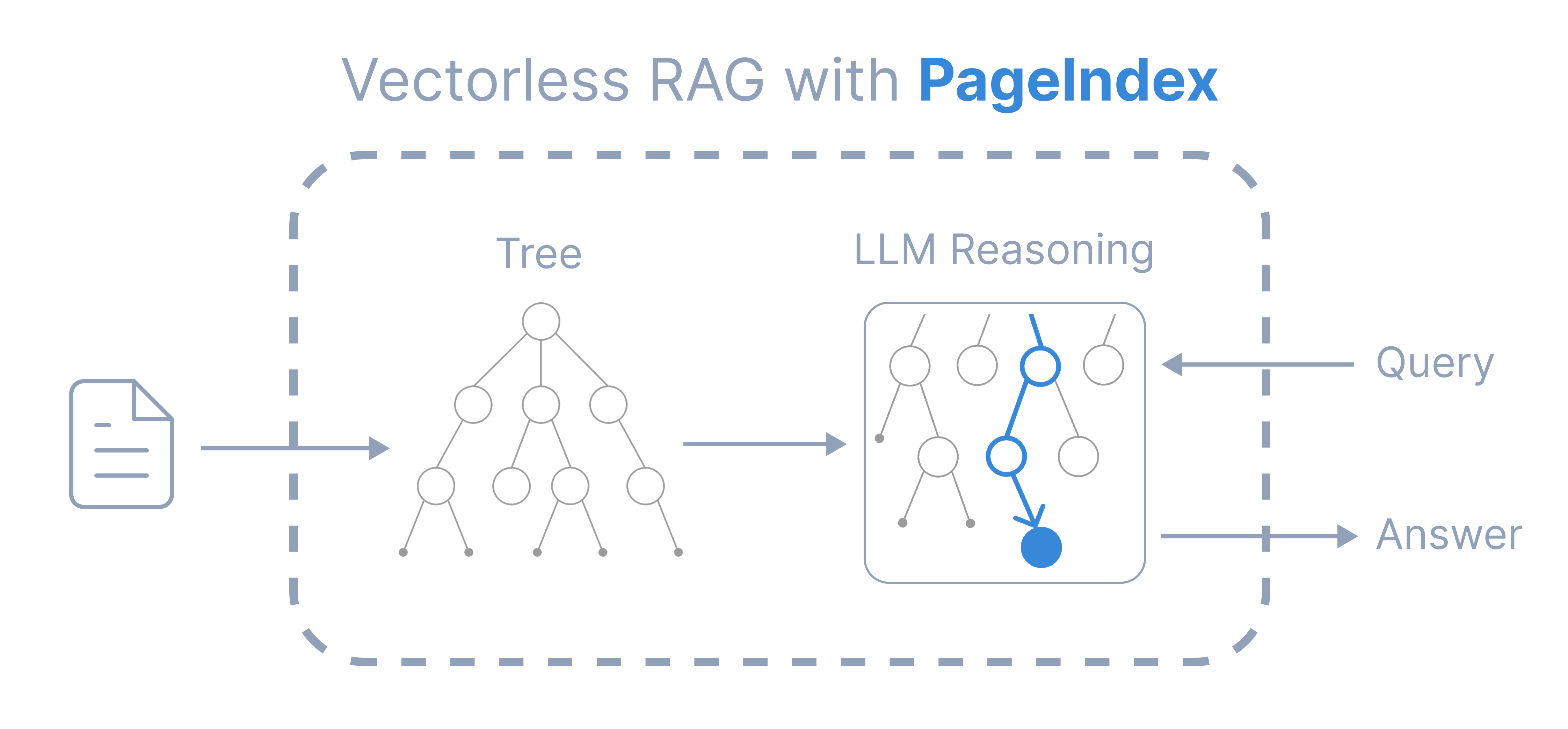
Inspired by AlphaGo, PageIndex replaces the vector index with a hierarchical tree index and lets an LLM reason its way through it, the way a human expert turns to and reads the right section of a long report. Retrieval happens in two steps:
- Index: generate a tree-structure index for each document
- Retrieve: agentically search that tree with LLM reasoning
TL;DR
PageIndex is a vectorless, reasoning-based RAG engine that mirrors how humans read, delivering traceable, explainable, and context-aware retrieval, with no vector DBs or chunking.
Compare with Vector RAG
| Vector RAG | PageIndex | |
|---|---|---|
| Index | vector index | tree index |
| Unit | fixed-size chunks | natural sections |
| Retrieval | semantic similarity search | LLM reasoning over the tree |
| Result | opaque, “vibe retrieval” | traceable to explicit references |
| Context | query embedding only | full context: conversation history, domain knowledge, etc. |
It is ideal for financial reports, legal documents, regulatory filings, technical manuals, medical literature, academic textbooks, and any other long, complex professional document.
Quickstart
pip install -U pageindex
import os
from pageindex import PageIndexClient

os.environ["OPENAI_API_KEY"] = "your-openai-key"

client = PageIndexClient(
    index="gpt-5.6-luna",               # model to build the tree index
    chat="gpt-5.6-sol",                 # model to search the tree
)
doc_id = client.submit_document("report.pdf")["doc_id"]

answer = client.chat("What was the 2023 operating margin?", doc_id=doc_id)
print(answer)
Model Recommendations
index=: a basic model is sufficient. The tree structure itself is extracted from the document layout without an LLM; the index model only summarizes and refines it, which a basic model does well.chat=: use the best model you can afford. The chat model searches the tree to retrieve information. See Query cost and accuracy.
Use PageIndex through the SDK client →
Configure other models, streaming, multi-document search, citations, and more.
Integrate PageIndex with your own agent →
Drop PageIndex tools into the OpenAI Agents SDK, the Claude Agent SDK, or any other framework.
Benchmarks
Local indexing cost and time
Building a tree locally runs about $0.001 per page with gpt-5.6-luna as the index model, so a 1,000-page textbook costs a little over a dollar and a few minutes, once, and every later question reuses it. PageIndex is designed not to rely heavily on the model used at index time, so in our experiments a basic model does not hurt quality.

Indexing time also scales predictably with document length. In the same local setup, the benchmark documents (9 to 1,098 pages) finished in roughly 13 seconds to 4.5 minutes.

Query cost and accuracy
PageIndex-OSS-Benchmark measures exactly the setup in the quickstart above (PageIndexClient() in local mode, flash indexing, no OCR) on 62 lookup questions over 34 PDFs (1,945 pages) drawn from MMLongBench-Doc-V2. Every question's answer is a fact stated in running text, so a wrong answer is a retrieval or reading failure, not a reasoning one.

Full results, data, and the runner are in the benchmark repo.
Cost per query vs. native PDF input
The alternative to retrieval is handing the model the whole PDF on every question. That cost grows with the document; PageIndex's does not, because it reads only the nodes its reasoning reaches. On documents where both routes return the same answer, native PDF input costs 2.1× more at 52 pages and 16.6× more at 420 (gpt-5.6-sol, prompt caching excluded) — and at 805 pages the document no longer fits in the context window at all.

Leading accuracy on FinanceBench
PageIndex reached a state-of-the-art 98.7% accuracy on FinanceBench (financial document QA benchmark), vastly outperforming vector-based RAG.

Explore the full FinanceBench evaluation results and the blog post.
PageIndex Cloud
The open-source version is ideal for text-heavy PDFs and local workflows. With PageIndex Cloud, document indexing and storage run in the cloud: PageIndex handles parsing, OCR, image understanding, tree-index construction, and managed storage for you. The chat and retrieval layer remains compatible with your model, so you can search the cloud-hosted index using the model provider your application already uses.
Moving indexing and storage from Local to Cloud only requires a PageIndex API key:
import os
from pageindex import PageIndexClient

os.environ["PAGEINDEX_API_KEY"] = "your-pageindex-key"
os.environ["OPENAI_API_KEY"] = "your-openai-key"

client = PageIndexClient(
    index="cloud",                       # build and store the index in PageIndex Cloud
    chat="gpt-5.6-sol",                  # use your preferred compatible model for chat
)
doc_id = client.submit_document("report.pdf", wait=True)["doc_id"]
print(client.chat("What was the 2023 operating margin?", doc_id=doc_id))
| Capability | Local (this repo) | Cloud (get an API key) |
|---|---|---|
| Best for | text-heavy PDFs and local workflows | scanned, image-heavy, and large document collections |
| Indexing | runs locally | runs in PageIndex Cloud, with production OCR and image understanding |
| Storage | local | managed in PageIndex Cloud |
| Chat model | your model | your model, or the managed chat included with your key |
| Citations | page-level | line-level |
| Image understanding | — | ✅ |
| Multi-document scale | manual | PageIndex File System |
| MCP server | — | ✅ |
More About PageIndex Cloud
- Scale PageIndex to Millions of Documents: PageIndex File System is a Cloud-only, file-level tree indexing layer that lets PageIndex reason over an entire corpus, not just a single document.
Ready to Try It?
- Get a PageIndex API key
- Read the PageIndex Cloud documentation
For dedicated deployment (VPC or on-premises), contact us or book a demo.
⭐ Support Us
Leave us a star 🌟 if you like our project. Thank you!
Please cite this work as:
Mingtian Zhang, Yu Tang and PageIndex Team,
"PageIndex: Next-Generation Vectorless, Reasoning-based RAG",
PageIndex Blog, Sep 2025.
Or use the BibTeX citation.
@article{zhang2025pageindex,
  author = {Mingtian Zhang and Yu Tang and PageIndex Team},
  title = {PageIndex: Next-Generation Vectorless, Reasoning-based RAG},
  journal = {PageIndex Blog},
  year = {2025},
  month = {September},
  note = {https://pageindex.ai/blog/pageindex-intro},
}
Connect with Us






© 2026 PageIndex AI