 realAsmaandClaude Fable 5
d641b4a524
realAsmaandClaude Fable 5
d641b4a524
## Summary This PR adds two scale-learning algorithms to Model Optimizer—**LSQ** and **Dual-LSQ**—and provides focused NVFP4 Quantization-Aware Distillation (QAD) recipes for them. - **LSQ (learnt scale quantization)** corresponds to the original [Learned Step Size Quantization paper](https://arxiv.org/pdf/1902.08153). ModelOpt uses the name *learnt scale quantization* and learns one scale shared before and after quantization. - **Dual-LSQ** learns separate pre-quantization and post-quantization scales. ModelOpt implements both algorithms with an `amax` reparameterization: it learns `amax` rather than the scale directly, with `scale = amax / max_bound`. This allows scale parameters to be optimized during QAD while the quantized model weights remain fixed. ## What changed - Add an `LSQConfig` algorithm and calibration mode with configurable learned pre/post amax values, tied-scale support, and optional pre-scale quantization. - Extend `TensorQuantizer`, tensor quantization, and the FP4 GEMM path so gradients propagate through LSQ scale parameters. - Preserve LSQ parameter dtypes when training with FSDP2. - Add two modular NVFP4 recipes: - **LSQ:** one shared learned pre/post amax value. - **Dual-LSQ:** independent learned pre/post amax values; the pre-scale is not quantized. - Add a scale-only QAD training config that trains only LSQ amax parameters. - Add focused CPU/GPU LSQ behavior, recipe, and FSDP2 coverage. ## QAD GPU memory Measured on the same four-GPU Qwen3-1.7B QAD setup: | Training mode | Peak allocated / GPU | Peak reserved / GPU | Reduction vs full-parameter QAD | |---|---:|---:|---:| | Full-parameter QAD | 28.3 GiB | 30.2 GiB | — | | Scale-only QAD | 24.1 GiB | 24.8 GiB | 4.2 GiB allocated (15%); 5.4 GiB reserved (18%) | Scale-only QAD learns only a small subset of parameters—typically about the model size divided by 16 or 8, depending on scale granularity. Optimizer states and gradients are therefore maintained only for those learned scale/`amax` parameters, which accounts for the lower GPU-memory footprint compared with full-parameter QAD. ## Validation - Focused LSQ and recipe unit tests: **38 passed** - GPU tests: `test_lsq_cuda.py` 6 passed; FSDP2 LSQ test passed. - Pre-commit checks passed for all changed files. - `git diff --check` passed. ## Qwen3-1.7B NVFP4 PTQ + QAD results All four variants are compared at the same 600-step cutoff. The full-parameter Dual-LSQ run had already reached step 757 when it was stopped for the requested cap, so its curves and summary below discard steps after 600. | Variant | Mean train loss (steps 1–600) | Eval loss (step 600) | |---|---:|---:| | Full-parameter Dual-LSQ | 0.2289485 | 0.1064966 | | Scale-only Dual-LSQ | 0.2604457 | 0.1264785 | | Scale-only LSQ | 0.3045209 | 0.1495215 | | Dynamic-max full-parameter | 0.2504419 | 0.1215034 | 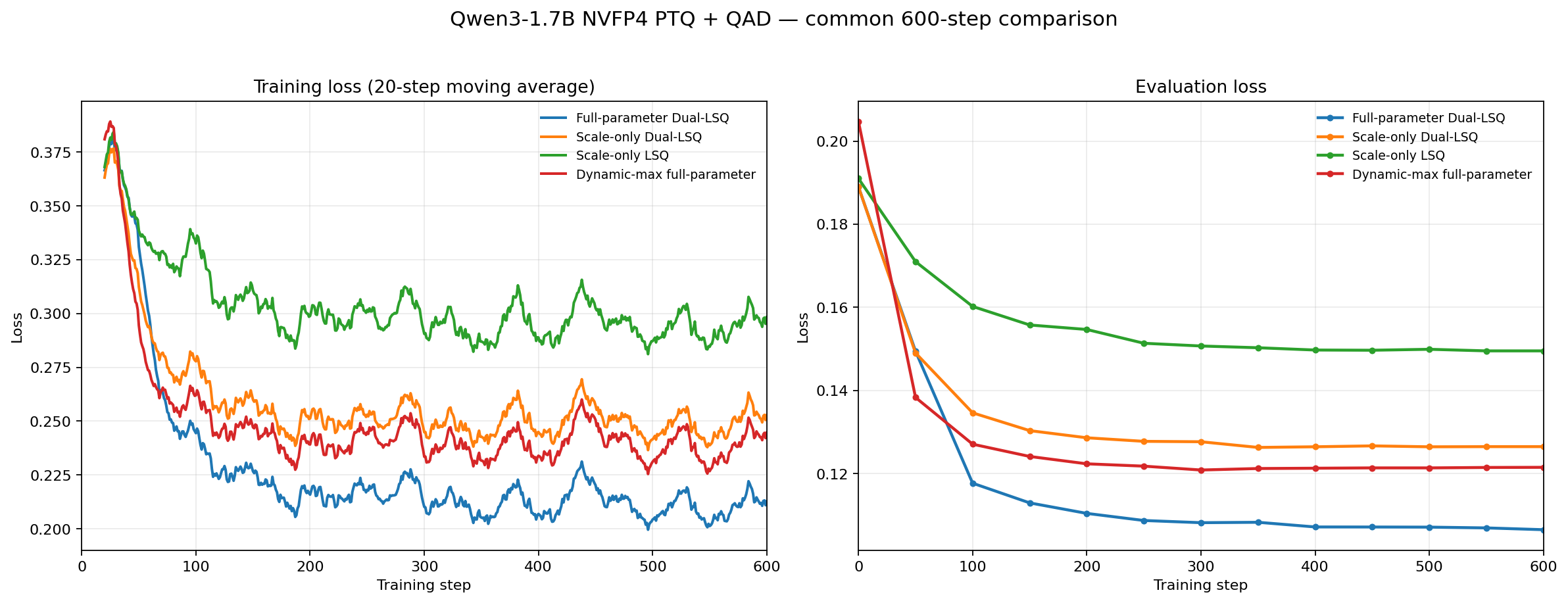 <!-- This is an auto-generated comment: release notes by coderabbit.ai --> ## Summary by CodeRabbit * **New Features** * Added LSQ quantization with learnable/tied `amax`, optional pre-scale quantization, and configurable scale-calibration. * Added FP4/INT4 straight-through casting utilities for training-time gradients. * Added unified QAT/QAD-capable quantization recipes and new LSQ-based recipe examples. * **Bug Fixes** * Improved quantization recipe loading/validation and broadened accepted recipe types for recipe directories and scripts. * Enhanced FSDP2 quantization by aligning LSQ `amax` parameter dtypes. * **Documentation** * Updated guides and examples to use the new quantization recipe name, including deprecation guidance for the old PTQ alias. <!-- end of auto-generated comment: release notes by coderabbit.ai --> --------- Signed-off-by: realAsma <akuriparambi@nvidia.com> Signed-off-by: realAsma <86726418+realAsma@users.noreply.github.com> Co-authored-by: Claude Fable 5 <noreply@anthropic.com>

Quantization Aware Training (QAT) and Distillation (QAD)
Quantization Aware Training (QAT) improves model accuracy beyond post-training quantization (PTQ) at low precisions (e.g., INT4, FP4 on NVIDIA Blackwell). Quantization Aware Distillation (QAD) further improves accuracy by using the original full-precision model as a teacher.
For background on how QAT enables low-precision accuracy recovery, see the QAT/QAD blog post.
| Section | Description | Link | Docs |
|---|---|---|---|
| Quick Start | Prerequisites and setup | [Link] | |
| End-to-End Example | Run QAT/QAD in 3 steps: quantize, train, export | [Link] | |
| Arguments | Full CLI/YAML argument reference | [Link] | |
| Background | How QAT/QAD work and when to use each | [Link] | [docs] |
| Support Matrix | Supported models, quantization formats, and backends | [Link] | |
| QLoRA | Model training with reduced GPU memory | [Link] | |
| Advanced Topics | FSDP2 config, YAML options | [Link] | |
| Results | Accuracy benchmarks | [Link] | |
| Resources | Extra links and references | [Link] |
Quick Start
Prerequisites
Please refer to hf_ptq/README.md for container recommendations and base ModelOpt installation guidance. For this QAT/QAD example, install the Hugging Face dependencies and the example-specific requirements:
pip install -U nvidia-modelopt[hf]
pip install -r examples/llm_qat/requirements.txt
The Qwen3-8B example below requires a minimum of 2 x 80GB GPUs.
Run End-to-End QAT/QAD Example
All arguments can be set via YAML, CLI, or both (CLI overrides YAML). See
ARGUMENTS.md, --help, and Configuration.
QAT
Quantize, fine-tune on labeled data, and export:
# 1. Quantize
python quantize.py \
  --model_name_or_path Qwen/Qwen3-8B \
  --dataset_config configs/dataset/blend.yaml \
  --recipe general/ptq/nvfp4_default-kv_fp8 \
  --output_dir qwen3-8b-quantized

# 2. Train
accelerate launch --config-file configs/accelerate/fsdp2.yaml train.py \
  --config configs/train/qat_nvfp4.yaml \
  --model_name_or_path qwen3-8b-quantized \
  --output_dir qwen3-8b-qat-nvfp4

# 3. Export
python export.py --pyt_ckpt_path qwen3-8b-qat-nvfp4 --export_path qwen3-8b-qat-deploy
QAD
Quantize, recover accuracy using the original model as teacher, and export:
# 1. Quantize
python quantize.py \
  --model_name_or_path Qwen/Qwen3-8B \
  --dataset_config configs/dataset/blend.yaml \
  --recipe general/ptq/nvfp4_default-kv_fp8 \
  --output_dir qwen3-8b-quantized

# 2. Train with distillation
accelerate launch --config-file configs/accelerate/fsdp2.yaml train.py \
  --config configs/train/qad_nvfp4.yaml \
  --model_name_or_path qwen3-8b-quantized \
  --teacher_model Qwen/Qwen3-8B \
  --output_dir qwen3-8b-qad-nvfp4

# 3. Export
python export.py --pyt_ckpt_path qwen3-8b-qad-nvfp4 --export_path qwen3-8b-qad-deploy
Exported checkpoints can be deployed on TensorRT-LLM, vLLM, or SGLang. See hf_ptq/README.md for deployment instructions. For quick accuracy evaluation without exporting, see Native Fake-Quantized Evaluation.
Note
For a minimal end-to-end demo (quantize + train + save in one script), see simple_qat_train.py. It runs on a single GPU only and is intended as a quick introduction to the QAT flow (without transformer trainer)—not for distributed training.
python simple_qat_train.py --model-path meta-llama/Llama-3.2-3B --recipe general/ptq/nvfp4_default-kv_fp8For multi-GPU training (FSDP2, DDP, DeepSpeed), use train.py with
accelerate launchas shown in the commands above.
Tip
For more performant QAD, please refer to examples/megatron_bridge/README.md for example scripts for PTQ / QAD with Megatron-Bridge which is generally more performant than the Hugging Face scripts.
Background
What is QAT?
Quantization Aware Training (QAT) inserts simulated quantization operations into the model graph and then fine-tunes the model so its weights learn to compensate for quantization error. During training, quantization scales are frozen while weights are updated. QAT is a general technique — it learns from labeled data on a quantized model.
import modelopt.torch.quantization as mtq
from modelopt.recipe import load_recipe

# 1. Load a quantization recipe
recipe = load_recipe("general/ptq/nvfp4_default-kv_fp8")

# 2. Quantize the model in-place
model = mtq.quantize(model, recipe.quantize, forward_loop)

# 3. Fine-tune the quantized model
trainer.train()
trainer.save_model()
ModelOpt provides accelerated quantization kernels using Triton for NVFP4 QAT. See the installation guide.
What is QAD?
Quantization Aware Distillation (QAD) is a special case of QAT that uses a teacher model (typically the original unquantized model) to guide the quantized student via a distillation loss. QAD is a pure accuracy recovery technique — its goal is to recover accuracy lost from quantization, not to teach the model a new task.
To learn more, read the QAT/QAD blog post.
When to Use QAT vs QAD
| QAT (without distillation) | QAD (with distillation) | |
|---|---|---|
| What it does | Fine-tunes a quantized model on labeled data | Recovers quantization accuracy using the original model as teacher |
| When to use | The model is already quantized and you want to fine-tune it for a new task (e.g., fine-tuning a GPT-OSS quantized checkpoint) | You want the best possible accuracy recovery after quantization |
| Recommended workflow | Start from a quantized checkpoint, fine-tune with task-specific data | Full-precision fine-tuning first, then QAD to recover quantization loss |
QAD is Model Optimizer's recommended strategy for accuracy recovery after quantization. In our experiments, full-precision fine-tuning followed by QAD delivers the best accuracy, especially at aggressive quantization levels (e.g., NVFP4). The optimal balance between QAT and QAD for a given model and task is an active area of research.
Using QATTrainer and QADTrainer
QATTrainer is a drop-in replacement for HuggingFace's Trainer that handles quantization-aware training seamlessly with various distributed backends (FSDP2, DeepSpeed, DDP):
from modelopt.torch.quantization.plugins.transformers_trainer import QATTrainer

trainer = QATTrainer(
    model=model,            # pre-quantized model
    processing_class=tokenizer,
    args=training_args,
    **data_module,
)
trainer.train()
trainer.save_model()
QADTrainer extends QATTrainer with distillation. Pass the teacher model and a DistillArguments instance:
from modelopt.torch.distill.plugins.huggingface import DistillArguments
from modelopt.torch.quantization.plugins.transformers_trainer import QADTrainer

distill_args = DistillArguments(
    distill=True,
    teacher_model="Qwen/Qwen3-8B",
    criterion="logits_loss",
)

trainer = QADTrainer(
    model=model,            # pre-quantized model
    processing_class=tokenizer,
    args=training_args,
    distill_args=distill_args,
    **data_module,
)
trainer.train()
trainer.save_model()
Quantization Recipes
Recipes are declarative YAML files that specify the quantization configuration. Built-in recipes are available in modelopt_recipes/:
# List available built-in recipes
ls modelopt_recipes/general/ptq/
See custom calibration for creating your own recipe.
Support Matrix
Supported Models
| Model | Chat Template | Support |
|---|---|---|
| Qwen2, 2.5, 3, 3.5 dense models; Nemotron ChatML models | ChatML | Yes (chat + assistant-only labels + pretrain) |
Models with {% generation %} chat templates |
Model-specific | Yes (chat + assistant-only labels + pretrain) |
| Other models with HuggingFace chat templates, including Llama 2, 3, 3.1 | Model-specific | Yes (chat full-label + pretrain) |
Note:
apply_chat_templatecontrols chat formatting.train_only_assistant_tokenscontrols label masking:autouses assistant-only labels when native{% generation %}masks or the tested Qwen/Nemotron ChatML heuristic is available, then falls back to all non-padding chat-template tokens; settrain_only_assistant_tokens: trueto require native or ChatML assistant-only labels, orfalseto always train on all chat-template tokens.
Supported Quantization Formats
Built-in recipes support full-model, partial-layer, and mixed-precision quantization. Common entry points:
| Format | Precision | Example Recipe | Use Case |
|---|---|---|---|
| NVFP4 | W4A4 + FP8 KV | general/ptq/nvfp4_default-kv_fp8 |
FP4 compute and compression on Blackwell GPUs |
| FP8 | W8A8 + FP8 KV | general/ptq/fp8_default-kv_fp8 |
Near-BF16 accuracy on Hopper or later GPUs |
| INT4 weight-only | W4A16 | general/ptq/int4_blockwise_weight_only |
Deployable on all Ampere or later GPUs |
| Partial / mixed | Pattern-specific | general/ptq/nvfp4_mlp_only-kv_fp8 |
Quantize selected layers or combine precisions |
Recipes can target different layers or GEMMs with different precisions, such as NVFP4 for MLP/MoE GEMMs and FP8 for attention GEMMs or KV cache. See
modelopt_recipes/general/ptq/andmodelopt_recipes/configs/ptq/for built-in options and reusable recipe units.
Supported Backends
| Backend | Config File | Notes |
|---|---|---|
| FSDP2 | configs/accelerate/fsdp2.yaml |
Recommended |
| DDP | configs/accelerate/ddp.yaml |
Add --gradient_checkpointing True |
| DeepSpeed | configs/accelerate/deepspeed.yaml |
Add --gradient_checkpointing True |
Replace --config-file configs/accelerate/fsdp2.yaml with the desired backend config in any of the commands above.
QLoRA (Real Quantization)
QLoRA reduces training memory by quantizing LoRA backbone weights with real quantization via mtq.compress().
# 1. Quantize with compression
python quantize.py \
  --model_name_or_path Qwen/Qwen3-8B \
  --dataset_config configs/dataset/blend.yaml \
  --recipe general/ptq/nvfp4_default-kv_fp8 \
  --compress True \
  --output_dir qwen3-8b-quantized

# 2. Train with QLoRA
accelerate launch --config-file configs/accelerate/ddp.yaml train.py \
  --config configs/train/qlora_nvfp4.yaml \
  --model_name_or_path qwen3-8b-quantized \
  --output_dir qwen3-8b-fp4-qlora

# 3. Export
python export.py \
  --pyt_ckpt_path qwen3-8b-fp4-qlora \
  --export_path qwen3-8b-fp4-qlora-hf

# 4. Serve with vLLM
vllm serve qwen3-8b-fp4-qlora-hf/base_model --enable-lora \
  --lora-modules adapter=qwen3-8b-fp4-qlora-hf --port 8000 \
  --tokenizer qwen3-8b-fp4-qlora-hf
QLoRA export is not currently supported with FSDP2.
Advanced Topics
FSDP2 and Model-Specific Layer Wrapping
The default fsdp2.yaml uses TRANSFORMER_BASED_WRAP with fsdp_transformer_layer_cls_to_wrap: Qwen3DecoderLayer. This setting is model-specific — if you are training a different model architecture, you must update it to match your model's decoder layer class.
You can either:
-
Override via CLI (recommended for one-off runs):
accelerate launch --config-file configs/accelerate/fsdp2.yaml \ --fsdp_transformer_layer_cls_to_wrap LlamaDecoderLayer \ train.py --config configs/train/qat_nvfp4.yaml ... -
Create a custom config (recommended for repeated use):
cp configs/accelerate/fsdp2.yaml configs/accelerate/fsdp2_llama.yaml
# Edit fsdp2_llama.yaml: change Qwen3DecoderLayer -> LlamaDecoderLayer
Common layer class names:
| Model Family | fsdp_transformer_layer_cls_to_wrap |
|---|---|
| Qwen2, Qwen2.5, Qwen3 | Qwen3DecoderLayer (or Qwen2DecoderLayer) |
| Llama 2, 3, 3.1 | LlamaDecoderLayer |
Configuration
There are two types of configs:
- Dataset configs (
configs/dataset/): Define the dataset blend — sources,blend_size(total samples), andsplits(train/eval/test ratios). These are self-contained and determine what gets cached. - Training configs (
configs/train/): Define training hyperparameters plus runtime caps (train_samples,eval_samples) that subset the pre-built dataset without retriggering caching.
quantize.py only needs --dataset_config and --recipe. train.py uses a full training config via --config. All arguments can be specified via YAML, CLI flags, or both (CLI overrides YAML). See ARGUMENTS.md for the full reference, regenerated with python_pwd examples/llm_qat/arguments.py --generate_docs examples/llm_qat/ARGUMENTS.md.
# YAML + CLI override
accelerate launch --config-file configs/accelerate/fsdp2.yaml train.py \
  --config configs/train/qat_nvfp4.yaml --learning_rate 5e-5
See Dataset Configuration for custom dataset blends and adding new datasets.
Pre-Building the Dataset
You can pre-tokenize and cache the dataset before training using dataset_utils.py. This is useful for large blends or multi-node setups where you want to build the cache once and reuse it across experiments.
python dataset_utils.py \
  --dataset_config configs/dataset/blend.yaml \
  --model_name_or_path Qwen/Qwen3-8B
The cached dataset is stored under .dataset_cache/tokenized/ by default (configurable via --dataset_cache_dir). The cache key depends on the dataset config (blend_size, splits, sources) and tokenizer — changing train_samples or eval_samples in the training config does not invalidate the cache.
Results
[Coming Soon]
Native Fake-Quantized Evaluation
ModelOpt quantized models can be saved and restored without exporting to a deployment platform. This is useful for fast evaluation with fake quantization using standard LLM benchmarks (MMLU, WikiText, etc.). See HuggingFace checkpointing for details.
cd ../llm_eval

python lm_eval_hf.py --model hf \
    --tasks mmlu,wikitext \
    --model_args pretrained=../llm_qat/qwen3-8b-qat-nvfp4 \
    --batch_size 4
See llm_eval/README.md for supported tasks.
Pre-Quantized Checkpoints
- Ready-to-deploy checkpoints: Hugging Face - NVIDIA Model Optimizer Collection
- Deployable on TensorRT-LLM, vLLM and SGLang