mirror of
https://github.com/NVIDIA/Model-Optimizer.git
synced 2026-11-02 08:03:22 +08:00
 h-guo18
2b296b2f62
# Support fine-tuning released DFlash/DSpark drafters (causal SWA, attention sink, warm start) ### What does this PR do? Type of change: New feature + bug fix Adds what ModelOpt was missing to fine-tune an already-published DFlash/DSpark draft model. The concrete target is [`nvidia/NVIDIA-Nemotron-3.5-Lightning-30B-A3B-BF16-DSpark`](https://huggingface.co/nvidia/NVIDIA-Nemotron-3.5-Lightning-30B-A3B-BF16-DSpark) on its hybrid Mamba/attention/MoE base, but every change is generic. Before this PR that checkpoint could not be trained faithfully — or even loaded: its attention-sink tensors were dropped as unexpected keys, its block-causal attention had no implementation, and its capture layers were silently overwritten with ModelOpt's defaults. **New user-facing options** (all default to today's behavior, so existing runs are unchanged): | Option | Values | Purpose | | --- | --- | --- | | `dflash_draft_attention` | `bidirectional` (default) / `causal` | Block-internal attention pattern. `causal` restricts a query at block position `i` to draft positions `<= i`. | | `dflash_attention_sink` | `false` (default) / `true` | Learnable per-head `attention_sink_bias [num_heads]` on every draft layer — one extra logit appended before the softmax and dropped after, so a head can put probability mass nowhere instead of being forced to attend inside its window (the GPT-OSS formulation). | | `dflash_init_checkpoint` | path | Warm-start the draft from an exported checkpoint instead of a random init. Any missing/unexpected/wrong-shaped tensor raises rather than warns. | | `dflash_architecture_config.target_layer_ids` | list | Which base layers feed the draft's `fc`. Previously recomputed unconditionally with no override. | **Bugs fixed along the way** (each one silently corrupts training rather than failing): - The exporter hard-coded `dflash_config.causal: False` and only wrote it under SWA, so even a correctly-trained causal draft would be served non-causally. It now reflects the trained setting, and emits `attention_sink_bias` when enabled. - `_build_generate_swa_mask` returned `None` whenever `swa_window_size` was unset, which would have dropped the causal structure at generation time while training used it. - `target_layer_ids` was recomputed from the uniform default on every convert. The released drafter uses `[1,5,19,29,41,51]`; the default for a 52-layer base is `[1,11,20,30,39,49]` — *different layers*. Here it surfaced as a matmul shape error only because the plane counts disagreed; with a matching count it would have trained on the wrong features silently. - The streaming dataset assumed the draft's aux layers all sit below the base's final layer (`aux = planes[:-1]`, `target = planes[-1]`). A draft whose top aux id *is* the final layer cannot get an extra plane — vLLM captures each layer once — so `final_aux_is_base_hidden` now lets the last plane serve both roles. It is derived from the model, not configured by hand. - DSpark head weights load from either the flat layout ModelOpt exports (upstream DeepSpec convention) or the nested `markov_head.` layout the NVIDIA release uses. Without the remap the two `[131072, 512]` Markov tables — ~14% of the draft's parameters — stay randomly initialized while everything else warm-starts, with no error. - `nemotron_h` is enabled in `_FINAL_NORM_TYPE_BY_MODEL_TYPE`: despite the hybrid stack, `NemotronHModel.norm_f` is a plain RMSNorm, and without the entry the offline/streaming fake base raises instead of reconstructing the distillation target. ### Usage ```yaml dflash: dflash_init_checkpoint: /path/to/NVIDIA-Nemotron-3.5-Lightning-30B-A3B-BF16-DSpark dflash_draft_attention: causal dflash_attention_sink: true dflash_swa_window_size: 1024 dflash_block_size: 8 dflash_mask_token_id: 990 dflash_architecture_config: target_layer_ids: [1, 5, 19, 29, 41, 51] ``` A full worked example is at `modelopt_recipes/general/speculative_decoding/dspark_nemotron35_warmstart.yaml`. ### Testing **Unit tests** — 124 pass (`test_hf_dflash.py`, `test_hf_dspark.py`, `test_hf_domino.py`, `test_hf_dflash_offline.py`, `test_modeling_final_norm.py`), 32 of them new: causal mask structure (lower-triangular per block, no cross-block leakage, context visibility unchanged), the sink math (degenerates to plain attention at `-inf`, absorbs mass monotonically, receives gradient), warm-start load/reject paths, Markov key remapping, and explicit `target_layer_ids`. **Checkpoint compatibility** — the released drafter loads with zero missing/unexpected keys and zero shape mismatches; all 77 tensors (6 attention sinks and both Markov tables included) match bit-exactly, and a training step runs with gradients reaching the sink and Markov parameters. **End-to-end streaming training** — Nemotron-3.5 base served by vLLM (1 node, TP8) feeding 8 trainer GPUs over NIXL; the draft warm-starts from the released checkpoint and trains with `causal` + sink + SWA 1024. 128 Daring-Anteater conversations, 20 epochs (the plot shows the first 5, where the trend is clearest — the curves flatten after that): 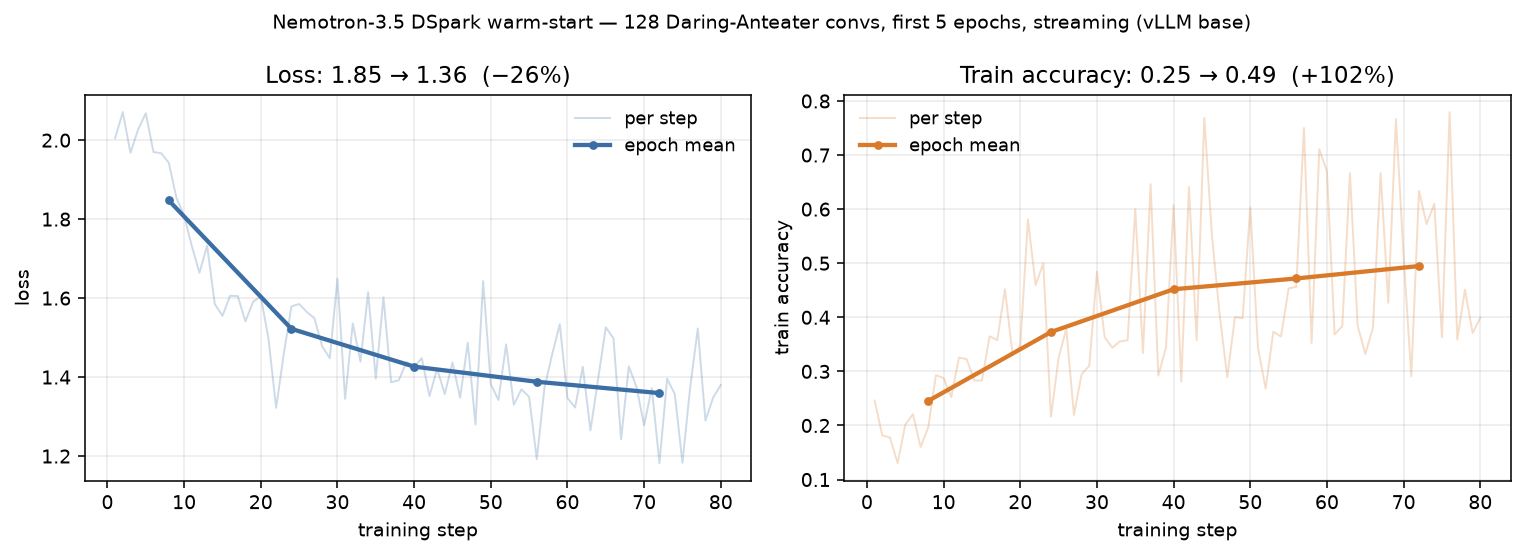 Over the first 5 epochs loss falls **1.85 → 1.36** and train accuracy rises **0.25 → 0.49**; across the full 20 epochs they reach **1.21** and **0.48** (peak 0.54) before flattening. This validates the pipeline end-to-end — capture layers, plane split, mask direction, sink loading and warm-start weights all have to be right for this curve to appear. It is *not* a model-quality result: 128 samples over 20 epochs overfits by construction, and the corpus is not generated by the base model, so the absolute numbers are not meaningful. ### TODO (follow-up) **A complete, robust checkpoint/config converter.** Both conversions are handled ad hoc here: - *Draft config → training config.* The recipe transcribes ~15 fields by hand from the drafter's `config.json`. Only the shape-bearing ones (`num_hidden_layers`, `num_attention_heads`, `intermediate_size`, `markov_rank`) fail loudly when mistyped; the rest — `mask_token_id`, `causal`, `swa_window_size`, `block_size` — train "successfully" on a wrong value and only surface later as a mysteriously low acceptance length. A converter should derive the whole block from the checkpoint, including its aliases (`pard_token`, `dspark_markov_rank`, `dflash_query_causal`, top-level `sliding_window` / `attention_sink_bias`) and duplicated fields. - *Weight layout.* The `markov_head.` remap is a load-time hook. A converter should normalize layouts explicitly, and decide whether export should also emit the release's aliases so a round-trip reproduces the original format (today it renames `architectures` to `DFlashDraftModel`). - *Base config.* Serving this base on vLLM needs its `config.json` layer-type vocabulary updated for the transformers-5 path (`mamba` → `linear_attention`, `attention` → `full_attention`, plus a matching `hybrid_override_pattern`). That is done by hand today and is not covered by this PR. ### Before your PR is "*Ready for review*" - **Make sure you read and follow [Contributor guidelines](https://github.com/NVIDIA/TensorRT-Model-Optimizer/blob/main/CONTRIBUTING.md)** and your commits are signed. - **Is this change backward compatible?**: Yes - **Did you write any new necessary tests?**: Yes - **Did you add or update any necessary documentation?**: Yes - **Did you update [Changelog](https://github.com/NVIDIA/TensorRT-Model-Optimizer/blob/main/CHANGELOG.rst)?**: No <!-- This is an auto-generated comment: release notes by coderabbit.ai --> ## Summary by CodeRabbit * **New Features** * Added configurable causal or bidirectional attention for DFlash models. * Added optional attention sinks, checkpoint warm starts, and explicit target-layer selection. * Improved streaming data handling for shared auxiliary and base hidden states. * Added Nemotron-3.5 Lightning DSpark warm-start training and serving recipes. * **Bug Fixes** * Preserved configured attention behavior during model export. * Prevented warm-start checkpoints from being reapplied during restoration. * Improved checkpoint compatibility, validation, and attention-mask handling. <!-- end of auto-generated comment: release notes by coderabbit.ai --> Signed-off-by: h-guo18 <67671475+h-guo18@users.noreply.github.com>

576 lines
25 KiB
Python
576 lines
25 KiB
Python
# SPDX-FileCopyrightText: Copyright (c) 2024 NVIDIA CORPORATION & AFFILIATES. All rights reserved.
|
|
# SPDX-License-Identifier: Apache-2.0
|
|
#
|
|
# Licensed under the Apache License, Version 2.0 (the "License");
|
|
# you may not use this file except in compliance with the License.
|
|
# You may obtain a copy of the License at
|
|
#
|
|
# http://www.apache.org/licenses/LICENSE-2.0
|
|
#
|
|
# Unless required by applicable law or agreed to in writing, software
|
|
# distributed under the License is distributed on an "AS IS" BASIS,
|
|
# WITHOUT WARRANTIES OR CONDITIONS OF ANY KIND, either express or implied.
|
|
# See the License for the specific language governing permissions and
|
|
# limitations under the License.
|
|
|
|
import inspect
|
|
from collections.abc import Callable
|
|
from pathlib import Path
|
|
from typing import TYPE_CHECKING
|
|
|
|
if TYPE_CHECKING:
|
|
from types import FrameType
|
|
import numpy as np
|
|
import torch
|
|
import transformers
|
|
from datasets import load_dataset
|
|
from packaging.version import Version
|
|
from scripts.ar_validate import validate_ar
|
|
from transformers import Trainer, TrainerCallback
|
|
|
|
import modelopt
|
|
from modelopt.torch.speculative.eagle.utils import (
|
|
EagleOfflineDataCollator,
|
|
OfflineSupervisedDataset,
|
|
)
|
|
from modelopt.torch.speculative.utils import get_ttt_msk_func
|
|
from modelopt.torch.utils import print_rank_0
|
|
from modelopt.torch.utils.distributed import is_master
|
|
from modelopt.torch.utils.plugins.transformers_dataset import (
|
|
LanguageDataCollator,
|
|
ShardedDataset,
|
|
VisionLanguageDataCollator,
|
|
)
|
|
|
|
try:
|
|
import wandb
|
|
|
|
wandb.log # Verify wandb is functional (not a stub module).
|
|
except (ImportError, AttributeError):
|
|
wandb = None
|
|
|
|
# Re-export for backward compatibility
|
|
__all__ = ["EagleOfflineDataCollator", "OfflineSupervisedDataset"]
|
|
|
|
|
|
def make_speculative_data_module(
|
|
tokenizer: transformers.PreTrainedTokenizer,
|
|
data_args,
|
|
train_len=None,
|
|
answer_only_loss=False,
|
|
shift_labels=True,
|
|
final_aux_is_base_hidden=False,
|
|
) -> dict:
|
|
"""Create data module for speculative decoding training.
|
|
|
|
Args:
|
|
shift_labels: If True, labels are shifted by 1 for autoregressive training (EAGLE3).
|
|
If False, labels are unshifted for diffusion-style training (DFlash).
|
|
final_aux_is_base_hidden: Streaming only. True when the draft's top aux layer is the
|
|
base's final layer, so the last captured plane is both the final aux feature and
|
|
the base (KD-target) hidden instead of an extra dedicated plane.
|
|
"""
|
|
# Load chat template from file if provided
|
|
chat_template = None
|
|
if getattr(data_args, "chat_template", None):
|
|
template_path = data_args.chat_template
|
|
with open(template_path) as f:
|
|
chat_template = f.read()
|
|
print_rank_0(f"Loaded chat template from {template_path}")
|
|
|
|
mode = getattr(data_args, "mode", "online")
|
|
if mode == "streaming":
|
|
# ``train_len`` right-truncates during tokenization and is also the collator's
|
|
# pad target; caller must ensure ``train_len <= vllm.max_model_len``.
|
|
# The streaming dataset tokenizes via ``tokenizer.apply_chat_template`` (no
|
|
# chat_template arg), so a custom template (e.g. one carrying {% generation %}
|
|
# tags for answer_only_loss) must be installed on the tokenizer here — unlike
|
|
# the online path, which threads ``chat_template`` straight into the collator.
|
|
if chat_template is not None:
|
|
tokenizer.chat_template = chat_template
|
|
print_rank_0("Installed custom chat template on tokenizer for streaming.")
|
|
print_rank_0(f"Streaming hidden states from {data_args.streaming_server_url}")
|
|
from modelopt.torch.speculative.plugins.hf_streaming_dataset import (
|
|
EagleVllmStreamingConfig,
|
|
EagleVllmStreamingDataset,
|
|
)
|
|
|
|
# data_path may be a single jsonl, a glob string, or a directory of shards.
|
|
# HF load_dataset's data_files takes a file/glob/list but NOT a bare directory,
|
|
# so expand a directory into its sorted *.jsonl files (avoids physically
|
|
# concatenating large multi-shard corpora and shell-glob fragility).
|
|
_dp = data_args.data_path
|
|
if Path(_dp).is_dir():
|
|
_data_files = sorted(str(p) for p in Path(_dp).glob("*.jsonl"))
|
|
if not _data_files:
|
|
raise ValueError(f"No .jsonl files found in directory {_dp}")
|
|
print_rank_0(f"Loading {len(_data_files)} jsonl shards from directory {_dp}")
|
|
else:
|
|
_data_files = _dp
|
|
ds = load_dataset("json", data_files=_data_files, split="train")
|
|
if data_args.sample_size > 0:
|
|
ds = ds.select(range(data_args.sample_size))
|
|
# Map-style dataset: each rank fetches its own DistributedSampler shard.
|
|
# Fetch concurrency comes from the DataLoader's num_workers, not a config knob;
|
|
# shuffling/order is the sampler's job (seeded by training_args.seed).
|
|
# ``server_urls`` accepts a comma-separated string for multi-server fan-out.
|
|
streaming_cfg = EagleVllmStreamingConfig(
|
|
server_urls=data_args.streaming_server_url,
|
|
model=data_args.streaming_model_name,
|
|
max_seq_len=train_len,
|
|
answer_only_loss=answer_only_loss,
|
|
final_aux_is_base_hidden=final_aux_is_base_hidden,
|
|
)
|
|
train_dataset = EagleVllmStreamingDataset(
|
|
entries=ds,
|
|
tokenizer=tokenizer,
|
|
config=streaming_cfg,
|
|
)
|
|
data_collator = EagleOfflineDataCollator(train_len=train_len)
|
|
|
|
elif mode == "online":
|
|
train_dataset = ShardedDataset("json", data_files=data_args.data_path)
|
|
|
|
if not data_args.vlm_processor:
|
|
data_collator = LanguageDataCollator(
|
|
tokenizer=tokenizer,
|
|
train_len=train_len,
|
|
return_labels=True,
|
|
answer_only_loss=answer_only_loss,
|
|
shift_labels=shift_labels,
|
|
chat_template=chat_template,
|
|
)
|
|
else:
|
|
data_collator = VisionLanguageDataCollator(
|
|
processor=data_args.vlm_processor,
|
|
train_len=train_len,
|
|
local_image_path=data_args.vlm_img_dir,
|
|
return_labels=True,
|
|
answer_only_loss=answer_only_loss,
|
|
shift_labels=shift_labels,
|
|
chat_template=chat_template,
|
|
)
|
|
|
|
else:
|
|
print_rank_0("Loading pre-processed data for offline training...")
|
|
assert not data_args.vlm_processor, "Offline data is not supported for VLM."
|
|
|
|
offline_data_path = Path(data_args.offline_data_path)
|
|
dumped_files = [str(p) for p in offline_data_path.rglob("*.pt")]
|
|
if not dumped_files:
|
|
raise ValueError(f"No .pt files found in {data_args.offline_data_path}")
|
|
|
|
# sample_size=-1 means use all samples; positive integer selects that many
|
|
if data_args.sample_size == 0 or data_args.sample_size < -1:
|
|
raise ValueError("sample_size must be -1 (use all samples) or a positive integer")
|
|
if data_args.sample_size > 0:
|
|
dumped_files = dumped_files[: data_args.sample_size]
|
|
train_dataset = OfflineSupervisedDataset(
|
|
dumped_files, answer_only_loss=answer_only_loss, tokenizer=tokenizer
|
|
)
|
|
data_collator = EagleOfflineDataCollator(train_len=train_len)
|
|
|
|
return {
|
|
"train_dataset": train_dataset,
|
|
"data_collator": data_collator,
|
|
}
|
|
|
|
|
|
class EagleTrainerWithAccLog(Trainer):
|
|
"""Wrapper around Trainer that logs training accuracy."""
|
|
|
|
def __init__(
|
|
self,
|
|
*args,
|
|
lora_lr_multiplier: float = 1.0,
|
|
**kwargs,
|
|
):
|
|
super().__init__(*args, **kwargs)
|
|
self.lora_lr_multiplier = lora_lr_multiplier
|
|
|
|
def create_optimizer(self):
|
|
"""Override to give LoRA parameters a higher learning rate."""
|
|
super().create_optimizer()
|
|
if self.lora_lr_multiplier != 1.0:
|
|
lora_ids = {
|
|
id(p) for n, p in self.model.named_parameters() if "lora_" in n and p.requires_grad
|
|
}
|
|
if lora_ids:
|
|
new_groups = []
|
|
for group in self.optimizer.param_groups:
|
|
lora = [p for p in group["params"] if id(p) in lora_ids]
|
|
others = [p for p in group["params"] if id(p) not in lora_ids]
|
|
if lora and others:
|
|
new_groups.append({**group, "params": others})
|
|
new_groups.append(
|
|
{**group, "params": lora, "lr": group["lr"] * self.lora_lr_multiplier}
|
|
)
|
|
elif lora:
|
|
new_groups.append({**group, "lr": group["lr"] * self.lora_lr_multiplier})
|
|
else:
|
|
new_groups.append(group)
|
|
self.optimizer.param_groups = new_groups
|
|
return self.optimizer
|
|
|
|
def compute_loss(self, *args, **kwargs):
|
|
"""Override compute_loss to save train accs and per-component losses in trainer state."""
|
|
if not hasattr(self.state, "training_accs"):
|
|
self.state.training_accs = []
|
|
if not hasattr(self.state, "component_losses"):
|
|
self.state.component_losses = {"eagle": [], "preservation": []}
|
|
kwargs.pop("num_items_in_batch", None)
|
|
loss, outputs = super().compute_loss(return_outputs=True, *args, **kwargs)
|
|
if hasattr(outputs, "train_acc") and any(outputs.train_acc):
|
|
self.state.training_accs.append(outputs.train_acc)
|
|
# Track per-component losses
|
|
for key, attr in [
|
|
("eagle", "eagle_loss"),
|
|
("preservation", "preservation_loss"),
|
|
]:
|
|
val = getattr(outputs, attr, None)
|
|
if val is not None:
|
|
self.state.component_losses[key].append(val.item())
|
|
return loss
|
|
|
|
|
|
class LoRAWarmupCallback(TrainerCallback):
|
|
"""Manages LoRA warmup: freezes LoRA during warmup, unfreezes after."""
|
|
|
|
def __init__(self, warmup_steps: int):
|
|
self.warmup_steps = warmup_steps
|
|
self._activated = False
|
|
|
|
def on_step_begin(self, args, state, control, **kwargs):
|
|
"""Check if warmup is over and activate LoRA co-training."""
|
|
if self._activated:
|
|
return control
|
|
if state.global_step >= self.warmup_steps:
|
|
model = kwargs["model"]
|
|
# Unwrap DDP/FSDP if needed
|
|
raw_model = model.module if hasattr(model, "module") else model
|
|
if hasattr(raw_model, "_lora_cotraining_active"):
|
|
raw_model._lora_cotraining_active = True
|
|
print_rank_0(
|
|
f"Step {state.global_step}: LoRA warmup complete, enabling co-training."
|
|
)
|
|
self._activated = True
|
|
return control
|
|
|
|
|
|
class DFlashFSDP2ShardedSDExportCallback(TrainerCallback):
|
|
"""Export the DFlash draft module after each checkpoint save, for FSDP2 sharded runs.
|
|
|
|
Applicable range: this is needed only under FSDP2 ``SHARDED_STATE_DICT``, where the
|
|
checkpoint holds distributed shards (``pytorch_model_fsdp_0/``) and no consolidated
|
|
``model.safetensors`` — so the post-training ``export_hf_checkpoint.py`` pass can't read
|
|
it. It gathers just the small draft submodule and writes the deployable export.
|
|
|
|
Gating is the caller's responsibility: ``main.py`` adds this callback only when the
|
|
accelerator's FSDP state dict type is ``SHARDED_STATE_DICT`` (full-state-dict runs —
|
|
DDP, single-device, FSDP2 FULL_STATE_DICT — use the launcher's post-run export instead).
|
|
"""
|
|
|
|
def on_save(self, args, state, control, **kwargs):
|
|
"""Export DFlash draft module weights + config after checkpoint save."""
|
|
import json
|
|
import os
|
|
|
|
from safetensors.torch import save_file
|
|
|
|
model = kwargs["model"]
|
|
if not hasattr(model, "dflash_module"):
|
|
return control
|
|
|
|
step = state.global_step
|
|
export_dir = os.path.join(args.output_dir, f"exported-checkpoint-{step}")
|
|
|
|
# All ranks participate in the state_dict gather (FSDP2 collective op). Only the
|
|
# dflash_module submodule is gathered (~328 MB for MiniMax-M2.7), not the 229B base.
|
|
try:
|
|
from torch.distributed.checkpoint.state_dict import (
|
|
StateDictOptions,
|
|
get_model_state_dict,
|
|
)
|
|
|
|
options = StateDictOptions(full_state_dict=True, cpu_offload=True)
|
|
try:
|
|
raw_sd = get_model_state_dict(
|
|
model, submodules={model.dflash_module}, options=options
|
|
)
|
|
except TypeError:
|
|
# Older PyTorch without the submodules= parameter: this gathers the FULL
|
|
# model (the entire base, e.g. ~229B for MiniMax-M2.7), defeating the
|
|
# submodule-only design and risking OOM. Warn loudly — upgrade PyTorch.
|
|
print_rank_0(
|
|
"WARNING: DFlash export: get_model_state_dict lacks submodules= on this "
|
|
"PyTorch — gathering the FULL base model (slow / may OOM). Upgrade PyTorch "
|
|
"for the submodule-only gather."
|
|
)
|
|
raw_sd = get_model_state_dict(model, options=options)
|
|
except ImportError:
|
|
# Non-distributed / single-GPU fallback
|
|
raw_sd = model.state_dict()
|
|
|
|
# Reuse the exporter's extraction (strips the dflash_module prefix, drops rotary
|
|
# buffers) for the common full-model key layout. Some PyTorch versions return the
|
|
# submodule gather with keys already stripped of the prefix — handle that directly.
|
|
exporter = model.get_exporter()
|
|
drafter_sd = exporter._extract_state_dict(raw_sd)
|
|
if not drafter_sd:
|
|
# Fallback for the already-stripped-key layout: a denylist heuristic rather than
|
|
# the prefix-based extractor. Warn, since a key-naming change upstream could let
|
|
# a malformed draft ship and only fail at vLLM load time.
|
|
print_rank_0(
|
|
"WARNING: DFlash export: prefix-based extraction found no dflash_module keys; "
|
|
"falling back to a denylist heuristic on already-stripped keys. Verify the "
|
|
"exported draft loads in vLLM."
|
|
)
|
|
drafter_sd = {
|
|
k: v
|
|
for k, v in raw_sd.items()
|
|
if "rotary_emb" not in k
|
|
and not any(p in k for p in ("model.", "lm_head.", "embed_tokens."))
|
|
}
|
|
del raw_sd
|
|
# Coerce to CPU for save_file (the distributed gather uses cpu_offload, but the
|
|
# single-GPU fallback may return CUDA tensors).
|
|
drafter_sd = {k: (v.cpu() if v.device.type != "cpu" else v) for k, v in drafter_sd.items()}
|
|
|
|
if not drafter_sd:
|
|
print_rank_0(f"Warning: No dflash_module weights found at step {step}, skipping export")
|
|
return control
|
|
|
|
# Only rank 0 writes files
|
|
if is_master():
|
|
try:
|
|
os.makedirs(export_dir, exist_ok=True)
|
|
save_file(drafter_sd, os.path.join(export_dir, "model.safetensors"))
|
|
|
|
config = exporter._export_config()
|
|
with open(os.path.join(export_dir, "config.json"), "w") as f:
|
|
json.dump(config, f, indent=2)
|
|
|
|
total_mb = sum(v.nbytes for v in drafter_sd.values()) / 1024 / 1024
|
|
print_rank_0(
|
|
f"Exported DFlash draft ({len(drafter_sd)} tensors, {total_mb:.0f}MB) "
|
|
f"to {export_dir}"
|
|
)
|
|
except Exception as e:
|
|
print_rank_0(f"Warning: DFlash export failed at step {step}: {e}")
|
|
|
|
return control
|
|
|
|
|
|
class EagleTrainingPlot(TrainerCallback):
|
|
"""Callback that plot training acc and AR during training."""
|
|
|
|
def __init__(self, ar_validate_steps: int = 1000, estimate_ar: bool = False):
|
|
self.ar_validate_steps = ar_validate_steps
|
|
if wandb is not None and wandb.run is not None and is_master():
|
|
wandb.init()
|
|
self.estimate_ar = estimate_ar
|
|
|
|
def on_log(self, args, state, control, **kwargs):
|
|
"""Log training acc and estimate AR during log step."""
|
|
if not hasattr(state, "training_accs") or len(state.training_accs) == 0:
|
|
return control
|
|
average_acc = np.mean(state.training_accs, axis=0)
|
|
# Always print accuracy to console
|
|
try:
|
|
acc_str = ", ".join(f"{a:.4f}" for a in np.array(average_acc).flatten())
|
|
print_rank_0(f"Step {state.global_step} Training Acc: [{acc_str}]")
|
|
except Exception:
|
|
print_rank_0(f"Step {state.global_step} Training Acc: {average_acc}")
|
|
# Log accuracy to HF Trainer's logs dict (picked up by TensorBoard)
|
|
logs = kwargs.get("logs") or {}
|
|
for i, draft_acc in enumerate(average_acc):
|
|
for j, step_acc in enumerate(draft_acc):
|
|
logs[f"train_acc/parallel_{i}_step_{j}"] = float(step_acc)
|
|
if self.estimate_ar:
|
|
# Calculate mean training AR since last log
|
|
# NOTE: This is only an estimate of the real AR.
|
|
est_ar = 1
|
|
acc_cumprod = 1
|
|
for step_acc in average_acc[0]:
|
|
acc_cumprod *= step_acc
|
|
est_ar += acc_cumprod
|
|
# Parallel draft tokens only used after all eagle tokens
|
|
for draft_acc in average_acc[1:]:
|
|
acc_cumprod *= draft_acc[-1]
|
|
est_ar += acc_cumprod
|
|
print_rank_0(f"Step {state.global_step} Estimated Training AR: {est_ar:.4f}")
|
|
logs["estimated_training_ar"] = est_ar
|
|
|
|
# log to wandb
|
|
if wandb is not None and wandb.run is not None and is_master():
|
|
if logs:
|
|
wandb.log({k: v for k, v in logs.items() if v is not None}, step=state.global_step)
|
|
|
|
# Log per-component losses
|
|
if hasattr(state, "component_losses"):
|
|
for key, vals in state.component_losses.items():
|
|
if vals:
|
|
wandb.log({f"{key}_loss": np.mean(vals)}, step=state.global_step)
|
|
|
|
# reset training_accs and component_losses
|
|
state.training_accs = []
|
|
if hasattr(state, "component_losses"):
|
|
state.component_losses = {"eagle": [], "preservation": []}
|
|
return control
|
|
|
|
def on_step_end(self, args, state, control, **kwargs):
|
|
"""Run AR validation periodically, if available."""
|
|
if self.ar_validate_steps <= 0:
|
|
return control
|
|
if state.global_step % self.ar_validate_steps == 0 and state.global_step > 0:
|
|
print_rank_0("Running AR validation...")
|
|
torch.cuda.empty_cache()
|
|
try:
|
|
ars = validate_ar(
|
|
model=kwargs["model"],
|
|
tokenizer=kwargs["processing_class"],
|
|
ds=load_dataset("HuggingFaceH4/mt_bench_prompts")["train"],
|
|
device=kwargs["model"].device,
|
|
)
|
|
print_rank_0(f"Step {state.global_step} AR: {sum(ars) / len(ars):.4f}")
|
|
if wandb is not None and wandb.run is not None and is_master():
|
|
wandb.log({"validate_ar": sum(ars) / len(ars)}, step=state.global_step)
|
|
except Exception:
|
|
print_rank_0("AR validation not available.")
|
|
return control
|
|
|
|
|
|
def get_patched_templated_ring_attn(orig_templated_attn: Callable):
|
|
"""
|
|
Return patched version of
|
|
torch.distributed.tensor.experimental._context_parallel._attention._templated_ring_attention
|
|
to support TTT.
|
|
"""
|
|
|
|
def _get_sharded_ttt_msk(i, rank, size, q_len, ttt_step, dtype):
|
|
"""Get chunk-interleaved TTT mask for current rank.
|
|
e.g.:
|
|
2 ranks, ttt_step=1;
|
|
full_ttt_mask = [[0, 0, 0, 0, x, 0, 0, 0],
|
|
[x, 0, 0, 0, 0, x, 0, 0],
|
|
[x, x, 0, 0, 0, 0, x, 0],
|
|
[x, x, x, 0, 0, 0, 0, x],
|
|
|
|
rank 0, step0: [[0, 0, x, 0],
|
|
[x, 0, 0, x]]
|
|
|
|
rank 1, step0: [[0, 0, x, 0],
|
|
[x, 0, 0, x]]
|
|
|
|
rank 0, step1: [[0, 0, 0, 0],
|
|
[0, 0, 0, 0]]
|
|
|
|
rank 1, step1: [[x, x, 0, 0],
|
|
[x, x, 0, 0]]
|
|
|
|
"""
|
|
device = torch.cuda.current_device()
|
|
q_indices = torch.arange(q_len * rank, q_len * (rank + 1), device=device)
|
|
kv_indices = (
|
|
torch.arange(q_len * size * (ttt_step + 1), device=device)
|
|
.view(ttt_step + 1, size, q_len)[:, (rank - i) % size, :]
|
|
.reshape(-1)
|
|
)
|
|
msk_func = get_ttt_msk_func(q_len * size, ttt_step)
|
|
attn_mask = msk_func(
|
|
None,
|
|
None,
|
|
q_indices.view(1, 1, -1, 1),
|
|
kv_indices.view(1, 1, 1, -1),
|
|
)
|
|
attn_bias = torch.where(
|
|
attn_mask,
|
|
torch.zeros((), dtype=dtype, device=attn_mask.device),
|
|
torch.full((), torch.finfo(dtype).min, dtype=dtype, device=attn_mask.device),
|
|
)
|
|
|
|
return attn_bias
|
|
|
|
def patched_templated_attn(*args, **kwargs):
|
|
"""Patched version of _templated_ring_attention."""
|
|
# Get original attention op
|
|
# Sensitive to impl of _templated_ring_attention
|
|
original_op = args[2]
|
|
|
|
# This patch is only enabled for eagle model by context manager, not base model.
|
|
patch_enbabled = modelopt.torch.speculative.plugins.hf_eagle.ENABLE_CP_TTT_PATCH
|
|
|
|
if patch_enbabled and original_op != torch.ops.aten._scaled_dot_product_cudnn_attention:
|
|
raise ValueError(f"CP TTT only supports cudnn attention now. Got: {original_op}")
|
|
|
|
# Unset is_causal to use custom attn mask
|
|
if patch_enbabled:
|
|
kwargs["is_causal"] = False
|
|
|
|
def patched_op(*args, **kwargs):
|
|
# Inspect the parent frame to get current shard info
|
|
# This is sensitive to torch _templated_ring_attention impl
|
|
try:
|
|
frame: FrameType = inspect.currentframe()
|
|
f_back: FrameType = frame.f_back
|
|
rank = f_back.f_locals["rank"]
|
|
size = f_back.f_locals["size"]
|
|
query = f_back.f_locals["query"]
|
|
key = f_back.f_locals["key"]
|
|
i = f_back.f_locals["i"]
|
|
ttt_step = (key.shape[2] // query.shape[2]) - 1
|
|
except Exception as e:
|
|
raise RuntimeError(
|
|
f"Failed to capture loop variables in patched _templated_ring_attention: {e}"
|
|
) from e
|
|
# Set attn mask to permuted TTT mask. Newer torch omits the attn_bias kwarg on the
|
|
# forward call, so key off grad_out instead to tell forward from backward.
|
|
if patch_enbabled and "grad_out" not in kwargs:
|
|
kwargs["attn_bias"] = _get_sharded_ttt_msk(
|
|
i, rank, size, query.shape[2], ttt_step, query.dtype
|
|
)
|
|
# Perform shard attention
|
|
return original_op(*args, **kwargs)
|
|
|
|
return orig_templated_attn(args[0], args[1], patched_op, *args[3:], **kwargs)
|
|
|
|
return patched_templated_attn
|
|
|
|
|
|
def patch_ring_attention_for_ttt():
|
|
"""Patch torch ring attention to support context parallelism for TTT."""
|
|
# Torch Ring Attention only supports no mask or causal mask. We apply the following patches to enable TTT mask.
|
|
|
|
if Version(torch.__version__) < Version("2.10.0"):
|
|
raise RuntimeError(
|
|
f"Context parallel TTT only supported for PyTorch >= 2.10.0. "
|
|
f"Got {torch.__version__}. "
|
|
f"Please use torch 2.10.0 or cp_size=1."
|
|
)
|
|
|
|
from torch.distributed.tensor.experimental._context_parallel import _attention
|
|
|
|
# 1. Disable load balance, which is designed for causal mask.
|
|
# This affect how buffers are sharded. So need to be done permanently before accelerate/hf trainer init.
|
|
_attention._cp_options.enable_load_balance = False
|
|
|
|
# 2. Patch templated ring attention for TTT mask.
|
|
original_templated_ring_attention = _attention._templated_ring_attention
|
|
original_templated_ring_attention_backward = _attention._templated_ring_attention_backward
|
|
_attention._templated_ring_attention = get_patched_templated_ring_attn(
|
|
original_templated_ring_attention
|
|
)
|
|
_attention._templated_ring_attention_backward = get_patched_templated_ring_attn(
|
|
original_templated_ring_attention_backward
|
|
)
|
|
|
|
# 3. Patch merger to skip the blank shard to avoid difference in output.
|
|
original_sdpa_merger_step = _attention._SDPAMerger.step
|
|
|
|
def patched_sdpa_merger_step(self, out: torch.Tensor, lse: torch.Tensor, partial: bool):
|
|
if lse.sum() <= 0:
|
|
return
|
|
return original_sdpa_merger_step(self, out, lse, partial)
|
|
|
|
_attention._SDPAMerger.step = patched_sdpa_merger_step
|