mirror of
https://github.com/NVIDIA/Model-Optimizer.git
synced 2026-11-07 08:54:02 +08:00
521f030cd41e44a474bcfdade74879f1bb9d2d64
96
Commits
| Author | SHA1 | Message | Date | |
|---|---|---|---|---|
 h-guo18 |
5db2682519 |
[Example]: Calibration-free FP8/NVFP4 PTQ for speculative-decoding drafters (#2027)
### What does this PR do? Type of change: new example Adds `examples/speculative_decoding/scripts/quantize_drafter.py`, a CLI that quantizes an exported speculative-decoding drafter to FP8 or NVFP4 — weight-only or weight+activation — with no calibration data. It needs no modeling code either. Exported drafters such as [`nvidia/MiniMax-M3-DSpark`](https://huggingface.co/nvidia/MiniMax-M3-DSpark) have no importable model class, so each 2-D weight is wrapped in a throwaway `nn.Linear` under its checkpoint key and ModelOpt's usual `quantizer_name` patterns select over those names. Works for any drafter layout (DSpark / DFlash / EAGLE3 / Medusa). **Formats:** `w4a16_nvfp4`, `nvfp4`, `fp8`, `fp8_pc_pt` — the ModelOpt formats vLLM's backend can actually serve. AWQ is deliberately not offered, since `awq_lite` silently degrades to plain RTN without a `forward_loop`. **Static activation scales without calibration.** `fp8` and `nvfp4` normally need an activation amax *measured* on calibration data; a fixed `input_scale` of 1.0 is applied instead. That works because acceptance length is governed almost entirely by **clipping**, not resolution: Sweeping the fixed scale over three decades (same setup as the Testing section below; bf16 baseline 3.1423): | `input_scale` | amax | FP8 AL | vs bf16 | NVFP4 AL | vs bf16 | |---|---|---|---|---|---| | 0.003 | 1.3 | 2.2204 | -29.34% | 2.2076 | -29.75% | | 0.01 | 4.5 | 2.6719 | -14.97% | 2.6641 | -15.22% | | 0.03 | 13.4 | 2.9751 | -5.32% | 2.9259 | -6.89% | | 0.1 | 44.8 | 3.1013 | -1.31% | 3.0206 | -3.88% | | 0.2 | 89.6 | 3.1178 | -0.78% | 3.0015 | -4.48% | | 0.3 | 134.4 | 3.1370 | -0.17% | 3.0222 | -3.82% | | 0.5 | 224.0 | 3.1268 | -0.50% | 3.0360 | -3.38% | | **1.0 (default)** | **448.0** | **3.1457** | **+0.11%** | **3.0193** | **-3.91%** | | 2.0 | 896.0 | 3.1354 | -0.22% | 3.0172 | -3.98% | | 4.0 | 1792.0 | 3.1245 | -0.57% | 3.0034 | -4.42% | Both formats fall off a cliff below ~0.03, where the declared range sits far under the activations' true magnitude and most of the tensor is clipped. Both then sit on a flat plateau from ~0.3 to 4.0 **with no drop-off at the top**, so the scale only has to be big enough. 1.0 is the middle of that plateau, which is why it is hardcoded rather than exposed. NVFP4 trails FP8 by a roughly constant 3.5% across the plateau — that gap is the 4-bit resolution cost, and no choice of scale recovers it. Deriving the amax from the weights instead was tried and does not work: `max|W|` averages 0.79 while a RMSNorm'd activation is O(1) with outlier channels in the tens, so the range lands 1–2 orders of magnitude low and clips, measuring -31% to -46% AL. **Where calibration would go.** All of this sits behind `resolve_activation_scales()`, the single place deciding where a static amax comes from. Real calibration slots in ahead of the fixed fallback with no change to the CLI or the call site, and composes because `set_static_activation_amax()` skips quantizers that already have an amax: ```python if calib_forward_loop is not None: mtq.calibrate(root, quant_cfg["algorithm"], forward_loop=calib_forward_loop) set_static_activation_amax(root) # fills in what calibration did not reach ``` **Serving a quantized drafter.** Four things had to be written into the exported checkpoint before vLLM would load one: - emit `quant_method` (`modelopt_fp4` / `modelopt`) — vLLM reads that key, ModelOpt writes only `quant_algo` - emit the exclusion list under `ignore` too — that is the key read from the flat `quantization_config`; `exclude_modules` alone yields an empty exclusion set - add `*<name>` wildcards so exclusions match a runtime's nested module prefix (`model.fc`) rather than the checkpoint key (`fc`) - add `*qkv_proj` / `*gate_up_proj` aliases for layers a runtime fuses, whose names appear in no checkpoint key Nothing is then needed on the caller side. **This closes the open question left in the previous revision of this PR: vLLM does read `quantization_config` off the draft checkpoint.** `ModelConfig._verify_quantization` fills `quantization` in from `quant_method` when it is unset, so once the export declares that key — the first fix above — detection works on its own. Verified on Nemotron-3.5-Lightning passing nothing: `Detected ModelOpt NVFP4 checkpoint (quant_algo=NVFP4)` → `FlashInferCuteDslNvFp4LinearKernel`, AL 4.278 against 4.203 measured earlier. `specdec_bench` also gains a `DSPARK` algorithm, which it did not have: an exported `Qwen3DSparkModel` would otherwise have to go through `DFLASH` and be built with vLLM `method="dflash"`. The branch sets `method="dspark"` and leaves `draft_sample_method` on vLLM's own default of `greedy`. A target whose fused-collective workspace (sized at CUDA-graph capture) overflows at large speculative batches can disable graphs with `--runtime_params '{"engine_args": {"enforce_eager": true}}'`. For DFlash-family drafters, `qwen3_dflash.py` builds its fused context-KV projection by reading `qkv_proj.weight` raw and calling `F.linear`, which cannot consume a packed weight. Keep those layers in bf16 with `--exclude '*q_proj*' '*k_proj*' '*v_proj*' '*qkv_proj*'`; `o_proj` and the MLP — the bulk of the drafter — still quantize. That exclusion is mandatory, not a tuning choice. `fc` (the projection from the target's captured layers into the draft) is the one real knob, and it is a genuine trade rather than a free win — see the Testing section for both models' numbers. The examples quantize it; add `'*fc*'` to the exclude list to keep it in bf16. `embed_tokens`, `markov_head` and `confidence_head` are excluded by default: they are 2-D so the flat view treats them as GEMMs, but they are embeddings or a single-output projection. `lm_head` is excluded by the preset itself — unlike on a base model it is 37% of this drafter's parameters, so `--quantize_lm_head` is a real lever (~1.9 GiB), but measure AL first. The flag re-enables both of `lm_head`'s quantizers; re-enabling only the weight one would ship a W+A checkpoint whose `lm_head` has no `input_scale` while the config still advertises it as quantized. ### Usage ```bash # weight+activation FP8, calibration-free, lossless on both models measured below python scripts/quantize_drafter.py \ --drafter_path deepseek-ai/dspark_qwen3_8b_block7 \ --qformat fp8 \ --export_path ./dspark-qwen3-8b-fp8 \ --exclude '*q_proj*' '*k_proj*' '*v_proj*' '*qkv_proj*' # smallest: weight-only NVFP4 python scripts/quantize_drafter.py \ --drafter_path nvidia/MiniMax-M3-DSpark \ --qformat w4a16_nvfp4 \ --export_path ./MiniMax-M3-DSpark-W4A16 ``` Or end to end on Slurm — quantize, then measure AL — via the launcher examples added here, one per target: ```bash uv run launch.py --yaml examples/Qwen/Qwen3-8B/hf_dspark_ptq_nvfp4.yaml --yes uv run launch.py --yaml examples/nvidia/NVIDIA-Nemotron-3.5-Lightning-30B-A3B-BF16/hf_dspark_ptq_nvfp4.yaml --yes ``` Serving one, if you are not going through `specdec_bench`: ```python speculative_config = { "method": "dspark", "model": "./dspark-qwen3-8b-fp8", # quantization is read from its config.json "num_speculative_tokens": 7, } ``` ### Testing Two targets with different architectures, so the conclusions are not one model's quirk: * **Qwen3-8B** (dense transformer) + [`deepseek-ai/dspark_qwen3_8b_block7`](https://huggingface.co/deepseek-ai/dspark_qwen3_8b_block7), `block_size` 7, TP1. * **Nemotron-3.5-Lightning-30B-A3B** (hybrid Mamba-MoE) + [`nvidia/NVIDIA-Nemotron-3.5-Lightning-30B-A3B-BF16-DSpark`](https://huggingface.co/nvidia/NVIDIA-Nemotron-3.5-Lightning-30B-A3B-BF16-DSpark), `block_size` 8, TP8, with the mamba engine settings the model card pins (`mamba_backend=flashinfer`, `mamba_ssm_cache_dtype=float16`, stochastic SSM-cache rounding). Both: MT-Bench 80 questions, greedy, one vLLM instance per point. | recipe | activations | Qwen3-8B AL | vs bf16 | Nemotron-3.5 AL | vs bf16 | |---|---|---|---|---|---| | bf16 baseline | — | 3.1423 | — | 4.3296 | — | | **`fp8`** | static, `input_scale` 1.0 | **3.1457** | **+0.11%** | **4.3289** | **-0.02%** | | `fp8_pc_pt` | dynamic per-token | 3.1228 | -0.62% | 4.3411 | +0.26% | | `w4a16_nvfp4`, `fc` in bf16 | bf16 (weight-only) | 3.0392 | -3.28% | 4.2899 | -0.92% | | `w4a16_nvfp4`, `fc` quantized | bf16 (weight-only) | 3.0186 | -3.94% | 4.2334 | -2.22% | | **`nvfp4`** | static, `input_scale` 1.0 | **3.0193** | **-3.91%** | **4.2030** | **-2.92%** | **FP8 weight+activation at the fixed `input_scale` of 1.0 is lossless on both.** +0.11% and -0.02% are both inside run-to-run noise — the Nemotron baseline was measured twice under identical settings and the two runs differ by 0.94% (4.3093 / 4.3499), which sets the resolution of that column. On the same reading, `fp8` and `fp8_pc_pt` are indistinguishable on Nemotron; the dynamic variant only pulls ahead on Qwen3. NVFP4 costs 3-4% on Qwen3 and 2-3% on Nemotron, i.e. the 4-bit weight resolution is the real price and it is model-dependent but bounded. Whether to quantize `fc` is a per-model call rather than a general recommendation — it buys a few percent of size for an AL cost that differs by ~2x between these two drafters: | `fc` bf16 → quantized | Qwen3-8B | Nemotron-3.5 | |---|---|---| | checkpoint size | 3.293 → 3.181 GiB (-3.4%) | 1.316 → 1.258 GiB (-4.4%) | | AL | 3.0392 → 3.0186 (-0.68%) | 4.2899 → 4.2334 (-1.32%) | `fc` itself is only 3.5% (Qwen3) / 4.5% (Nemotron) of drafter parameters; `embed_tokens` is the bulk (26% / 36%) and is excluded by default. The Qwen3 `w4a16_nvfp4` rows were measured in a later session than the rest of that column; the `fc`-in-bf16 run reproduced the original number to four decimals (3.0392), so the column is internally comparable. Also validated on `nvidia/MiniMax-M3-DSpark`: `w4a16_nvfp4` runs in 67 s on CPU, 9.98 GiB (fp32) -> 3.51 GiB; all 43 quantized tensors round-trip within 0.0952 relative error; the 29 untouched tensors are bit-identical to `bf16(source)`. ### Before your PR is "*Ready for review*" - Is this change backward compatible?: ✅ (example-only) - If you copied code from any other sources or added a new PIP dependency, did you follow guidance in `CONTRIBUTING.md`: N/A - Did you write any new necessary tests?: ❌ — validated manually as above. Can add a `tests/examples/speculative_decoding/` test over a small synthetic drafter if wanted before merge. - Did you update [Changelog](https://github.com/NVIDIA/Model-Optimizer/blob/main/CHANGELOG.rst)?: N/A (example-only) - Did you get Claude approval on this PR?: ❌ (not yet run) ### Additional Information The measurements above are one drafter on one target with one benchmark; the plateau's location and the ~3.5% NVFP4 gap should be re-measured before assuming they carry to a different drafter. Note when reading an exported checkpoint: `input_scale` is `amax/448` for FP8 but `amax/(6*448)` for NVFP4, so the one fixed amax records as 1.0 in an FP8 checkpoint and 0.1667 in an NVFP4 one. Both mean the same activation range. Signed-off-by: h-guo18 <67671475+h-guo18@users.noreply.github.com> |
||
|
h-guo18
|
2b296b2f62 |
Support fine-tuning released DFlash/DSpark drafters (causal SWA, attention sink, warm start) (#2149)
# Support fine-tuning released DFlash/DSpark drafters (causal SWA, attention sink, warm start) ### What does this PR do? Type of change: New feature + bug fix Adds what ModelOpt was missing to fine-tune an already-published DFlash/DSpark draft model. The concrete target is [`nvidia/NVIDIA-Nemotron-3.5-Lightning-30B-A3B-BF16-DSpark`](https://huggingface.co/nvidia/NVIDIA-Nemotron-3.5-Lightning-30B-A3B-BF16-DSpark) on its hybrid Mamba/attention/MoE base, but every change is generic. Before this PR that checkpoint could not be trained faithfully — or even loaded: its attention-sink tensors were dropped as unexpected keys, its block-causal attention had no implementation, and its capture layers were silently overwritten with ModelOpt's defaults. **New user-facing options** (all default to today's behavior, so existing runs are unchanged): | Option | Values | Purpose | | --- | --- | --- | | `dflash_draft_attention` | `bidirectional` (default) / `causal` | Block-internal attention pattern. `causal` restricts a query at block position `i` to draft positions `<= i`. | | `dflash_attention_sink` | `false` (default) / `true` | Learnable per-head `attention_sink_bias [num_heads]` on every draft layer — one extra logit appended before the softmax and dropped after, so a head can put probability mass nowhere instead of being forced to attend inside its window (the GPT-OSS formulation). | | `dflash_init_checkpoint` | path | Warm-start the draft from an exported checkpoint instead of a random init. Any missing/unexpected/wrong-shaped tensor raises rather than warns. | | `dflash_architecture_config.target_layer_ids` | list | Which base layers feed the draft's `fc`. Previously recomputed unconditionally with no override. | **Bugs fixed along the way** (each one silently corrupts training rather than failing): - The exporter hard-coded `dflash_config.causal: False` and only wrote it under SWA, so even a correctly-trained causal draft would be served non-causally. It now reflects the trained setting, and emits `attention_sink_bias` when enabled. - `_build_generate_swa_mask` returned `None` whenever `swa_window_size` was unset, which would have dropped the causal structure at generation time while training used it. - `target_layer_ids` was recomputed from the uniform default on every convert. The released drafter uses `[1,5,19,29,41,51]`; the default for a 52-layer base is `[1,11,20,30,39,49]` — *different layers*. Here it surfaced as a matmul shape error only because the plane counts disagreed; with a matching count it would have trained on the wrong features silently. - The streaming dataset assumed the draft's aux layers all sit below the base's final layer (`aux = planes[:-1]`, `target = planes[-1]`). A draft whose top aux id *is* the final layer cannot get an extra plane — vLLM captures each layer once — so `final_aux_is_base_hidden` now lets the last plane serve both roles. It is derived from the model, not configured by hand. - DSpark head weights load from either the flat layout ModelOpt exports (upstream DeepSpec convention) or the nested `markov_head.` layout the NVIDIA release uses. Without the remap the two `[131072, 512]` Markov tables — ~14% of the draft's parameters — stay randomly initialized while everything else warm-starts, with no error. - `nemotron_h` is enabled in `_FINAL_NORM_TYPE_BY_MODEL_TYPE`: despite the hybrid stack, `NemotronHModel.norm_f` is a plain RMSNorm, and without the entry the offline/streaming fake base raises instead of reconstructing the distillation target. ### Usage ```yaml dflash: dflash_init_checkpoint: /path/to/NVIDIA-Nemotron-3.5-Lightning-30B-A3B-BF16-DSpark dflash_draft_attention: causal dflash_attention_sink: true dflash_swa_window_size: 1024 dflash_block_size: 8 dflash_mask_token_id: 990 dflash_architecture_config: target_layer_ids: [1, 5, 19, 29, 41, 51] ``` A full worked example is at `modelopt_recipes/general/speculative_decoding/dspark_nemotron35_warmstart.yaml`. ### Testing **Unit tests** — 124 pass (`test_hf_dflash.py`, `test_hf_dspark.py`, `test_hf_domino.py`, `test_hf_dflash_offline.py`, `test_modeling_final_norm.py`), 32 of them new: causal mask structure (lower-triangular per block, no cross-block leakage, context visibility unchanged), the sink math (degenerates to plain attention at `-inf`, absorbs mass monotonically, receives gradient), warm-start load/reject paths, Markov key remapping, and explicit `target_layer_ids`. **Checkpoint compatibility** — the released drafter loads with zero missing/unexpected keys and zero shape mismatches; all 77 tensors (6 attention sinks and both Markov tables included) match bit-exactly, and a training step runs with gradients reaching the sink and Markov parameters. **End-to-end streaming training** — Nemotron-3.5 base served by vLLM (1 node, TP8) feeding 8 trainer GPUs over NIXL; the draft warm-starts from the released checkpoint and trains with `causal` + sink + SWA 1024. 128 Daring-Anteater conversations, 20 epochs (the plot shows the first 5, where the trend is clearest — the curves flatten after that): 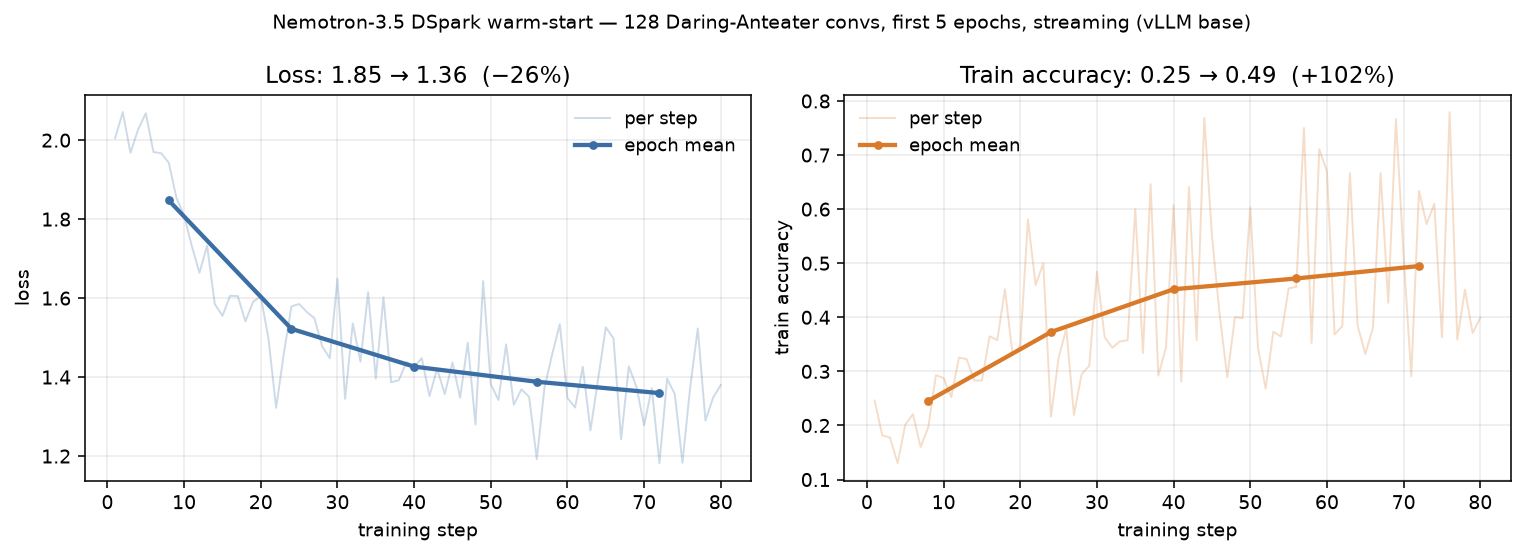 Over the first 5 epochs loss falls **1.85 → 1.36** and train accuracy rises **0.25 → 0.49**; across the full 20 epochs they reach **1.21** and **0.48** (peak 0.54) before flattening. This validates the pipeline end-to-end — capture layers, plane split, mask direction, sink loading and warm-start weights all have to be right for this curve to appear. It is *not* a model-quality result: 128 samples over 20 epochs overfits by construction, and the corpus is not generated by the base model, so the absolute numbers are not meaningful. ### TODO (follow-up) **A complete, robust checkpoint/config converter.** Both conversions are handled ad hoc here: - *Draft config → training config.* The recipe transcribes ~15 fields by hand from the drafter's `config.json`. Only the shape-bearing ones (`num_hidden_layers`, `num_attention_heads`, `intermediate_size`, `markov_rank`) fail loudly when mistyped; the rest — `mask_token_id`, `causal`, `swa_window_size`, `block_size` — train "successfully" on a wrong value and only surface later as a mysteriously low acceptance length. A converter should derive the whole block from the checkpoint, including its aliases (`pard_token`, `dspark_markov_rank`, `dflash_query_causal`, top-level `sliding_window` / `attention_sink_bias`) and duplicated fields. - *Weight layout.* The `markov_head.` remap is a load-time hook. A converter should normalize layouts explicitly, and decide whether export should also emit the release's aliases so a round-trip reproduces the original format (today it renames `architectures` to `DFlashDraftModel`). - *Base config.* Serving this base on vLLM needs its `config.json` layer-type vocabulary updated for the transformers-5 path (`mamba` → `linear_attention`, `attention` → `full_attention`, plus a matching `hybrid_override_pattern`). That is done by hand today and is not covered by this PR. ### Before your PR is "*Ready for review*" - **Make sure you read and follow [Contributor guidelines](https://github.com/NVIDIA/TensorRT-Model-Optimizer/blob/main/CONTRIBUTING.md)** and your commits are signed. - **Is this change backward compatible?**: Yes - **Did you write any new necessary tests?**: Yes - **Did you add or update any necessary documentation?**: Yes - **Did you update [Changelog](https://github.com/NVIDIA/TensorRT-Model-Optimizer/blob/main/CHANGELOG.rst)?**: No <!-- This is an auto-generated comment: release notes by coderabbit.ai --> ## Summary by CodeRabbit * **New Features** * Added configurable causal or bidirectional attention for DFlash models. * Added optional attention sinks, checkpoint warm starts, and explicit target-layer selection. * Improved streaming data handling for shared auxiliary and base hidden states. * Added Nemotron-3.5 Lightning DSpark warm-start training and serving recipes. * **Bug Fixes** * Preserved configured attention behavior during model export. * Prevented warm-start checkpoints from being reapplied during restoration. * Improved checkpoint compatibility, validation, and attention-mask handling. <!-- end of auto-generated comment: release notes by coderabbit.ai --> Signed-off-by: h-guo18 <67671475+h-guo18@users.noreply.github.com> |
||
|
skierat
|
c4129b6e03 |
Add Cosmos3 Nano DFlash multimodal training recipe (#2053)
### What does this PR do? Type of change: new example Adds an end-to-end Cosmos3 Nano DFlash training recipe for multimodal speculative decoding. - Adds a notebook that prepares data, launches synthetic generation in Slurm, trains a DFlash draft model, exports it, and provides a vLLM smoke-test command. - Adds PAI-Understanding, VQA v2, and multilingual prompt sharding and distributed-generation helpers. - Adds an atomic, multimodal-safe merge and conservative deduplication flow. - Extends the VLM data collator to handle structured image/video messages, configurable visual bounds, and fixed DFlash sequence lengths. - Hardens generation launch scripts and preserves truncated generated responses. ### Usage ```bash cd examples/speculative_decoding/recipes export MODEL_PATH=/path/to/cosmos3-nano export PLAIN_TEXT_INPUT=/path/to/nemotron-chat-or-approved-user-data.jsonl jupyter lab train_dflash_cosmos3_nano.ipynb Run the notebook in order: 1. Configure paths. 2. Prepare prompts on a CPU-only node and generate target completions in a Slurm GPU allocation. 3. Merge the four required sources and submit training. 4. Export a saved checkpoint and run the vLLM deployment smoke test. ### Testing - jq empty examples/speculative_decoding/recipes/train_dflash_cosmos3_nano.ipynb - bash -n on the modified launch, worker, and recipe shell scripts. - Ran a two-step Cosmos3 Nano DFlash Slurm smoke job; it completed and wrote modelopt_state.pth. - Not run: pytest tests/unit/torch/speculative/plugins/test_hf_speculative_offline.py (pytest is unavailable in the current environment). ### Before your PR is "Ready for review" - Is this change backward compatible?: ✅ - If you copied code from any other sources or added a new PIP dependency, did you follow guidance in CONTRIBUTING.md?: N/A - Did you write any new necessary tests?: ✅ - Did you update CHANGELOG.rst?: N/A - Did you get Claude approval on this PR?: N/A ### Additional Information Security follow-up required before marking ready: the notebook hardcodes model.trust_remote_code=true and --trust_remote_code. Either parameterize this with a default of false, or obtain and document a security exception. <!-- This is an auto-generated comment: release notes by coderabbit.ai --> ## Summary by CodeRabbit * **New Features** * Added end-to-end multimodal workflows for dataset preparation, distributed generation, result merging, training, export, and deployment testing. * Added support for image and video inputs, multiple dataset formats, resumable JSONL generation, configurable serving, and parallel processing. * Added configurable prompt, media, token, sequence, temperature, and tensor-parallel settings. * **Bug Fixes** * Improved truncated-response handling, assistant-label processing, validation, health checks, cleanup, deduplication, media resolution, atomic outputs, and failure reporting. <!-- end of auto-generated comment: release notes by coderabbit.ai --> --------- Signed-off-by: Slawomir Kierat <skierat@nvidia.com> |
||
|
Keval Morabia
|
bee497de03 |
Fix EAGLE3 offline dump skipping all conversations on newer transformers (#2172)
### What does this PR do? Type of change: Bug fix **Fix EAGLE3 offline hidden-state dump silently skipping every conversation on newer `transformers`.** `tokenizer.apply_chat_template(...)` returns a **`BatchEncoding`** (dict of `input_ids` + `attention_mask`) on `transformers>=5` rather than a `list[int]`, so `len(input_ids)` evaluated to **2** (the number of dict fields), tripping the `num_input_tokens <= 10` "too short" filter for **every** conversation. The dump wrote **zero `.pt` files** and offline EAGLE3 training aborted with `No .pt files found`. The token-id extraction is consolidated into `modelopt.torch.speculative.utils.get_conversation_input_ids`, which normalizes the result to a flat `list[int]` (unwrapping `BatchEncoding` / 2-D tensor / batch-wrapped list, asserting the shape so a future `transformers` change fails loudly instead of silently). It is called from all three offline-dump entry points that shared the bug: - `examples/speculative_decoding/collect_hidden_states/compute_hidden_states_trtllm.py` - `examples/speculative_decoding/collect_hidden_states/send_conversations_for_hiddens.py` - `examples/speculative_decoding/scripts/send_conversation_vllm.py` (the two `send_conversation*` scripts additionally indexed/`decode()`d the `BatchEncoding`). Also fixes the `add_generation_template` -> `add_generation_prompt` typo at each site. ### Testing - `tests/unit/torch/speculative/test_speculative_utils.py` — asserts the helper returns the exact token-id sequence of the rendered chat prompt, and pins every `apply_chat_template` return shape (`BatchEncoding`, 2-D tensor, batch-wrapped list, plain list) to a flat `list[int]` via deterministic stubs, so the fixed branch is covered regardless of the installed `transformers` version. - **End-to-end on ComputeLab (H100, TRT-LLM 1.3.0rc20):** reran the exact dump on the 100 conversations that previously failed. Before: 0/100 (0 `.pt` files). After: **97/100** (97 `.pt` files; the 3 skips are genuinely `> max_seq_len`). ### Before your PR is "*Ready for review*" - Is this change backward compatible?: ✅ - If you copied code from any other sources or added a new PIP dependency, did you follow guidance in `CONTRIBUTING.md`: N/A - Did you write any new necessary tests?: ✅ (`tests/unit/torch/speculative/test_speculative_utils.py`) - Did you update Changelog?: N/A - Did you get Claude approval on this PR?: 🔄 `/claude review` run; findings addressed, re-review pending ### Additional Information Surfaced by an nmm-sandbox CI run where `Qwen3-8B_EAGLE3_offline` failed after the container bump to `tensorrt-llm/release:1.3.0rc20`; the auto-blame heuristic mis-attributed it to an unrelated MLflow commit. `compute_hidden_states_vllm.py` is unaffected (it routes through `common.tokenize_with_loss_mask`, which passes `return_dict=True`). --------- Signed-off-by: Keval Morabia <28916987+kevalmorabia97@users.noreply.github.com> |
||
|
Keval MorabiaandClaude Opus 5
|
22b6a148b0 |
Fix EAGLE-3 context-parallel training and re-enable its tests (#2086)
### What does this PR do?

Type of change: Bug fix

**EAGLE-3 context-parallel training (`--cp_size > 1`) is fixed, and its
tests run again.** CP has been broken since `accelerate` 1.13, and the
tests never caught it: the guard compared `Version("2.10.0a0")` against
`Version("2.10.0")`, which is False on every NGC alpha torch build, so
`test_llama_eagle3[cp_size=2]` has never actually run in CI.

Five fixes:

- **`main.py`** — rebuild the FSDP2 plugin accelerate requires for
`cp_size > 1`. The `--fsdp full_shard --fsdp_config` launcher flags that
used to supply it were dropped from `launch_train.sh`, so CP could not
start at all. Also pass the CP degree to the draft model.
- **`modeling_eagle.py`** — apply the draft model's first input norm
inside `layers[0]`'s own forward, where FSDP2 has actually unsharded its
weights, and only stash the input embeds on the path whose pre-hook
consumes them.
- **`hf_eagle.py`** — skip the dense eagle attention mask under CP
(causal masking comes from `is_causal`, TTT masking from the
ring-attention patch), and warn that padded positions are therefore
unmasked. Also stop `(eagle_loss or 0)` replacing a `0.0` loss tensor
with a plain `int`, which detached the graph.
- **`eagle_utils.py`** — key TTT-mask injection off the backward call's
`grad_out` kwarg, since newer torch omits `attn_bias` on the forward
call, silently disabling TTT masking.
- **`utils.py`** — CUDNN-only SDPA under CP; the `MATH` backend
decomposes SDPA and breaks on DTensors. Scoped to `cp_size > 1`, since
this context manager wraps every training forward and CPU has no cudnn
backend.

**Drops the `speculative_decoding` 26.01 container override.** It was
added when the lane ran 25.06 and spec-dec needed something *newer* — a
floor. Later bumps moved the default past it, so it had silently become
a ceiling holding spec-dec on a 6-month-old image.

### Testing

Ran `tests/examples/speculative_decoding` in
`nvcr.io/nvidia/pytorch:26.07-py3` on 2 GPUs, reproducing the CI install
steps (`pip uninstall -y nvidia-modelopt`, `pip install -e
".[hf,dev-test]"`, example requirements): **16 passed, 2 skipped** — the
2 skipped being pre-existing `--run-manual` tests. All four
`test_llama_eagle3` cases pass, including both `cp_size=2` ones.

### Before your PR is "*Ready for review*"

- Is this change backward compatible?: ✅
- If you copied code from any other sources or added a new PIP
dependency, did you follow guidance in `CONTRIBUTING.md`: N/A
- Did you write any new necessary tests?: N/A — the existing `cp_size=2`
tests are re-enabled
- Did you update
[Changelog](https://github.com/NVIDIA/Model-Optimizer/blob/main/CHANGELOG.rst)?:
✅
- Did you get Claude approval on this PR?: ❌ — not yet run

Signed-off-by: Keval Morabia <28916987+kevalmorabia97@users.noreply.github.com>
Co-authored-by: Claude Opus 5 <noreply@anthropic.com>
|
||
|
skieratandh-guo18
|
c94405e602 |
add Qwen3-VL support for DFlash training (#1975)
### What does this PR do?

  Type of change: new feature

Adds online DFlash training support for Qwen3-VL–style vision-language
models.

  Changes include:

- Load VLMs through the Transformers 5 `AutoModelForImageTextToText`
API, while retaining compatibility with the legacy VLM auto-model API.
- Run the base model through its top-level multimodal forward when
image/video inputs are present, ensuring vision embeddings are injected
before collecting DFlash target hidden states.
  - Extend `VisionLanguageDataCollator` to:
- propagate `answer_only_loss`, chat-template, and DFlash
label-alignment settings;
    - apply `VLM_MIN_PIXELS` / `VLM_MAX_PIXELS` processor limits;
- derive assistant-only masks from ChatML/Llama chat boundaries when
processor generation masks are unavailable;
- enforce the fixed `training_seq_len` required by DFlash block
training.
- Preserve the existing text-only DFlash path.

### Usage

```bash
python -m torch.distributed.run \
--nproc_per_node 4 \
examples/speculative_decoding/main.py \
--config modelopt_recipes/general/speculative_decoding/dflash.yaml \
model.model_name_or_path=/path/to/qwen3-vl-model \
model.trust_remote_code=true \
data.data_path=/path/to/train.jsonl \
data.vlm_processor=/path/to/qwen3-vl-model \
data.vlm_img_dir=/path/to/image/root \
training.training_seq_len=4096 \
training.answer_only_loss=true \
dflash.dflash_block_size=8 \
dflash.dflash_mask_token_id=151669


### Testing
- git diff --check
- Parsed all modified Python modules successfully.
- Ran iterative multi-node Slurm smoke tests with a Qwen3-VL-family model and mixed multimodal data:
    - validated VLM model loading with Transformers 5;
    - validated distributed initialization, DFlash conversion, and VLM collation paths;
    - identified and addressed processor padding/truncation behavior required by fixed-size DFlash blocks.
This PR remains draft pending a completed end-to-end training smoke test and automated regression coverage.

### Before your PR is "Ready for review"
Make sure you read and follow Contributor guidelines (https://github.com/NVIDIA/Model-Optimizer/blob/main/CONTRIBUTING.md) and your commits are signed (git commit -s -S).
Make sure you read and follow the Security Best Practices (https://github.com/NVIDIA/Model-Optimizer/blob/main/SECURITY.md#security-coding-practices-for-contributors) (e.g. avoiding hardcoded trust_remote_code=True, torch.load(...,
weights_only=False), pickle, etc.).
- Is this change backward compatible?: ✅
- If you copied code from any other sources or added a new PIP dependency, did you follow guidance in CONTRIBUTING.md: N/A
- Did you write any new necessary tests?: ❌ — automated Qwen3-VL/DFlash regression coverage still needs to be added before review.
- Did you update Changelog (https://github.com/NVIDIA/Model-Optimizer/blob/main/CHANGELOG.rst)?: ❌ — evaluate and add an entry before marking ready for review if this is considered user-facing speculative-decoding support.
- Did you get Claude approval on this PR?: N/A
### Additional Information
The PR intentionally excludes local Slurm launch scripts, logs, model paths, datasets, and environment-specific configuration.


<!-- This is an auto-generated comment: release notes by coderabbit.ai -->
## Summary by CodeRabbit

* **New Features**
  * Expanded VLM data-collation controls, including `shift_labels` and more robust `answer_only_loss` masking.
  * Improved Qwen3-VL speculative decoding for Transformers 5.3+ with correct video frame grouping and safer position-id handling.
  * Improved DFlash RoPE export to reliably read `rope_theta` from newer config formats.

* **Bug Fixes**
  * Hardened multimodal preprocessing and training loss masking to keep label/attention alignment consistent.
  * Improved behavior when anchor sampling yields no valid blocks.
  * More resilient VLM model loading when certain Transformers auto classes are unavailable.

* **Tests**
  * Added coverage for RoPE export, Qwen3-VL position-id logic across Transformers versions, and VLM label-mode/collator options.
<!-- end of auto-generated comment: release notes by coderabbit.ai -->

---------

Signed-off-by: Slawomir Kierat <skierat@nvidia.com>
Signed-off-by: h-guo18 <67671475+h-guo18@users.noreply.github.com>
Co-authored-by: h-guo18 <67671475+h-guo18@users.noreply.github.com>
|
||
|
h-guo18
|
6105fe84e9 |
[Examples]: MiniMax-M3 DSpark (#1965)
### What does this PR do?

Type of change: new example + bug fixes

Adds a **MiniMax-M3 DSpark streaming training recipe** under
`tools/launcher/examples/MiniMaxAI/MiniMax-M3/`, plus the four fixes it
needs to actually run. Each fix addresses a failure mode that is silent
or misleading without it:

1. **Gemma-style final norm for the fake base**
(`modeling_final_norm.py`, `modeling_fakebase.py`): M3 uses a
gemma-style final RMSNorm (`(1 + weight)` scale, fp32
multiply-then-cast). Selecting the norm by `model_type` alone picks
plain `rmsnorm` — MiniMax's VL remote code coerces its `model_type`-less
`text_config` to **mixtral** — which silently drops the `+1` and
corrupts the distillation target. New `_FinalGemmaRMSNorm` + selection
by the explicit `use_gemma_norm` config flag (only MiniMax sets it).
2. **Loud failure for un-maskable `answer_only_loss`**
(`hf_streaming_dataset.py`): with a fast tokenizer whose chat template
has no `{% generation %}` tags,
`apply_chat_template(return_assistant_tokens_mask=True)` only warns and
returns an **all-zero mask** — training runs at zero loss on every
sample with no other symptom. Now raises at tokenization with an
actionable message.
3. **`SERVE_BLOCK_SIZE` knob** (`train_eagle_streaming.sh`): nemo_run
exports env values unquoted, so a multi-token
`SERVE_EXTRA_ARGS="--trust-remote-code --block-size 128"` loses
everything after the first token. M3's MSA sparse attention requires KV
block 128 (`ValueError: No common block size for 16` at engine init
otherwise), so `--block-size` gets a dedicated single-token knob.
4. **Relax the speculative_decoding `transformers` pin to `<5.13`**
(match `pyproject.toml`): the old `<5.4` pin downgrades recent vLLM
containers (e.g. transformers 5.12.1, which also provides in-tree
`minimax_m3_vl`) and breaks `vllm serve` (`ALLOWED_LAYER_TYPES` needs
>=5.5.3).

The example itself encodes the validated M3 specifics: generation-tagged
chat template copy (required for `answer_only_loss` — see fix 2), draft
dims + base `rope_theta=5e6` set explicitly (not inherited), mask token
200063 (reserved slot; added tokens end at 200060), `EAGLE_CAPTURE_IDS`
= draft default `target_layer_ids+1` + final layer, `trust_remote_code`
at serve/export, and AWS-EFA NIXL notes (UCX segfaults at agent init on
EFA nodes; LIBFABRIC required there).

### Usage

```bash
cd tools/launcher
export SLURM_HOST=localhost SLURM_ACCOUNT=<account> SLURM_PARTITION=<partition> \
       SLURM_HF_LOCAL=<hf_models_dir> SLURM_JOB_DIR=<experiments_dir> NEMORUN_HOME=$PWD
uv run launch.py --yaml examples/MiniMaxAI/MiniMax-M3/hf_streaming_dspark_multi_node.yaml \
       identity=$HOME/.ssh/id_ecdsa detach=True --yes
```

### Testing

- `tests/unit/torch/speculative/plugins/`: **129 passed** inside a
current vLLM x86_64 nightly container (transformers 5.12.1), including 3
new tests for the assistant-mask guard.
- Generation-tagged template verified against real corpus samples:
`input_ids` identical to the original template, mask covers exactly the
assistant turns (think prefix + content + eos), contiguous, no
user-prompt leak.
- The recipe is exercised end-to-end by a live M3 DSpark training run
(this yaml modulo cluster paths): streaming serve + NIXL transport +
resume all healthy; drafter MT-Bench AL exceeds our Kimi-K2.6 DSpark
reference by ~8k steps.
- `ruff check` / `ruff format` (0.15.20) clean.

### Before your PR is "*Ready for review*"

- Is this change backward compatible?: ✅ (norm selection only changes
models with `use_gemma_norm=True`, previously mis-normed; the guard
turns a silent zero-loss run into an error; `SERVE_BLOCK_SIZE` is
opt-in; the pin relax widens the allowed range)
- Did you write any new necessary tests?: ✅
- Did you update
[Changelog](https://github.com/NVIDIA/Model-Optimizer/blob/main/CHANGELOG.rst)?:
❌ (can add if desired)

🤖 Generated with [Claude Code](https://claude.com/claude-code)


<!-- This is an auto-generated comment: release notes by coderabbit.ai
-->
## Summary by CodeRabbit

- **New Features**
- Added Gemma-style RMS normalization support for speculative decoding.
- Added MiniMax-M3 multi-node training configuration, including a full
Jinja chat template for tool calls, multimodal content, and thinking
modes.
  - Added optional `SERVE_BLOCK_SIZE` support for vLLM serve launches.
- **Bug Fixes**
- Improved `answer_only_loss` masking validation: now fails fast with
clear errors when required `{% generation %}` markers are missing or
when using a non-fast tokenizer.
- **Compatibility**
- Expanded the supported Transformers version range for speculative
decoding examples.
<!-- end of auto-generated comment: release notes by coderabbit.ai -->

---------

Signed-off-by: h-guo18 <67671475+h-guo18@users.noreply.github.com>
|
||
|
h-guo18
|
bc5bc1ac5f |
[Feat]: Add Final Norm for vLLM Hidden Extractor (#1846)
### What does this PR do? **Type of change:** Bug fix vLLM captures the final-layer hidden state *before* the model's final norm, but the offline/streaming distillation path fed it straight into `lm_head`, so the reconstructed base logits (the KD target) were computed from un-normed hidden states. This PR re-applies the base model's final norm before `lm_head` when the producer declares a pre-norm capture (`base_hidden_prenorm`), for both DFlash and EAGLE: - Producer sets `base_hidden_prenorm` (streaming: `True`; offline: from the dump). - Consumer (`_maybe_apply_base_final_norm`) re-applies the base final norm, and **fails loud** if pre-norm is declared but the model's norm type isn't supported (no silent corruption). - `FakeBaseModel` now loads the base final norm (+ `rope_theta`/`rms_norm_eps`); norm type is gated by an explicit `model_type` allowlist (gpt_oss excluded pending a matching norm class). ### Testing `tests/unit/torch/speculative/plugins/test_modeling_final_norm.py`; DFlash/EAGLE streaming training verified end-to-end. - Backward compatible?: ✅ (post-norm captures declare `base_hidden_prenorm=False` → unchanged) - New tests: ✅ <!-- This is an auto-generated comment: release notes by coderabbit.ai --> ## Summary by CodeRabbit * **New Features** * Expanded speculative decoding/distillation to reconstruct missing base-model logits by optionally applying a base model’s final pre–LM-head normalization when pre-norm hidden states are provided. * Streaming dataset now emits `base_hidden_prenorm` and can configure RDMA backends from environment settings. * **Bug Fixes** * Rejects mixed `base_hidden_prenorm` values within a batch. * Fails fast on streaming token-length mismatches. * Streaming dataset loading supports directory inputs by expanding sorted JSONL shards (and errors if none are found). * **Tests** * Added/updated unit and dataset tests for final-norm behavior and the new batch field. <!-- end of auto-generated comment: release notes by coderabbit.ai --> Signed-off-by: h-guo18 <67671475+h-guo18@users.noreply.github.com> |
||
|
ZhiyuandClaude Opus 4.8
|
f335459dc0 |
refactor(examples): rename llm_ptq → hf_ptq (symlink for back-compat) (#1759)
## What does this PR do? **Type of change:** refactor / deprecation (examples) Follow-up to #1705 (which consolidated `examples/vlm_ptq` into `examples/llm_ptq`). Since that example now covers Hugging Face **LLM and VLM** PTQ, the `llm_ptq` name is a misnomer. This renames the directory to `examples/hf_ptq` and leaves a relative symlink `examples/llm_ptq → hf_ptq` so existing paths/commands keep working during a deprecation window. Requested by @kevalmorabia97 on #1705 (with the symlink-for-back-compat approach), targeted for the **same 0.46 release** as the consolidation. ### Changes - `git mv examples/llm_ptq → examples/hf_ptq` and `tests/examples/llm_ptq → tests/examples/hf_ptq` (the CI runner maps the matrix name to both `examples/<name>` and `tests/examples/<name>`). - Add a tracked back-compat symlink `examples/llm_ptq → hf_ptq`. - Update CI matrices and all repo **path references** (docs, READMEs, agent skills, launcher/debugger tools, tests) from `llm_ptq` to `hf_ptq`. - Keep Python identifiers / test-util module names (`run_llm_ptq_command`, `llm_ptq_utils`) — they name the LLM-PTQ task, not the directory. - Preserve the CODEOWNERS team slug (`modelopt-examples-llm_ptq-codeowners`) and historical CHANGELOG entries; add a CHANGELOG deprecation note. ### Back-compat caveats (inherent to git directory symlinks) - ✅ Linux/macOS CLI usage and Python `cwd`/pytest resolution work through the symlink. - ⚠️ Windows git checkouts don't materialize symlinks by default (low impact — this example is Linux-only in practice). - ⚠️ GitHub web doesn't follow directory symlinks, so legacy external deep-links to `examples/llm_ptq/...` won't navigate in. All **internal** references are repointed to `hf_ptq`, so the symlink is only for legacy external/CLI use. ### Usage (unchanged via symlink) ```bash # New canonical path cd examples/hf_ptq scripts/huggingface_example.sh --model <hf_model> --quant fp8 # Old path still works (forwards via symlink) cd examples/llm_ptq && scripts/huggingface_example.sh --model <hf_model> --quant fp8 ``` ### Testing - `bash -n` on moved/edited shell scripts (new path + via symlink). - `py_compile` on moved/edited Python; test re-export shim repointed to `examples/hf_ptq/example_utils`. - Verified git tracks `examples/llm_ptq` as a single symlink (mode 120000), not a duplicated tree (no pre-commit / pytest double-processing). - `pre-commit run` on all changed files passes. ### Before your PR is "*Ready for review*" - Is this change backward compatible?: ✅ (relative symlink keeps `examples/llm_ptq` paths valid; see caveats above) - Did you write any new necessary tests?: N/A (pure rename; existing tests moved with the dir) - Did you update Changelog?: ✅ ### Additional Information Follow-up (later release): remove the `examples/llm_ptq` symlink once external references have migrated. 🤖 Generated with [Claude Code](https://claude.com/claude-code) <!-- This is an auto-generated comment: release notes by coderabbit.ai --> ## Summary by CodeRabbit * **New Features** * PTQ guidance now directs to the unified Hugging Face PTQ flow, including VLM quantization via the shared `--vlm` entry point. * **Documentation** * Updated README and guide links, references, and command snippets to use `hf_ptq` (replacing `llm_ptq`). * Deprecated and consolidated `vlm_ptq` into `hf_ptq`; removed VILA/NVILA coverage from the Hugging Face PTQ examples. * **Bug Fixes** * Improved detection and routing so local/manual setup uses the correct PTQ source. * **Tests / Chores** * CI and example tests updated to run the `hf_ptq` variants. <!-- end of auto-generated comment: release notes by coderabbit.ai --> --------- Signed-off-by: Zhiyu Cheng <zhiyuc@nvidia.com> Co-authored-by: Claude Opus 4.8 (1M context) <noreply@anthropic.com> |
||
|
|
c248dd5434 |
[Feat]: Domino support (#1710)
### What does this PR do? Type of change: New feature Adds **Domino** speculative decoding: the parallel DFlash draft backbone plus a lightweight **GRU causal correction head**. The backbone produces *base* logits for a full draft block in one forward; a GRU over the block's teacher-forced tokens produces a causal state that is fused with the backbone hidden state and projected to a vocab-sized logit correction on the block suffix — injecting the intra-block causal dependency the parallel backbone lacks. Trained with a dual loss `(1-λ)*final + λ*base`, where `λ_base` decays linearly 1→0 (curriculum: learn the parallel backbone first, then the correction). Reuses the DFlash mode/config/recipe; selected via `dflash_architecture_config.projector_type=domino` and routed to its own registry so `HFDominoModel` does not shadow `HFDFlashModel`. Exports in the z-lab/SpecForge drafter format (`prefix_gru.*` / `embed_proj.*`). > Note: the inference side (vLLM / AR evaluation) is intentionally **not** wired up yet — the correction head is not applied in serving. To be added once the inference path lands. ### Usage ```bash # Online training (recipe: projector_type=domino) uv run launch.py --yaml examples/Qwen/Qwen3-8B/hf_online_domino.yaml --yes ``` ### Testing CPU unit tests in `tests/unit/torch/speculative/plugins/test_hf_domino.py` cover conversion routing, the training forward (dual loss + grads), the λ schedule, and the export format. Online Qwen3-8B training validated end-to-end (loss curve below). <img width="1803" height="809" alt="image" src="https://github.com/user-attachments/assets/7c9d2001-bd80-4dec-919b-443e61089cca" /> ### Before your PR is "*Ready for review*" - Is this change backward compatible?: ✅ (opt-in via `projector_type=domino`; DFlash path unchanged) - If you copied code from any other sources or added a new PIP dependency, did you follow guidance in `CONTRIBUTING.md`: N/A (no new dependency) - Did you write any new necessary tests?: ✅ - Did you update [Changelog](https://github.com/NVIDIA/Model-Optimizer/blob/main/CHANGELOG.rst)?: ✅ - Did you get Claude approval on this PR?: ❌ ### Additional Information Reference: SpecForge PR #571 (z-lab); drafter format `huggingface.co/Huang2020/Qwen3-8B-Domino-b16`. <!-- This is an auto-generated comment: release notes by coderabbit.ai --> ## Summary by CodeRabbit ## Release Notes * **New Features** * Added Domino speculative-decoding training with a decaying base/final dual-loss curriculum and Domino-specific lambda scheduling (training-only; inference wiring not yet included). * Added Domino draft-head export support for training checkpoints. * **Documentation & Configuration** * Added a Domino speculative-decoding training recipe and an HF Online Domino launcher configuration for Qwen3-8B. * **Refactor** * Updated speculative model conversion/export to route to Domino variants based on the configured projector type. * **Tests** * Added unit tests for Domino conversion, training loss/metrics, lambda decay behavior, and exporter output layout. <!-- end of auto-generated comment: release notes by coderabbit.ai --> --------- Signed-off-by: h-guo18 <67671475+h-guo18@users.noreply.github.com> Signed-off-by: Keval Morabia <28916987+kevalmorabia97@users.noreply.github.com> Co-authored-by: Claude Opus 4.8 (1M context) <noreply@anthropic.com> Co-authored-by: Keval Morabia <28916987+kevalmorabia97@users.noreply.github.com> |
||
|
Keval Morabia
|
b6bf6b7997 |
Update Roadmap Issue link
Signed-off-by: Keval Morabia <28916987+kevalmorabia97@users.noreply.github.com> |
||
|
jzh26andh-guo18
|
48f8d8984f |
Fix conversation loading logic in UltraChat dataset (#1680)
### What does this PR do?
Type of change: Bug fix.

<!-- Details about the change. -->
Previously, only the first user prompt was extracted from each example,
discarding all subsequent turns. UltraChat stores full multi-turn
conversations in the "messages" field, so switching to that field
preserves the complete dialogue rather than truncating to a single user
message.
### Usage

```python
# Add a code snippet demonstrating how to use this
```

### Testing
 python make_dataset.py -f test_cfg.yaml --full
 python make_dataset.py -f test_cfg.yaml
```yaml
      - name: "ultrachat"
        splits:
          train_gen: 100
          train_sft: 100
```
### Before your PR is "*Ready for review*"

Make sure you read and follow [Contributor
guidelines](https://github.com/NVIDIA/Model-Optimizer/blob/main/CONTRIBUTING.md)
and your commits are signed (`git commit -s -S`).

Make sure you read and follow the [Security Best
Practices](https://github.com/NVIDIA/Model-Optimizer/blob/main/SECURITY.md#security-coding-practices-for-contributors)
(e.g. avoiding hardcoded `trust_remote_code=True`, `torch.load(...,
weights_only=False)`, `pickle`, etc.).

- Is this change backward compatible?: ✅ / ❌ / N/A <!--- If ❌, explain
why. -->
- If you copied code from any other sources or added a new PIP
dependency, did you follow guidance in `CONTRIBUTING.md`: ✅ / ❌ / N/A
<!--- Mandatory -->
- Did you write any new necessary tests?: ✅ / ❌ / N/A <!--- Mandatory
for new features or examples. -->
- Did you update
[Changelog](https://github.com/NVIDIA/Model-Optimizer/blob/main/CHANGELOG.rst)?:
✅ / ❌ / N/A <!--- Only for new features, API changes, critical bug fixes
or backward incompatible changes. -->
- Did you get Claude approval on this PR?: ✅ / ❌ / N/A <!--- Run
`/claude review`. NVIDIA org members can self-trigger for complex
changes; orthogonal to CodeRabbit. -->

### Additional Information
<!-- E.g. related issue. -->


<!-- This is an auto-generated comment: release notes by coderabbit.ai
-->
## Summary by CodeRabbit

* **Breaking Changes**
* Removed UltraChat support from the example dataset mixer, so UltraChat
splits can no longer be loaded.

* **Documentation**
* Updated the dataset examples README and the example dataset
configuration to remove UltraChat and adjust split settings for other
datasets.
* Updated the speculative decoding fine-tuning documentation to
reference Daring-Anteater instead of UltraChat.
<!-- end of auto-generated comment: release notes by coderabbit.ai -->

---------

Signed-off-by: jzh26 <226629529+jzh26@users.noreply.github.com>
Signed-off-by: h-guo18 <67671475+h-guo18@users.noreply.github.com>
Co-authored-by: h-guo18 <67671475+h-guo18@users.noreply.github.com>
|
||
|
h-guo18
|
9048d13b86 |
[Feat]:Support DPace (#1724)
### What does this PR do? Type of change: New feature Adds the **D-PACE** (Dynamic Position-Aware Cross-Entropy) loss objective for DFlash speculative-decoding training ([arXiv:2605.18810](https://arxiv.org/abs/2605.18810)). It replaces the static exponential position decay with per-position CE weights derived from the draft's own confidence `q_i = exp(-CE_i)`: smoothed `q̃_i = (1-α)q_i + α` (Eq.7) and weighted by the suffix-sum of prefix products `w_j = Σ_{m≥j} ∏_{i≤m} q̃_i` (Eq.8), which directly targets expected accepted block length and shifts signal toward whichever positions currently limit acceptance. Selected via `dflash_loss_objective` — **D-PACE is now the default** (`dpace`); set `dflash_loss_objective: decay` to restore the previous static schedule. Smoothing via `dflash_dpace_alpha` (default 0.5). Weights are detached from the gradient — training-only, ~2.3% overhead, no architecture or inference change. Mutually exclusive with `dflash_loss_decay_factor`. ### Usage ```yaml # DFlash recipe / training config dflash: dflash_loss_objective: dpace # default: decay dflash_dpace_alpha: 0.5 # smoothing in (0, 1]; stable in [0.3, 0.7] ``` ### Testing CPU unit tests in `tests/unit/torch/speculative/plugins/test_hf_dflash.py`: weights match the paper closed form, are detached and non-increasing, the α smoothing floor keeps later weights non-zero, and convert wires/validates the new fields (rejects bad objective and degenerate α). Training validated on Qwen3-8B (curve below). <img width="1803" height="809" alt="image" src="https://github.com/user-attachments/assets/d34dcd76-9e46-4051-94d4-c880b1987965" /> ### Before your PR is "*Ready for review*" - Is this change backward compatible?: ⚠️ Behavior change — D-PACE is now the **default** objective, so DFlash training loss weighting changes unless you set `dflash_loss_objective=decay` (which reproduces the previous static-decay behavior). - If you copied code from any other sources or added a new PIP dependency, did you follow guidance in `CONTRIBUTING.md`: N/A (no new dependency) - Did you write any new necessary tests?: ✅ - Did you update [Changelog](https://github.com/NVIDIA/Model-Optimizer/blob/main/CHANGELOG.rst)?: ✅ - Did you get Claude approval on this PR?: ❌ ### Additional Information Reference: D-PACE, [arXiv:2605.18810](https://arxiv.org/abs/2605.18810). See `examples/speculative_decoding/doc/dflash.md` for the math and tuning notes. <!-- This is an auto-generated comment: release notes by coderabbit.ai --> ## Summary by CodeRabbit ## Release Notes * **New Features** * Added a **D-PACE** training loss objective for DFlash speculative decoding (`dflash_loss_objective: dpace`), configurable via `dflash_dpace_alpha` (default `0.5`). * **Documentation** * Documented D-PACE’s confidence-derived, dynamically weighted per-position loss behavior (training-only) and noted that `dflash_loss_decay_factor` is ignored with D-PACE. * **Bug Fixes** * Updated DFlash loss to reuse the precomputed per-token cross-entropy in the non-KD path. * **Tests** * Added unit tests for D-PACE weight correctness, masking, gradient detachment, monotonicity, smoothing, and config/validation behavior. <!-- end of auto-generated comment: release notes by coderabbit.ai --> --------- Signed-off-by: h-guo18 <67671475+h-guo18@users.noreply.github.com> |
||
|
h-guo18
|
977d34dc3c |
[Fix](nvbug6304585): specdec README online base-model example should use Instruct model (#1755)
### What does this PR do?

Type of change: Bug fix

The **Training Draft Model with Online/Offline Base Model** examples in
`examples/speculative_decoding/README.md` used
`meta-llama/Llama-3.2-1B`, a
base / pretrained checkpoint that ships **no chat template**. The online
EAGLE3
flow tokenizes conversations through
`tokenizer.apply_chat_template(...)`, so
the data collator fails fast at startup:

```
ValueError: No valid chat template!
```

This PR:

- Switches both README example commands (online and offline) to
  `meta-llama/Llama-3.2-1B-Instruct`, which carries a chat template.
- Makes the collator error message in
`modelopt/torch/utils/plugins/transformers_dataset.py` actionable — it
now
explains the cause (base checkpoints have no chat template) and points
users
  at an Instruct model or a custom `chat_template`.

### Usage

```bash
./launch_train.sh \
    --config ../../modelopt_recipes/general/speculative_decoding/eagle3.yaml \
    model.model_name_or_path=meta-llama/Llama-3.2-1B-Instruct \
    data.data_path=input_conversations/train.jsonl \
    training.output_dir=ckpts/llama-3.2-1b-online
```

### Testing

- Reproduced the original `No valid chat template!` failure with the
base
`Llama-3.2-1B` and confirmed the Instruct variant carries a chat
template.
- Verified the new error message renders correctly when a template is
missing.

### Before your PR is "*Ready for review*"

Make sure you read and follow [Contributor
guidelines](https://github.com/NVIDIA/Model-Optimizer/blob/main/CONTRIBUTING.md)
and your commits are signed (`git commit -s -S`).

Make sure you read and follow the [Security Best
Practices](https://github.com/NVIDIA/Model-Optimizer/blob/main/SECURITY.md#security-coding-practices-for-contributors)
(e.g. avoiding hardcoded `trust_remote_code=True`, `torch.load(...,
weights_only=False)`, `pickle`, etc.).

- Is this change backward compatible?: ✅
- If you copied code from any other sources or added a new PIP
dependency, did you follow guidance in `CONTRIBUTING.md`: N/A
- Did you write any new necessary tests?: N/A
- Did you update
[Changelog](https://github.com/NVIDIA/Model-Optimizer/blob/main/CHANGELOG.rst)?:
N/A
- Did you get Claude approval on this PR?: ❌

### Additional Information

Fixes nvbug 6304585: https://nvbugspro.nvidia.com/bug/6304585


<!-- This is an auto-generated comment: release notes by coderabbit.ai
-->

## Summary by CodeRabbit

## Release Notes

* **Documentation**
* Updated speculative decoding example training commands to reference
the Llama-3.2-1B-Instruct model.

* **Bug Fixes**
* Enhanced error message when chat template configuration is missing,
providing actionable guidance for resolution.

<!-- end of auto-generated comment: release notes by coderabbit.ai -->

Signed-off-by: h-guo18 <67671475+h-guo18@users.noreply.github.com>
|
||
|
h-guo18
|
e6790ef7b4 |
[Examples]: GPT-oss, Qwen3Moe streaming specdec example (#1692)
### What does this PR do?

Type of change: new example

Adds **streaming speculative-decoding examples (EAGLE3 + DFlash)** for
**gpt-oss-20b** and **Qwen3-30B-A3B** to the ModelOpt launcher,
mirroring the existing Qwen3-8B/Kimi examples.

- New yamls:
`tools/launcher/examples/{openai/gpt-oss-20b,Qwen/Qwen3-30B-A3B}/hf_streaming_{eagle3,dflash}_multi_node.yaml`,
plus gpt-oss `chat_template_train.jinja` (generation-tagged, for
`answer_only_loss`).
- `eagle_utils.py`: the streaming path now installs a custom
`data.chat_template` on the tokenizer (the online path already did) —
needed for the tagged template.

### Usage

```bash
cd tools/launcher
export SLURM_HOST=... SLURM_ACCOUNT=... SLURM_HF_LOCAL=... SLURM_JOB_DIR=...
uv run launch.py --yaml examples/openai/gpt-oss-20b/hf_streaming_eagle3_multi_node.yaml --yes
```

### Testing

Pipeline sanity test on **unsynthesized** data (daring-anteater), 1×
H100-80GB, 12k steps. All four train and pass the vLLM acceptance-length
eval:

| Model | Method | Train speed | vLLM AL |
|---|---|---|---|
| Qwen3-30B-A3B | EAGLE3 | 7.12 it/s | **1.74** |
| Qwen3-30B-A3B | DFlash | 2.31 it/s | 1.29 |
| gpt-oss-20b | EAGLE3 | 5.07 it/s | 1.19 |
| gpt-oss-20b | DFlash | 2.01 it/s | 1.14 |

<img width="1300" height="780" alt="image"
src="https://github.com/user-attachments/assets/2be22562-5b77-4a9f-9dc0-6f936a059736"
/>

> Sanity test only, not a quality run. gpt-oss AL is low because it is a
reasoning model (CoT at inference) while daring-anteater has no
reasoning traces and `answer_only_loss` masks all but the final content
— quality runs need synthesized/reasoning data.

### Before your PR is "*Ready for review*"

- Is this change backward compatible?: ✅
- If you copied code from any other sources or added a new PIP
dependency, did you follow guidance in `CONTRIBUTING.md`: N/A
- Did you write any new necessary tests?: N/A
- Did you update
[Changelog](https://github.com/NVIDIA/Model-Optimizer/blob/main/CHANGELOG.rst)?:
N/A
- Did you get Claude approval on this PR?: ❌


<!-- This is an auto-generated comment: release notes by coderabbit.ai
-->

## Summary by CodeRabbit

## Release Notes

* **New Features**
* Added multi-node speculative decoding pipeline configurations for
Qwen3-30B-A3B and gpt-oss-20b with DFlash and EAGLE3 support.
* Introduced chat template training support for improved model
instruction formatting.

* **Enhancements**
* Increased benchmark concurrency from 1 to 32 across Qwen3-8B
configurations for more realistic performance evaluation.
  * Extended training runs from 500 to 2000 steps for Kimi-K2.5 models.
  * Improved chat template handling in speculative decoding workflows.

<!-- end of auto-generated comment: release notes by coderabbit.ai -->

---------

Signed-off-by: h-guo18 <67671475+h-guo18@users.noreply.github.com>
|
||
|
yeyu-nvidiaandClaude Opus 4.6
|
e004d8d90e |
DFlash speculative decoding for MiniMax-M2.7 (FSDP2): auto mask-token, FSDP2 resume fixes, per-checkpoint draft export (#1621)
## What
Brings up DFlash block-diffusion speculative decoding for large MoE
targets (MiniMax-M2.7, 229B) trained under accelerate FSDP2, and fixes
the regressions that broke checkpoint resume and per-checkpoint draft
export.
## Commits
- **auto-add mask token for DFlash** when the tokenizer lacks one
(resize embeddings, restore dtype).
- **requeue support** in `build_slurm_executor` + **FSDP2
cpu_ram_efficient_loading** for 229B on multi-node.
- **FSDP2 buffer patch** (`fsdp2_buffer_patch.py`): handle non-DTensor
buffers in `fsdp2_load_full_state_dict`, broadcast dtype codes from rank
0, and an FSDP2-safe `clip_grad_norm_`. Required because MiniMax-M2.7
pins transformers 4.57.x (no native `ParallelismConfig`).
- **dtype fix**: use the broadcast dtype (rank 0) rather than the local
meta-device param dtype, so non-leader ranks don't cast bf16 back to
fp32 on resume.
- **restore `DFlashExportCallback`** (this PR's headline): the
Pydantic-recipe refactor (
|
||
|
h-guo18
|
46eddab877 |
[Feat]: Specdec Streaming: RDMA + Multinode (#1611)
### What does this PR do? Type of change: New feature Multi-node **streaming** training for speculative decoding (EAGLE3 / DFlash): a live `vllm serve` captures the target model's hidden states and moves them straight to the trainer over **NIXL RDMA** — no disk round-trip. The streaming dataset is map-style — each rank fetches only its own `DistributedSampler` shard (concurrency from `dataloader_num_workers`), round-robins across multiple serve replicas (`server_urls`), and scales to multi-node DDP. Serve-side tensor parallelism (TP>1) is supported: hidden states are replicated across TP ranks, so rank 0 alone owns the pool + transfer. ### How - `RdmaHiddenStatesConnector` — out-of-tree vLLM connector (no vLLM source edits): one pre-registered pinned NIXL pool per serve, a ring slot per request, and a small HTTP sidecar serving transfer metadata. The trainer RDMA-READs the slot into a per-worker buffer. RDMA is the **only** transport (the earlier disk/safetensors path is removed). - Map-style dataset + multi-node accelerate launch (`--machine_rank`, optional Slurm `--segment` to keep nodes in one NVLink domain). ### Usage ```yaml data: mode: streaming streaming_server_url: "http://node0:8000,http://node1:8000" # round-robin ``` ### Validation (Qwen3-8B, oci-nrt H100) sandbox CI: https://gitlab-master.nvidia.com/omniml/integration/nmm-sandbox/-/jobs/337489812 **1. End-to-end convergence — EAGLE3 & DFlash, 5000 steps.** Both algorithms converge and export a deployable draft; the DFlash drafts also serve under vLLM speculative decoding (8/8 smoke prompts pass). | algorithm | topology (nodes) | train loss (step 0 → 5000) | vLLM draft acc-len | |---|---|---|---| | EAGLE3 | 2 serve TP=2 + 2 trainer DDP (4) | 37.1 → 8.20 | — | | DFlash | 1 serve TP=1 + 1 trainer (2) | 11.7 → 5.56 | 1.11 | | DFlash | 2 serve TP=2 + 2 trainer DDP (4) | 10.9 → 5.26 | 1.19 | <!-- Drag these PNGs in here (GitHub turns them into asset URLs): eagle3_streaming_loss.png, dflash_streaming_loss_singlenode.png, dflash_streaming_loss_multinode.png --> **2. Scalability — 1 → 12 nodes (EAGLE3, 200 steps).** Throughput scales ~23× across the sweep below. The step-time growth is cross-node DDP all-reduce, not the streaming path — RDMA (~0.33 ms/req @ 2 MB, ~47 GB/s host-pinned READ) is never the bottleneck. Scale serve + trainer nodes together for near-linear speedup. | serve / trainer | nodes | step time | samples / step | samples / sec (global) | acc @ step 200 | |---|---|---|---|---|---| | 1 serve / 1 rank (co-located, 1 node 2 GPU) | 1 | 0.23 s | 1 | 4.4 | [0.141, 0.094, 0.072] | | 1 serve / 1 rank (cross-node) | 2 | 0.23 s | 1 | 4.3 | [0.137, 0.105, 0.074] | | 2 serve / 8 ranks | 3 | 0.26 s | 8 | 31.1 | [0.215, 0.126, 0.097] | | 4 serve / 16 ranks (2 trainer nodes) | 6 | 0.28 s | 16 | 56.5 | [0.217, 0.148, 0.110] | | 8 serve / 32 ranks (4 trainer nodes) | 12 | 0.31 s | 32 | 101.9 | [0.235, 0.165, 0.137] | **3. Serve-side TP correctness.** TP=1 vs TP=2 draft top-1 accuracy track step-for-step (hidden states are replicated across TP ranks). <img width="910" height="546" alt="serve-tp-acc" src="https://github.com/user-attachments/assets/73df9214-7ff0-4ab4-bf2f-95842b12cd5f" /> ### Before your PR is "*Ready for review*" - Backward compatible?: ❌ — streaming is now RDMA-only; `server_url` → `server_urls`; the disk transport (`HS_TRANSPORT`, `streaming_shared_storage_path`) is removed. - New tests?: ✅ `tests/unit/torch/speculative/plugins/test_hf_streaming_dataset.py` (map-style dataset + mocked RDMA fetch). - Updated Changelog?: ❌ - Claude approval?: ❌ --------- Signed-off-by: h-guo18 <67671475+h-guo18@users.noreply.github.com> |
||
|
yeyu-nvidiaandClaude Opus 4.6
|
5bd04c3876 |
Revert unverified EAGLE3 model examples; keep triage code + baseline (#1623)
### What does this PR do? Type of change: Revert / cleanup (follow-up to #1417) Per review feedback (@h-guo18): `main` should be production-ready and user-facing. Most of the EAGLE3 model example YAMLs added in #1417 are not yet verified to work end-to-end in modelopt (~80% fail at some pipeline stage), which is confusing to ship. The agreed plan is to **land the triage infrastructure now and re-add each model's launcher YAML in a dedicated follow-up PR once it is verified green**. **Removed** (unverified, to be re-added per-model once verified): - Per-model launcher configs (`hf_offline_eagle3.yaml` + `eagle3_quick_check.yaml`) for: DeepSeek-V3.2, GLM-5, MiniMax-M2.5, Ministral-3-8B, Ministral-3-14B, Kimi-K2.5, Kimi-K2.5-NVFP4, GPT-OSS-20B, Qwen3.5-9B, Qwen3.5-27B, Qwen3.5-35B-A3B, Step-3.5-Flash. - Per-model status docs: `tools/launcher/examples/EAGLE3_TRIAGE.md`, `examples/speculative_decoding/pipeline/eagle3/eagle3_triage_chart.md` (volatile status — tracked internally instead). **Kept** (the durable triage infrastructure from #1417): - Verified baseline example `tools/launcher/examples/Qwen/Qwen3-8B/eagle3_quick_check.yaml`. - Launcher common scripts (vLLM native-extractor dump, etc.) and `compute_hidden_states_vllm.py`. - modelopt code fixes: FakeBaseModel VLM detection, `consolidated.safetensors` load, `use_cache` export templates. - New-model triage guide (`eagle3_new_model_triage_guide.md`); its "document results" step now points at the internal tracker rather than the removed chart. ### Testing No code paths change — this only removes example YAMLs and two status docs and edits one doc reference. Pre-commit (ruff/markdownlint/yaml/license) passes on the kept/edited files. ### Before your PR is "*Ready for review*" - Is this change backward compatible?: ✅ (removes unverified examples only; kept infra unchanged) - If you copied code from any other sources or added a new PIP dependency, did you follow guidance in `CONTRIBUTING.md`: N/A - Did you write any new necessary tests?: N/A - Did you update Changelog?: N/A - Did you get Claude approval on this PR?: ❌ (pending) ### Additional Information Follow-up to #1417. Next step (tracked separately): verify each removed model end-to-end in modelopt, then re-add its YAML in a dedicated PR. Note: the nmm-sandbox weekly EAGLE3 CI is being trimmed to the Qwen3-8B baseline to match. 🤖 Generated with [Claude Code](https://claude.com/claude-code) <!-- This is an auto-generated comment: release notes by coderabbit.ai --> ## Summary by CodeRabbit * **Documentation** * Updated EAGLE3 triage guide to streamline the verification workflow; contributors now record test outcomes (status, experiment IDs, errors, and applied fixes) in the team's internal triage tracker before submitting model launcher configurations. * **Chores** * Removed legacy EAGLE3 example pipeline configurations and deprecated triage documentation to reduce maintenance overhead. <!-- end of auto-generated comment: release notes by coderabbit.ai --> Signed-off-by: Ye Yu <yeyu@nvidia.com> Co-authored-by: Claude Opus 4.6 <noreply@anthropic.com> |
||
|
yeyu-nvidiaandClaude Opus 4.6
|
a7b0a92047 |
EAGLE3 new model support: pipeline configs, triage docs, and Ministral-3 fixes (#1417)
## Summary EAGLE3 automation triage work (OKR-30): testing the 4-step EAGLE3 offline pipeline against 12 new model architectures, documenting failure modes, and fixing issues found. ### Code fixes (modelopt) | File | Change | |------|--------| | `modelopt/torch/speculative/utils.py` | Extend VLM detection in `load_vlm_or_llm` to check `text_config`/`llm_config` attrs (catches `mistral3` models) | | `modelopt/torch/speculative/plugins/modeling_fakebase.py` | Add `consolidated.safetensors` fallback for checkpoints with incomplete HF shards | | `modelopt/torch/export/plugins/hf_spec_configs.py` | Set `use_cache=True` in EAGLE export templates (fixes strict `huggingface_hub` validation) | ### Pipeline infrastructure - `examples/speculative_decoding/pipeline/eagle3/` — pipeline scripts and configs: - `offline_training.sh` — training + export with runtime patches for older container modelopt - `dump_offline_data_vllm.sh` — vLLM-based hidden state extraction (with speculators compat patches) - `dump_offline_data.sh`, `dump_offline_data_hf.sh` — alternative dump paths - 18 quick-fail-check YAMLs for 12 models - 4 standalone task1 YAMLs ### Documentation - `eagle3_triage_chart.md` — model test matrix, triage decision tree, per-model results, failure catalog - `eagle3_new_model_triage_guide.md` — step-by-step guide for triaging new models ### Model test results (as of 2026-05-27) | Model | task_0 | task_1 | task_2 | task_3 | Blocker | |-------|--------|--------|--------|--------|---------| | Qwen3-8B | - | - | - | - | Reference (existing) | | Kimi-K2.5 | - | - | - | - | Existing (GB200) | | **Ministral-3-8B** | SKIP | PASS | PASS | FAIL | `use_cache=null` in export (fixed) | | Ministral-3-14B | FAIL | - | - | FAIL | vLLM engine init fails | | Qwen3.5-35B-A3B | TIMEOUT | - | - | - | Data synth too slow | | gpt-oss-20b | FAIL | - | - | - | Tokenizer `HarmonyError` | | Step-3.5-Flash | TIMEOUT | - | - | - | Data synth time limit | | MiniMax-M2.5 | TIMEOUT | - | - | - | `trust_remote_code` needed | | DeepSeek-V3.2 | no log | - | - | - | May not be mirrored | | Qwen3.5-9B | - | - | - | - | Not yet run | | Qwen3.5-27B | - | - | - | - | Not yet run | | GLM-5 | - | - | - | - | Not yet run | ### Issues found and fixed | # | Issue | Fix | |---|-------|-----| | 1 | `mistral3` model type not detected as VLM | Check `text_config`/`llm_config` attrs in `load_vlm_or_llm` | | 2 | Missing HF shard file (Ministral-3-8B) | Fallback to `consolidated.safetensors` with Mistral native key aliases | | 3 | `use_cache=null` in exported EAGLE config | Set `use_cache=True` in export template configs | | 4 | speculators incompatible with vLLM container | Runtime patches in `dump_offline_data_vllm.sh` | | 5 | `offline_training.sh` infra issues | Rewritten with runtime patches for container modelopt | ## Test plan - [x] Ministral-3-8B training passes (`cicd_1779829129`) - [x] Ministral-3-8B export succeeds - [ ] Ministral-3-8B benchmark passes (`cicd_1779901409` — pending with all fixes) - [ ] Dry-run remaining model configs ## Note GitHub secret scanning alert #6 is a **false positive** — `Mistral3ForConditionalGeneration` (a HuggingFace model class name in a YAML comment) was flagged as a "Mistral AI API Key". 🤖 Generated with [Claude Code](https://claude.com/claude-code) --------- Signed-off-by: Ye Yu <yeyu@nvidia.com> Co-authored-by: Claude Opus 4.6 <noreply@anthropic.com> |
||
|
yeyu-nvidia
|
651fd223e6 |
feat: EAGLE3 LoRA co-training improvements (#1607)
Layer-selective LoRA injection for EAGLE3 co-training, optimizer-stable warmup (LoRA always in the optimizer; warmup gated by a flag), and an export+merge+lm_eval evaluation script. Review feedback addressed: - trust_remote_code is caller-controlled (TRUST_REMOTE_CODE / --trust_remote_code), default False - eagle_base_lora_start_layer raises ValueError instead of silently injecting zero adapters - eval_lora.sh validates HF_MODEL_CKPT / EAGLE_CKPT up front - added unit tests for start-layer injection and validation (8/8 passing, incl. on-cluster GPU run) Signed-off-by: Ye Yu <yeyu@nvidia.com> |
||
|
h-guo18
|
902d36921a |
[Feat]: Streaming Hidden-states Dataset (#1509)
### What does this PR do? Type of change: new feature **Design doc:** https://gist.github.com/h-guo18/241c94968b0591324c361d97cf995dd0 Jira ticket: https://jirasw.nvidia.com/browse/OMNIML-4341 Sandbox CI: https://gitlab-master.nvidia.com/omniml/integration/nmm-sandbox/-/jobs/327911555#L2228 Streaming hidden-states dataset: per-sample activations pulled from a live `vllm serve` over HTTP, replacing on-disk activation dumps. Two axes for future extensions: - **Backend** (`_fetch`): vLLM now; TRT-LLM / SGLang next. - **Algorithm** (`_format`): Eagle now; distillation / probing next. - **Sandbox CI**: https://gitlab-master.nvidia.com/omniml/integration/nmm-sandbox/-/merge_requests/169 Shared plumbing — async producer, token-level truncation to `training_seq_len`, loss-mask alignment, DDP via Accelerate's dispatcher (rank 0 fetches, broadcasts), circuit breaker, resume — lives in `StreamingDataset`. First instance: **`EagleVllmStreamingDataset`**. API: `data.mode ∈ {online, offline, streaming}`; legacy configs auto-promote. ### Usage ```yaml data: mode: streaming data_path: input_conversations/train.jsonl streaming_server_url: http://localhost:8000 streaming_model_name: meta-llama/Llama-3.1-8B-Instruct training: training_seq_len: 4096 # also caps the prompt sent to vllm ``` Requires `vllm serve` with `ExampleHiddenStatesConnector` and `dataloader_num_workers=0`. End-to-end Slurm pipeline: `tools/launcher/examples/Qwen/Qwen3-8B/hf_streaming_eagle3.yaml`. ### Testing - **Unit**: full-corpus invariant, rank-0-only iter, resume, circuit breaker, mocked-httpx integration. - **E2E**: `launch_train.sh` against a stdlib `HTTPServer` mimicking the connector. - **Smoke** (Qwen3-8B / 8×H100 / 4096 ultrachat samples, single epoch): train_loss 32 → 18, MT-Bench AR 1.003 → 1.20. ### TODO before un-drafting - [ ] Observability counters (filtered, fetch failures, queue depth, latency). - [ ] Changelog entry. - [x] Add test in sandbox. **Non-goals (v1):** multi-epoch streaming, cross-rank dynamic load balancing. ### Before your PR is "*Ready for review*" - Backward compatible: ✅ (legacy configs auto-promote) - New PIP dep: N/A - New tests: ✅ - Changelog: ❌ (TODO above) - Claude approval: ❌ <!-- This is an auto-generated comment: release notes by coderabbit.ai --> ## Summary by CodeRabbit * **New Features** * Streaming training mode with server-backed hidden-state fetching, deterministic seed control, resume support, and streaming-specific dataset options (server, model, prefetch, shared storage). * **Behavior / Bug Fixes** * Stronger mode validation; offline behavior derived from data mode; resume handling adjusted to avoid double-skip during streaming runs. * **Tests** * End-to-end CI streaming test and expanded unit tests covering streaming, resume, DDP, determinism, and failure cases. * **Infrastructure** * Launcher script and pipeline config for end-to-end streaming training. <!-- review_stack_entry_start --> [](https://app.coderabbit.ai/change-stack/NVIDIA/Model-Optimizer/pull/1509?utm_source=github_walkthrough&utm_medium=github&utm_campaign=change_stack) <!-- review_stack_entry_end --> <!-- end of auto-generated comment: release notes by coderabbit.ai --> --------- Signed-off-by: h-guo18 <67671475+h-guo18@users.noreply.github.com> |
||
|
h-guo18
|
40a4dd326d |
[Feat]: Eagle Dry Run Mode (#1566)
### What does this PR do? Type of change: new feature Adds `--dry_run` to `examples/speculative_decoding/main.py`: load → `mtsp.convert` → save, then exit (no `trainer.train()`). With `FakeBaseModel`, the convert→save→export chain runs in seconds and produces an exportable EAGLE3 / Medusa / DFlash checkpoint with correct structure but untrained draft-head weights — useful for end-to-end plumbing smoke tests on downstream stacks (vLLM, TRT-LLM, SGLang) without paying for a real training run. Where it sits among existing EAGLE3 modes: ``` EAGLE3 modes ├── online base model runs forward in-loop ├── offline reads pre-dumped hidden states from disk ├── streaming streams hidden states from a live server in-loop └── dry-run ★ skip training entirely; convert + save + export ← NEW (this PR) ``` Companion `FakeBaseModel` fixes so small base checkpoints work: - Synthesize the weight_map from a single `model.safetensors` when no sharded index is present (Llama-3.2-1B, Qwen3-0.6B, …). - Honor `tie_word_embeddings`: reuse `embed_tokens` when `lm_head` is absent from safetensors. A new launcher YAML (`tools/launcher/examples/Qwen/Qwen3-8B/hf_eagle3_dryrun.yaml`) wires this together as a one-task pipeline. ### Usage ```bash # Direct python main.py --dry_run \ --config modelopt_recipes/general/speculative_decoding/eagle3.yaml \ model.model_name_or_path=meta-llama/Llama-3.1-8B-Instruct \ model.use_fake_base_for_offline=true \ data.offline_data_path=/tmp/dryrun-placeholder \ training.output_dir=ckpts/dryrun python scripts/export_hf_checkpoint.py --model_path ckpts/dryrun --export_path export/dryrun # Launcher uv run launch.py --yaml examples/Qwen/Qwen3-8B/hf_eagle3_dryrun.yaml --yes ``` ### Testing - `tests/unit/torch/speculative/plugins/test_fakebase.py`: 3 new cases — single-file fallback, tied-embeddings fallback, and the negative case (missing `lm_head` without tying). - `tests/examples/speculative_decoding/test_eagle.py::test_eagle3_dry_run`: full `launch_train.sh --dry_run → export_hf_checkpoint.py` chain on `tiny_llama`; asserts exported state_dict has all `LLAMA_EAGLE_SINGLE_LAYER` required keys. - Manually verified end-to-end on Llama-3.1-8B-Instruct (sharded), Llama-3.2-1B-Instruct (single-file + tied), and Qwen3-0.6B (single-file). ### Before your PR is "*Ready for review*" - Is this change backward compatible?: ✅ — `--dry_run` is opt-in; `FakeBaseModel` changes are additive fallbacks. - If you copied code from any other sources or added a new PIP dependency, did you follow guidance in `CONTRIBUTING.md`: N/A - Did you write any new necessary tests?: ✅ - Did you update [Changelog](https://github.com/NVIDIA/Model-Optimizer/blob/main/CHANGELOG.rst)?: N/A — examples-only addition. - Did you get Claude approval on this PR?: ❌ ### Additional Information N/A <!-- This is an auto-generated comment: release notes by coderabbit.ai --> ## Summary by CodeRabbit * **New Features** * Added a `--dry_run` CLI flag to perform a fast early-exit execution that saves model artifacts without training. * Added support for single-file model checkpoint formats in the loader. * **Bug Fixes** * Improved checkpoint-loading error messages and handling. * Enhanced tied-embeddings fallback when head weights are absent. * **Tests** * Added integration and unit tests covering dry-run behavior and single-file/tied-embedding loading. * **Documentation** * Added a launcher example for dry-run smoke testing. <!-- review_stack_entry_start --> [](https://app.coderabbit.ai/change-stack/NVIDIA/Model-Optimizer/pull/1566?utm_source=github_walkthrough&utm_medium=github&utm_campaign=change_stack) <!-- review_stack_entry_end --> <!-- end of auto-generated comment: release notes by coderabbit.ai --> --------- Signed-off-by: h-guo18 <67671475+h-guo18@users.noreply.github.com> |
||
|
Shengliang Xu
|
9d0d97829a |
chore(lint): modernize typing (PEP 604/585) and enable UP032 (#1537)
### What does this PR do? Type of change: chore / refactor (no behavior change) Two small lint-cleanup commits: **1. `chore(typing): modernize Union/Optional/List to PEP 604 / 585 syntax`** (8 files) - Replace `X = Union[A, B] # noqa: UP007` with `X: TypeAlias = A | B` for the six module-level type aliases (`ModelLike`, `Criterion`, `NodeTarget`, `CalibrationDataType`, `Hparam.Importance` / `ActiveSlice`). The `TypeAlias` annotation is required so mypy continues to treat them as aliases under PEP 604. - Modernize forward-ref unions in `modelopt/onnx/quantization/autotune/` to full-string forward refs (e.g. `"RegionPattern | None"`). - Update docstring type tags in `examples/puzzletron/evaluation/hf_deployable_anymodel.py`. **2. `chore(lint): remove UP032 ignore and convert .format() to f-strings`** (10 files) - Drop `UP032` from `extend-ignore` in `pyproject.toml`. - Auto-convert 19 `"...".format(...)` calls to f-strings across export plugins, examples, tests, and tools. One conversion in `modelopt/torch/utils/plugins/megatron_generate.py` was wrapped manually to stay under the 100-char limit. **Intentionally left as-is:** - `tools/launcher/slurm_config.py` keeps its `# ruff: noqa: UP045` — nemo_run's CLI parser can't introspect PEP 604 optional annotations. - `modelopt/torch/puzzletron/*` is **not** touched. The subtree disables ruff's `UP` family entirely (per-file-ignore `"UP"`) while migration is in progress, and converting `Optional[X]` to `X | None` there would silently break runtime introspection in `block_config._get_dataclass_type` that uses `get_origin(tp) is typing.Union` (PEP 604 unions return `types.UnionType` from `get_origin`, not `typing.Union`). Best revisited when puzzletron's lint carve-out is narrowed. - `UP038` (`isinstance(x, (int, float))` → `isinstance(x, int | float)`) — ruff has officially deprecated this rule; PEP 604 in isinstance is slightly slower and misleads readers about PEP 695 / `Optional`. Ignore kept. ### Usage No user-facing API changes. ### Testing - Pre-commit hooks (ruff check, ruff format, mypy, bandit, license) pass on both commits. - Ruff status against `main`: 37 unrelated pre-existing findings (W291/W293/E501/RUF005/PLR1704); zero new findings introduced by this PR. ### Before your PR is "*Ready for review*" - Is this change backward compatible?: ✅ — Runtime behavior of the six type aliases changes from a `typing.Union` instance to `types.UnionType`. Downstream code introspecting via `get_origin(...) is typing.Union` on these aliases would break, but no in-repo caller does this on them. (The introspection in `modelopt/torch/puzzletron/block_config.py` operates on user-supplied dataclass field types, none of which are these aliases.) - If you copied code from any other sources or added a new PIP dependency, did you follow guidance in `CONTRIBUTING.md`: N/A - Did you write any new necessary tests?: N/A (no behavior change) - Did you update [Changelog](https://github.com/NVIDIA/Model-Optimizer/blob/main/CHANGELOG.rst)?: ❌ — internal style refactor; happy to add a Misc note if reviewers want one. - Did you get Claude approval on this PR?: ❌ — not yet. <!-- This is an auto-generated comment: release notes by coderabbit.ai --> ## Summary by CodeRabbit * **Style** * Modernized type annotations across the codebase to use Python 3.10+ union syntax and TypeAlias where appropriate. * Standardized string formatting to f-strings, improving clarity of logs, errors, and validation messages. * **Chores** * Updated linting configuration to reflect modern typing/style rules. <!-- review_stack_entry_start --> [](https://app.coderabbit.ai/change-stack/NVIDIA/Model-Optimizer/pull/1537?utm_source=github_walkthrough&utm_medium=github&utm_campaign=change_stack) <!-- review_stack_entry_end --> <!-- end of auto-generated comment: release notes by coderabbit.ai --> --------- Signed-off-by: Shengliang Xu <shengliangx@nvidia.com> |
||
|
h-guo18
|
7038dec918 |
[1/2Refactor] speculative decoding: use mto config subsystem (#1328)
### What does this PR do?

Type of change: new feature

Port the speculative-decoding example to ModelOpt's recipe/config
subsystem: `model` / `data` / `training` / `<algo>` now load from a
single YAML with Pydantic validation and OmegaConf dotlist overrides.
Adds built-in `eagle3` / `dflash` recipes, drops the redundant
`training.mode` field (inferred from recipe class), and shrinks
`main.py` by ~145 lines (−208 / +63).

JIRA: OMNIML-3859

### Usage

```bash
python main.py --config general/speculative_decoding/eagle3 \
    model.model_name_or_path=meta-llama/Llama-3.2-1B \
    data.data_path=train.jsonl \
    training.output_dir=ckpts/test
```

### Testing

- `pytest tests/unit/recipe/test_loader.py` — new coverage for Eagle /
DFlash YAML loading, dotlist overrides, and field-level validation.
- Smoke-trained both built-in `eagle3` and `dflash` recipes end-to-end.

### Before your PR is "*Ready for review*"

Make sure you read and follow [Contributor
guidelines](https://github.com/NVIDIA/Model-Optimizer/blob/main/CONTRIBUTING.md)
and your commits are signed (`git commit -s -S`).

Make sure you read and follow the [Security Best
Practices](https://github.com/NVIDIA/Model-Optimizer/blob/main/SECURITY.md#security-coding-practices-for-contributors)
(e.g. avoiding hardcoded `trust_remote_code=True`, `torch.load(...,
weights_only=False)`, `pickle`, etc.).

- Is this change backward compatible?: ❌ — `main.py` CLI switched to
`--config <recipe>` (+ dotlist overrides); the old argparse flags are
removed.
- If you copied code from any other sources or added a new PIP
dependency, did you follow guidance in `CONTRIBUTING.md`: N/A — no new
deps (`pydantic`, `omegaconf` already in core).
- Did you write any new necessary tests?: ✅ —
`tests/unit/recipe/test_loader.py`.
- Did you update
[Changelog](https://github.com/NVIDIA/Model-Optimizer/blob/main/CHANGELOG.rst)?:
❌ — to be added.

### Additional Information

Follow-up to the `modelopt.recipe` subsystem introduced for PTQ; this PR
extends the same declarative-YAML pattern to speculative decoding
(Eagle3 / DFlash / Medusa).


<!-- This is an auto-generated comment: release notes by coderabbit.ai
-->
## Summary by CodeRabbit

* **New Features**
* Added typed speculative-decoding recipe support for EAGLE, DFlash, and
Medusa; CLI dotlist overrides supported for single-file recipes.
* Trainer/config schema extended with speculative-training fields and
draft-vocab cache loading for Eagle.

* **Bug Fixes**
* Offline training no longer mutates model configs; loader enforces
required algorithm sections and prints recipe/config only on the primary
process.
* Reduced noisy per-rank logging by restricting status output to the
primary process.

* **Tests**
* Expanded tests for recipe loading, dotlist overrides, validation
strictness, and error cases.

* **Documentation**
  * Recipe YAMLs updated with metadata and usage notes.
<!-- end of auto-generated comment: release notes by coderabbit.ai -->

---------

Signed-off-by: h-guo18 <67671475+h-guo18@users.noreply.github.com>
|
||
|
yeyu-nvidiaandClaude Sonnet 4.6
|
383ab4e224 |
fix: include medusa in data_module assignment in main.py (#1370)
## Problem
When `training.mode == "medusa"` is used in `main.py`, the `data_module`
variable is never assigned because line 344 only covered `eagle3` and
`dflash` modes. This causes an `UnboundLocalError` when the trainer is
constructed with `**data_module`.

Fixes OMNIML-4147

## Fix
Add `"medusa"` to the `training_args.mode in ("eagle3", "dflash")`
condition so `data_module` is correctly populated for medusa training.

<!-- This is an auto-generated comment: release notes by coderabbit.ai
-->

## Summary by CodeRabbit

* **Bug Fixes**
* Fixed speculative decoding example to properly handle "medusa" mode
alongside existing "eagle3" and "dflash" modes.

<!-- end of auto-generated comment: release notes by coderabbit.ai -->

Signed-off-by: Ye Yu <yeyu@nvidia.com>
Co-authored-by: Claude Sonnet 4.6 <noreply@anthropic.com>
|
||
|
h-guo18
|
1ec931c2c7 |
[2/3][Feat]: Offline DFlash training (#1343)
### What does this PR do? Type of change: new feature Part 2 of a 3-PR series splitting #1271: - **[1/3] #1296**: File reorg + deprecate `ParallelDraft` - **[2/3] this PR**: Offline DFlash training (depends on #1296) - **[3/3] #1297**: Extract `HFSpecDecMixin` Changes: - Add `dflash_offline` flag to `DFlashConfig` for training from pre-computed hidden states; deletes base model layers to save memory. - Add Pydantic validators on `DFlashConfig`: - `_derive_dflash_offline` — auto-derive `dflash_offline` from `data_args.offline_data_path` in validation context. Not user-configurable: any user-supplied value is overridden by the derived value. - `_resolve_mask_token_id` — auto-detect `dflash_mask_token_id` from `tokenizer.mask_token_id`. - `_check_mask_token_id` — fail fast if unset after resolution. - `HFDFlashModel.modify()`: select `num_orig_hidden_layers` when offline; pick `_base_model_lm_head` device when no base layers present; drop base-model `layers` module. - `HFDFlashModel.forward()`: add offline branch — consumes precomputed `base_model_outputs` via `DFlashBaseModelOutput.from_offline_dict`, and when `dflash_self_logit_distillation` is enabled with `base_model_logits` absent, recomputes logits from `base_model_hidden_states` via `_base_model_lm_head`. Raises a clear error from the non-training / `pseudo_speculative_generate` paths when `dflash_offline=True`, since base-model layers have been deleted. - `DFlashBaseModelOutput` dataclass in `modeling_dflash.py` (with `from_offline_dict` classmethod) to unify online/offline output shapes. `aux_hidden_states` is required in `from_offline_dict` so missing keys fail fast at the entry point rather than deeper in the forward. - `examples/speculative_decoding/main.py`: replace inline `mask_token_id` auto-detect with `DFlashConfig.model_validate(dflash_cfg, context={"tokenizer": tokenizer, "data_args": data_args})`. ### Silent bug fix — `add_generation_template` → `add_generation_prompt` The pre-refactor `compute_hidden_states_hf.py` passed `add_generation_template=False` to `tokenizer.apply_chat_template`. This kwarg does not exist on HF `apply_chat_template` and was being silently ignored, so the intended "don't append a generation prompt" behavior was never actually applied. The new `tokenize_with_loss_mask` helper in `examples/speculative_decoding/collect_hidden_states/common.py` uses the correct `add_generation_prompt=False`. **This is a real behavior change** for anyone re-dumping hidden states: trailing generation prompts that were previously appended to the tokenized sequences will no longer be included. ### Testing - New tests: - `tests/unit/torch/speculative/plugins/test_hf_dflash_offline.py` — CPU unit tests for convert path (online keeps base layers, offline deletes them; `num_orig_hidden_layers` drives `target_layer_ids` in offline mode) and `DFlashConfig._derive_dflash_offline` validator. - `TestDFlashOfflineForwardGPU` in `tests/gpu/torch/speculative/plugins/test_hf_dflash.py` — GPU forward smoke with precomputed `base_model_outputs`, plus the `dflash_self_logit_distillation` logit-recompute path. - training test: <img width="454" height="317" alt="image" src="https://github.com/user-attachments/assets/79b92790-4d15-4313-bb9b-f35665b012e6" /> <img width="456" height="310" alt="image" src="https://github.com/user-attachments/assets/4558559f-9c35-49ed-b36e-82fbc99eab23" /> ### Before your PR is "*Ready for review*" Make sure you read and follow [Contributor guidelines](https://github.com/NVIDIA/Model-Optimizer/blob/main/CONTRIBUTING.md) and your commits are signed (`git commit -s -S`). Make sure you read and follow the [Security Best Practices](https://github.com/NVIDIA/Model-Optimizer/blob/main/SECURITY.md#security-coding-practices-for-contributors) (e.g. avoiding hardcoded `trust_remote_code=True`, `torch.load(..., weights_only=False)`, `pickle`, etc.). - Is this change backward compatible?: ✅ — additive `dflash_offline` flag defaulting to `False`; validators fall through when context not provided. - If you copied code from any other sources or added a new PIP dependency, did you follow guidance in `CONTRIBUTING.md`: N/A - Did you write any new necessary tests?: ✅ — see Testing section above. - Did you update [Changelog](https://github.com/NVIDIA/Model-Optimizer/blob/main/CHANGELOG.rst)?: ✅ ### TODO (follow-up) - [x] Update `examples/speculative_decoding/collect_hidden_states/compute_hidden_states_*.py` to support DFlash offline data. Current scripts are Eagle-specific — they hardcode the `[2, N/2, N-3]` aux-layer selection and emit `{input_ids, hidden_states, aux_hidden_states}`. DFlash offline needs: - Aux layer indices driven by `build_target_layer_ids(num_orig_hidden_layers, num_draft_layers)` (or a configurable list), not the Eagle triplet. - `base_model_hidden_states` key (last-layer hidden) so `DFlashBaseModelOutput.from_offline_dict` + the `dflash_self_logit_distillation` recompute path can consume it. - Optional `base_model_logits` dump so offline training can skip the self-distillation logit recomputation when logits are available. ### Additional Information Base branch is #1296 (file reorg). Retarget to `main` once #1296 merges. <!-- This is an auto-generated comment: release notes by coderabbit.ai --> ## Summary by CodeRabbit * **New Features** * Offline DFlash speculative-decoding training from precomputed base-model hidden states * Answer-only-loss training with persisted loss masks and optional chat-template support * Flexible auxiliary-layer selection via CLI and an exposed default aux-layer helper * Auto-derived offline flag in config and automatic memory optimization during offline conversion * **Documentation** * Updated guides for offline pipeline, aux-layer selection, and loss-masking options * **Tests** * New unit, GPU, and regression tests covering offline conversion, training, and config derivation <!-- end of auto-generated comment: release notes by coderabbit.ai --> --------- Signed-off-by: h-guo18 <67671475+h-guo18@users.noreply.github.com> |
||
|
h-guo18
|
7c80d85751 |
[1/3][Refactor]: File reorg; deprecate ParallelDraft (#1296)
### What does this PR do? Type of change: refactoring Part 1 of a 3-PR series splitting #1271: - **[1/3] this PR**: File reorg + deprecate `ParallelDraft` - **[2/3] #1295**: Offline DFlash training - **[3/3] #1297**: Extract `HFSpecDecMixin` Changes: - **File reorg**: `transformers.py` → `hf_eagle.py`; extract `HFMedusaModel` → `hf_medusa.py`; extract `EagleModule` / `EagleBaseModelOutput` → `modeling_eagle.py`; extract `DFlashModule` / `DFlashAttention` / `DFlashDecoderLayer` / `build_target_layer_ids` / `apply_rotary_pos_emb` → `modeling_dflash.py`. - **Deprecate `ParallelDraft`**: remove `parallel_draft_step`, `parallel_draft_heads_num_layers`, and the `ParallelDraft` module from HF Eagle; remove the `EagleMedusaExporter` branch from `HFEagleModel.get_exporter()` (the `EagleMedusaExporter` class itself still lives in `hf_spec_export.py` for Megatron parity). - **Rename**: `_draft_model_config` → `eagle_config` in export plugin. - Update imports in `examples/speculative_decoding/` and `modelopt/torch/speculative/utils.py` to follow the module rename. ### Testing Validated with existing Eagle and DFlash training scripts (re-run after `9ae5302729 revert behavior change`). ### Before your PR is "*Ready for review*" Make sure you read and follow [Contributor guidelines](https://github.com/NVIDIA/Model-Optimizer/blob/main/CONTRIBUTING.md) and your commits are signed (`git commit -s -S`). Make sure you read and follow the [Security Best Practices](https://github.com/NVIDIA/Model-Optimizer/blob/main/SECURITY.md#security-coding-practices-for-contributors) (e.g. avoiding hardcoded `trust_remote_code=True`, `torch.load(..., weights_only=False)`, `pickle`, etc.). - Is this change backward compatible?: ❌ — renames `modelopt.torch.speculative.plugins.transformers` → `.hf_eagle`; removes `parallel_draft_step` / `parallel_draft_heads_num_layers` from Eagle config; renames `_draft_model_config` → `eagle_config` in export plugin. - If you copied code from any other sources or added a new PIP dependency, did you follow guidance in `CONTRIBUTING.md`: N/A - Did you write any new necessary tests?: N/A — pure refactor; existing tests updated for the rename. `test_hf_spec_rope_export.py` assertions were also corrected to reflect the actual production path (the old assertions were masked by `MagicMock` not invoking the `_draft_model_config` `@property`). - Did you update [Changelog](https://github.com/NVIDIA/Model-Optimizer/blob/main/CHANGELOG.rst)?: ❌ ### Additional Information Breaking changes: - `modelopt.torch.speculative.plugins.transformers` → `.hf_eagle` - `parallel_draft_step` / `parallel_draft_heads_num_layers` removed from Eagle config - `_draft_model_config` → `eagle_config` in export plugin <!-- This is an auto-generated comment: release notes by coderabbit.ai --> ## Summary by CodeRabbit * **Refactoring** * Reorganized speculative-decoding plugins into focused modules, converting the legacy "transformers" entry into a deprecated shim that re-exports the new plugin surface. * Consolidated DFlash implementation into a shared modeling component and introduced a dedicated EAGLE decoder module. * **New Features** * Added a Medusa speculative-decoding plugin with configurable heads and combined-loss training behavior. * **Chores** * Updated pre-commit license-hook exclusion and feature-flag wiring. * **Tests** * Updated export tests to expect rope-scaling fallback semantics. <!-- end of auto-generated comment: release notes by coderabbit.ai --> --------- Signed-off-by: h-guo18 <67671475+h-guo18@users.noreply.github.com> |
||
|
yeyu-nvidiaandClaude Opus 4.6
|
2fef374ded |
fix: auto-compute dp_replicate_size from world_size (#1302)
## Summary - When `dp_shard_size < world_size` (e.g., `dp_shard_size=4` on 8 GPUs across 2 nodes), `ParallelismConfig` raises `total_size (4) does not match num_processes (8)` because `dp_replicate_size` defaults to 1 - Auto-compute `dp_replicate_size = world_size // (dp_shard_size * cp_size)` so intra-node FSDP2 sharding + inter-node data-parallel replication works without manual config - This enables `dp_shard_size` to be set to per-node GPU count (better NVLink utilization) while automatically creating replicas across nodes ## Test plan - [ ] Verify single-node training (dp_shard_size == world_size, dp_replicate_size == 1) unchanged - [ ] Verify multi-node with dp_shard_size < world_size creates correct replica groups - [ ] Verify existing EAGLE3/DFlash configs still work 🤖 Generated with [Claude Code](https://claude.com/claude-code) <!-- This is an auto-generated comment: release notes by coderabbit.ai --> ## Summary by CodeRabbit * **Refactor** * Enhanced parallelism configuration initialization in the speculative decoding example to better handle distributed training scenarios. <!-- end of auto-generated comment: release notes by coderabbit.ai --> Signed-off-by: Ye Yu <yeyu@nvidia.com> Co-authored-by: Claude Opus 4.6 <noreply@anthropic.com> |
||
|
Chenhan D. YuandClaude Opus 4.6
|
355c6b7883 |
fix: PTQ 1GPU, export PP divisibility, hidden states conversations key (#1293)
## Summary - **megatron_lm_ptq.yaml**: Qwen3-8B PTQ to single GPU for L40 clusters (TP=1, all tasks) - **quantize.sh**: Auto-find largest PP dividing model's `num_hidden_layers` for export step. Qwen3-8B has 36 layers which isn't divisible by 8, causing `AssertionError` on 8-GPU nodes - **compute_hidden_states_trtllm.py**: Use `messages` with `conversations` fallback, matching the HF version. Fixes `KeyError: 'conversations'` when data uses OpenAI `messages` format ## Test plan - [x] Qwen3-8B PTQ runs on single L40 GPU - [x] Export PP auto-selects valid divisor (36 layers → PP=6 on 8 GPUs, PP=4 on 4 GPUs, PP=1 on 1 GPU) - [x] EAGLE3 offline pipeline reads data with `messages` field 🤖 Generated with [Claude Code](https://claude.com/claude-code) <!-- This is an auto-generated comment: release notes by coderabbit.ai --> ## Summary by CodeRabbit * **New Features** * Dataset input handling now supports multiple field formats for enhanced compatibility. * **Bug Fixes** * Optimized GPU resource allocation during model quantization with improved pipeline parallelism computation. * Updated quantization configuration for more efficient resource utilization. <!-- end of auto-generated comment: release notes by coderabbit.ai --> Signed-off-by: Chenhan Yu <chenhany@nvidia.com> Co-authored-by: Claude Opus 4.6 (1M context) <noreply@anthropic.com> |
||
|
yeyu-nvidiaandClaude Opus 4.6
|
07ae8e7128 |
Add LoRA co-training support for HF EAGLE speculative decoding (#1060)
### What does this PR do?

Type of change: New feature + bug fixes

Adds **LoRA co-training** support for HF EAGLE speculative decoding.
When `eagle_base_lora=True`, HF PEFT LoRA adapters are injected into the
base model and co-trained alongside the EAGLE draft module in a single
online training pass. A preservation loss (KL divergence between the
original frozen base model output and the LoRA-adapted output) prevents
base model drift. LoRA adapter weights are exported in standard peft
format alongside EAGLE draft artifacts.

### Key features

- **LoRA injection**: `peft.inject_adapter_in_model` applied in-place
(no wrapper), keeping the existing `HFEagleModel` structure intact.
- **Preservation loss**: Cross-entropy `H(ref, lora)` — equivalent
gradient to `KL(ref || lora)` since `H(ref)` is constant w.r.t. LoRA
params.
- **Warmup schedule**: `eagle_base_lora_warmup_steps` freezes LoRA for N
steps while the EAGLE head stabilizes, then enables co-training via a
`LoRAWarmupCallback`.
- **Logits detach regularization**: `eagle_base_lora_logits_detach_prob`
stochastically detaches base logits from the EAGLE loss path, preventing
LoRA from degenerating to maximize EAGLE accuracy at the cost of base
model quality.
- **Export**: Standard peft format (`adapter_model.safetensors` +
`adapter_config.json`) alongside EAGLE draft model.
- **Merge script**: `scripts/merge_lora.py` merges LoRA weights into the
base model and restores the original `config.json` (avoids transformers
5.x rewriting `rope_theta` → `rope_parameters` which breaks
vLLM/TRT-LLM).
- **Multinode fix**: `dp_shard_size` now uses `WORLD_SIZE` instead of
local GPU count.

### Config options

```python
mtsp.convert(model, mode=[("eagle", {
    "eagle_base_lora": True,                          # enable LoRA co-training
    "eagle_base_lora_rank": 64,                       # LoRA rank
    "eagle_base_lora_alpha": 16.0,                    # LoRA scaling
    "eagle_base_lora_target_modules": ["q_proj", "k_proj", "v_proj", "o_proj"],
    "eagle_base_lora_preservation_loss_weight": 0.1,  # preservation loss weight
    "eagle_base_lora_warmup_steps": 0,                # freeze LoRA for N steps
    "eagle_base_lora_logits_detach_prob": 0.5,        # detach prob (0=never, 1=always)
})])
```

### Experimental results (Qwen3-8B, checkpoint-60000)

Base model quality preserved across detach_prob sweep (lm_eval: IFEval,
ARC-C, Winogrande — results pending final collection).

**Acceptance rate** (mt_bench, draft_length=3, output_length=4096,
temperature=0):

| detach_prob | vLLM AR | TRT-LLM AR |
|---|---|---|
| baseline (no LoRA) | 2.14 | 2.15 |
| 0.5 | 1.45 | 1.44 |
| 0.8 | **3.06** | **3.01** |
| 0.85 | 2.90 | 2.90 |
| 0.9 | 2.76 | 2.77 |
| 0.95 | 2.51 | 2.58 |
| 0.99 | 2.37 | 2.37 |
| 0.999 | 2.30 | 2.27 |
| 0.9999 | 2.31 | 2.26 |

Best AR at `detach_prob=0.8`: ~40% improvement over baseline.

### Testing

`tests/unit/torch/speculative/plugins/test_hf_speculative_lora.py` (5
tests):
- `test_lora_layers_injected` — LoRA layers present after conversion
- `test_trainable_params` — only `lora_*` and `eagle_module` params are
trainable
- `test_forward_returns_loss` — forward returns non-zero scalar loss
- `test_eagle_offline_incompatible` — `eagle_base_lora=True` +
`eagle_offline=True` raises `ValueError`
- `test_export_lora_artifacts` — export produces standard peft adapter
files

### Bug fixes (included in this PR)

1. **`launch_train.sh` case pattern ordering**: glob
`--eagle_base_lora*` was before specific patterns
(`--eagle_base_lora_rank*`, etc.), silently swallowing LoRA args.
2. **LoRA optimizer exclusion during warmup**: warmup freezing excluded
LoRA from the optimizer entirely; fixed with `add_param_group` in the
callback.
3. **`merge_lora.py` config.json**: `save_pretrained()` with
transformers >=5.x rewrites `rope_theta` → `rope_parameters`, breaking
vLLM positional embeddings. Fixed by copying the original base model
config.
4. **Multinode `dp_shard_size`**: used local GPU count instead of
`WORLD_SIZE`.

### Checklist

- [x] Backward compatible (all new config fields have defaults)
- [x] Uses `peft` via lazy imports (no hard dependency)
- [x] Unit tests added
- [x] Online HF training only (`eagle_offline=True` blocked)

---------

Signed-off-by: Ye Yu <yeyu@nvidia.com>
Co-authored-by: Claude Opus 4.6 <noreply@anthropic.com>
|
||
|
Chenhan D. YuandClaude Opus 4.6
|
3131195241 |
add: DFlash block diffusion speculative decoding (#1211)
DFlash (Block Diffusion for Flash Speculative Decoding) predicts an entire block of tokens in a single forward pass using masked parallel prediction with KV injection from the target model's hidden states. Key features: - Feature fusion (multi-layer hidden states -> FC + RMSNorm) - KV injection (fused features as K/V in every draft layer with QK-norm) - Random anchor sampling with bidirectional intra-block attention - Logit distillation with exponential loss decay (gamma weighting) - Multi-node DDP training with checkpoint resume - Export to z-lab compatible HF format - Online validation (context-dependent ground truth) Training recipe: modelopt_recipes/general/speculative_decoding/dflash.yaml Results: examples/speculative_decoding/doc/dflash_results.md ### ModelOpt Eval (online validation, osl=512) | Dataset | z-lab | ModelOpt (306K) | Diff | |---------|-------|-----------------|------| | gsm8k | 4.10 | **5.19** | **+1.09** | | MT-Bench | 3.58 | **4.36** | **+0.78** | ### z-lab Official Eval (dflash.benchmark, osl=512) | Dataset | z-lab | ModelOpt (306K) | Diff | |---------|-------|-----------------|------| | gsm8k | **5.00** | 4.08 | -0.92 | | MT-Bench | **3.28** | 2.99 | -0.29 | > z-lab model trained with block_size=16. ModelOpt trained with block_size=8. ## Evaluation Method Impact (gsm8k) | Eval Method | z-lab checkpoint | ModelOpt (306K) | |-------------|-----------------|-----------------| | Fixed GT (ModelOpt eval) | 2.95 | 4.23 | | Online GT (ModelOpt eval) | 4.10 | **5.19** | | z-lab official eval | **5.00** | 4.08 | ### What does this PR do? Type of change: ? <!-- Use one of the following: Bug fix, new feature, new example, new tests, documentation. --> <!-- Details about the change. --> ### Usage ```python # Add a code snippet demonstrating how to use this ``` ### Testing <!-- Mention how have you tested your change if applicable. --> ### Before your PR is "*Ready for review*" Make sure you read and follow [Contributor guidelines](https://github.com/NVIDIA/Model-Optimizer/blob/main/CONTRIBUTING.md) and your commits are signed (`git commit -s -S`). Make sure you read and follow the [Security Best Practices](https://github.com/NVIDIA/Model-Optimizer/blob/main/SECURITY.md#security-coding-practices-for-contributors) (e.g. avoiding hardcoded `trust_remote_code=True`, `torch.load(..., weights_only=False)`, `pickle`, etc.). - Is this change backward compatible?: ✅ / ❌ / N/A <!--- If ❌, explain why. --> - If you copied code from any other sources or added a new PIP dependency, did you follow guidance in `CONTRIBUTING.md`: ✅ / ❌ / N/A <!--- Mandatory --> - Did you write any new necessary tests?: ✅ / ❌ / N/A <!--- Mandatory for new features or examples. --> - Did you update [Changelog](https://github.com/NVIDIA/Model-Optimizer/blob/main/CHANGELOG.rst)?: ✅ / ❌ / N/A <!--- Only for new features, API changes, critical bug fixes or backward incompatible changes. --> ### Additional Information <!-- E.g. related issue. --> <!-- This is an auto-generated comment: release notes by coderabbit.ai --> ## Summary by CodeRabbit * **New Features** * Added DFlash speculative decoding mode with parallel block prediction support. * Included training launchers and MT-Bench evaluation scripts for DFlash models. * Added online acceptance rate validation for improved inference verification. * **Documentation** * DFlash quick start guide with configuration parameters and training examples. * Performance results and benchmarks for DFlash-trained models. <!-- end of auto-generated comment: release notes by coderabbit.ai --> --------- Signed-off-by: Chenhan Yu <chenhany@nvidia.com> Co-authored-by: Claude Opus 4.6 (1M context) <noreply@anthropic.com> |
||
|
h-guo18
|
6403389eb0 |
Feat: Configurable Eagle ROPE scaling during export (#1238)
### What does this PR do? JIRA ticket: https://jirasw.nvidia.com/browse/OMNIML-3469 Type of change: New feature Decouple EAGLE training rope configuration from export rope configuration, enabling separate YaRN rope scaling injection at export time for long-context inference. #### Changes **Configurable export rope scaling (`EagleConfig`)** - Add `eagle_export_rope_scaling` field to `EagleConfig` with default YaRN config (`factor=32.0`, `original_max_position_embeddings=2048`) - Set to `{}` to disable rope scaling injection at export **Simplified training defaults (`default_config.py`)** - Change default training rope from `llama3` (theta=500k) to `default` (theta=10k) — models now train with simple positional embeddings; rope scaling is applied only at export - Add `rope_theta` inside `rope_scaling` dict for transformers 5.x cross-version compatibility **Move config validation/rewriting into `EagleConfig` (`config.py`)** - `_derive_eagle_offline`: derives `eagle_offline` from `data_args.offline_data_path` via validation context, removing manual assignment in `main.py` - `_check_rope_scaling_consistency`: rejects configs where `eagle_export_rope_scaling` is set but training `rope_type` is not `"default"` - `_warn_rope_vs_training_seq_len`: warns when `original_max_position_embeddings` differs from `training_seq_len` **Export rope injection (`hf_spec_export.py`)** - Inject `eagle_export_rope_scaling` into the exported HF config when training rope_type is `"default"` - Fall back `rope_theta` from `rope_scaling` dict for transformers 5.x compatibility **Fix Megatron RotaryEmbedding crash (`megatron_eagle.py`)** - `dict_to_config()` set `rope_scaling=True` whenever the `rope_scaling` key existed, even without a `"factor"` — causing `RotaryEmbedding` to divide by `None` - Now only enables `rope_scaling` when the dict actually contains a `"factor"` key ### Usage Configure in YAML config (or use defaults from `eagle3.yaml`): ```yaml eagle: eagle_export_rope_scaling: rope_type: yarn factor: 32.0 original_max_position_embeddings: 2048 ``` Set to empty dict to disable export rope injection: ```yaml eagle: eagle_export_rope_scaling: {} ``` ### Testing - New unit tests: `tests/unit/torch/speculative/test_eagle_config.py` — rope consistency validator, seq_len warning, context-derived `eagle_offline` - New unit tests: `tests/unit/torch/export/test_hf_spec_rope_export.py` — export rope injection, fallback, and empty-config cases ### Before your PR is "*Ready for review*" Make sure you read and follow [Contributor guidelines](https://github.com/NVIDIA/Model-Optimizer/blob/main/CONTRIBUTING.md) and your commits are signed (`git commit -s -S`). Make sure you read and follow the [Security Best Practices](https://github.com/NVIDIA/Model-Optimizer/blob/main/SECURITY.md#security-coding-practices-for-contributors) (e.g. avoiding hardcoded `trust_remote_code=True`, `torch.load(..., weights_only=False)`, `pickle`, etc.). - Is this change backward compatible?: ✅ (new field has sensible default; existing configs work unchanged) - If you copied code from any other sources or added a new PIP dependency, did you follow guidance in `CONTRIBUTING.md`: N/A - Did you write any new necessary tests?: ✅ - Did you update [Changelog](https://github.com/NVIDIA/Model-Optimizer/blob/main/CHANGELOG.rst)?: ❌ (should be added if merging as a feature) <!-- This is an auto-generated comment: release notes by coderabbit.ai --> ## Summary by CodeRabbit * **New Features** * Add export-time rope-scaling configuration for EAGLE models. * **Improvements** * Stronger validation and context-aware reconciliation between training and export configs. * Export now injects rope-scaling and rope-theta when appropriate. * Default rope-scaling values updated for EAGLE variants. * Model instances now expose export rope-scaling for downstream use. * **Tests** * Added unit tests covering rope-scaling export behavior and configuration validators. <!-- end of auto-generated comment: release notes by coderabbit.ai --> --------- Signed-off-by: h-guo18 <67671475+h-guo18@users.noreply.github.com> |
||
|
yeyu-nvidiaandClaude Sonnet 4.6
|
9050188034 |
Fix test_collect_hidden_states: use synthetic short conversations (#1234)
## Summary - `test_collect_hidden_states` was using real daring-anteater conversations (typically 1000+ tokens) but the tiny test model has `max_position_embeddings=32`. Both sampled conversations exceeded the default `--max-seq-len 3072` filter, producing zero `.pt` files and failing the assertion. - Added a `tiny_conversations_path` fixture with synthetic short single-turn conversations that tokenize within `max_position_embeddings=32`. - Changed `test_collect_hidden_states` to use this fixture with `--max-seq-len 32`. - Added a `None` guard for `tokenizer.chat_template.replace(...)` to avoid `AttributeError` when the tokenizer has no chat template. ## Test plan - [ ] `pytest tests/examples/speculative_decoding/test_eagle_offline_ptq.py::test_collect_hidden_states` passes - [ ] CI `speculative_decoding` job passes 🤖 Generated with [Claude Code](https://claude.com/claude-code) <!-- This is an auto-generated comment: release notes by coderabbit.ai --> ## Summary by CodeRabbit * **Bug Fixes** * Resolved compatibility issues when tokenizers do not have a chat template configuration by adding proper error handling. * Standardized tokenization input extraction logic across different transformer library versions for consistent behavior. * **Tests** * Enhanced test infrastructure with new conversation data fixtures and improved sequence length validation for speculative decoding examples. <!-- end of auto-generated comment: release notes by coderabbit.ai --> --------- Signed-off-by: Ye Yu <yeyu@nvidia.com> Co-authored-by: Claude Sonnet 4.6 <noreply@anthropic.com> |
||
|
yeyu-nvidiaandClaude Sonnet 4.6
|
c901814ff9 |
Fix compute_hidden_states_hf.py: handle BatchEncoding from apply_chat_template (#1225)
## Summary

- `apply_chat_template(..., return_tensors="pt")` returns a
`BatchEncoding` in transformers 4.46+, which no longer subclasses `dict`
- The old guard `isinstance(tokenized, dict)` evaluates to `False` for
`BatchEncoding`, so `input_ids` was set to the whole `BatchEncoding`
object
- Calling `.shape[1]` on a `BatchEncoding` triggers
`__getattr__("shape")` → `AttributeError`
- Fix: check `isinstance(tokenized, torch.Tensor)` instead, which
correctly handles both old transformers (plain tensor) and new
transformers (BatchEncoding)

This is causing `test_collect_hidden_states` to fail in the speculative
decoding CI for all open PRs (#1207, #1210, #1221).

## Test plan

- [ ] `torch-pr (speculative_decoding, 26.01)` CI passes
- [ ] Verify fix handles both `torch.Tensor` return (old transformers)
and `BatchEncoding` return (new transformers 4.46+)

🤖 Generated with [Claude Code](https://claude.com/claude-code)

Signed-off-by: Ye Yu <yeyu@nvidia.com>
Co-authored-by: Claude Sonnet 4.6 <noreply@anthropic.com>
|
||
|
Keval Morabia
|
04cd596d79 |
Add experimental support for transformers>=5.0 + min torch 2.8 (#975)
### What does this PR do? - Add experimental support for transformers >=5.0 and remove deprecated usages: https://github.com/huggingface/transformers/blob/main/MIGRATION_GUIDE_V5.md - ⚠️ For accelerate examples that used `--warmup-ratio: float` (deprecated in 5.x), we now change it to `--warmup-steps: float | int` which works as ratio if float but only for 5.x. For 4.x, it will error out if float and prompt user to change back to `--warmup-ratio` or pass an int absolute step count. - ⚠️ Unified Hugging Face checkpoint export for quantized checkpoints may not work for some models with transformers>=5.0 yet as it requires a lot of fixes (e.g. change in how MoE experts are organized) - ~Add Workaround for TRT-LLM's import of deprecated transformers functions so trt-llm based gpu unit tests work fine. Still deployment for models needs proper fixes directly in TRT-LLM hence llm/vlm ptq example tests still run with transformers 4.57~ - Everything except PTQ and Export (mainly MoE) should work fine with transformers>=5.0 - Bump min torch to 2.8 and enable 2.11 cicd testing - NOTE: Upcoming Nemo:26.04 container comes with transformers 5.3 ### Testing <!-- Mention how have you tested your change if applicable. --> - [x] CI/CD tests passing - [x] Manually tested unit tests, gpu tests with transformers 4.56 and 5.4 - [x] Manually tested example tests (except trt-llm container tests) with transformers 4.56 and 5.4 - [x] 2-gpu nightly CICD tests manually triggered and passing: [gpu tests](https://github.com/NVIDIA/Model-Optimizer/actions/runs/23867257540), [example tests](https://github.com/NVIDIA/Model-Optimizer/actions/runs/23867260643) ### Before your PR is "*Ready for review*" Make sure you read and follow [Contributor guidelines](https://github.com/NVIDIA/Model-Optimizer/blob/main/CONTRIBUTING.md) and your commits are signed (`git commit -s -S`). Make sure you read and follow the [Security Best Practices](https://github.com/NVIDIA/Model-Optimizer/blob/main/SECURITY.md#security-coding-practices-for-contributors) (e.g. avoiding hardcoded `trust_remote_code=True`, using `torch.load(..., weights_only=True)`, avoiding `pickle`, etc.). - Is this change backward compatible?: ✅ <!--- If ❌, explain why. --> - If you copied code from any other source, did you follow IP policy in [CONTRIBUTING.md](https://github.com/NVIDIA/Model-Optimizer/blob/main/CONTRIBUTING.md#-copying-code-from-other-sources)?: N/A <!--- Mandatory --> - Did you write any new necessary tests?: ✅ <!--- Mandatory for new features or examples. --> - Did you update [Changelog](https://github.com/NVIDIA/Model-Optimizer/blob/main/CHANGELOG.rst)?: ✅ <!--- Only for new features, API changes, critical bug fixes or backward incompatible changes. --> <!-- This is an auto-generated comment: release notes by coderabbit.ai --> ## Summary by CodeRabbit * **New Features** * Make remote-code usage opt-in via a configurable --trust_remote_code flag across examples and tools. * **Bug Fixes** * Improve checkpoint/resume detection and related training guidance to avoid erroneous errors. * **Refactor** * Consolidate dtype/config naming, switch warmup settings from ratio → steps, and unify tokenizer invocation patterns. * **Documentation** * Simplify changelog title and add misc notes for release 0.44. * **Chores** * Remove scheduled PR-branch cleanup workflow and relax/remove several transformers version pins. * **Tests** * Adjust test gates, skips, and structures to align with updated deps and behaviors. <!-- end of auto-generated comment: release notes by coderabbit.ai --> --------- Signed-off-by: Keval Morabia <28916987+kevalmorabia97@users.noreply.github.com> |
||
|
yeyu-nvidiaandClaude Sonnet 4.6
|
cccfded8a9 |
Add support for offline speculative decoding model PTQ (#883)
## What does this PR do? **Type of change:** new feature **Overview:** This PR enables loading in a ModelOpt pretrained offline speculative decoding model (e.g., EAGLE3) and performs PTQ on it and export. ## Usage Follow the speculative_decoding examples to train an offline speculative decoding model first. Then follow the command below to quantize and export it: ```bash python hf_ptq.py --pyt_ckpt_path <dir_of_offline_specdec_model> --specdec_offline_dataset <dir_of_dataset> ``` ## Testing <!-- Mention how have you tested your change if applicable. --> ## Before your PR is "*Ready for review*" <!-- If you haven't finished some of the above items you can still open `Draft` PR. --> - **Make sure you read and follow [Contributor guidelines](https://github.com/NVIDIA/Model-Optimizer/blob/main/CONTRIBUTING.md)** and your commits are signed. - **Is this change backward compatible?**: Yes/No <!--- If No, explain why. --> - **Did you write any new necessary tests?**: Yes/No - **Did you add or update any necessary documentation?**: Yes/No - **Did you update [Changelog](https://github.com/NVIDIA/Model-Optimizer/blob/main/CHANGELOG.rst)?**: Yes/No <!--- Only for new features, API changes, critical bug fixes or bw breaking changes. --> ## Additional Information <!-- E.g. related issue. --> <!-- This is an auto-generated comment: release notes by coderabbit.ai --> ## Summary by CodeRabbit * **New Features** * Offline speculative decoding workflow: support loading a local dataset for calibration, generation, and export; new CLI option to specify the offline dataset. * **Improvements** * Export and quantization paths now accept and propagate offline speculative-decoding inputs. * Offline data loading honors a sample-size limit and enforces safe batch sizing for calibration. * **Bug Fixes** * Better handling of model/config mismatches and varied batch types in offline flows. <!-- end of auto-generated comment: release notes by coderabbit.ai --> --------- Signed-off-by: Ye Yu <yeyu@nvidia.com> Co-authored-by: Claude Sonnet 4.6 <noreply@anthropic.com> |
||
|
Keval Morabia
|
ba4f42df1c |
Minor fix for example tests
Signed-off-by: Keval Morabia <28916987+kevalmorabia97@users.noreply.github.com> |
||
|
Keval Morabia
|
ebc534d765 |
Update code-copying guidelines in CONTRIBUTING.md
Signed-off-by: Keval Morabia <28916987+kevalmorabia97@users.noreply.github.com> |
||
|
Chenhan D. Yu
|
0246041b01 |
feat(speculative): add vLLM data synthesis pipeline and Nemotron dataset preparation scripts (#1176)
### What does this PR do? Type of change: New feature, new example, bug fix Adds a vLLM-based synthetic data generation pipeline for speculative decoding draft model training, along with dataset preparation scripts for NVIDIA's Nemotron Post-Training dataset collections. **Data synthesis pipeline** (`tools/launcher/common/vllm/query.sh` + `common/query.py`): - Launch a vLLM server and run multi-turn inference to synthesize training data from input conversation skeletons - Fork-safe OpenAI client: reinitializes HTTP connection pool after `datasets.map()` forks worker processes, preventing 400 errors from corrupted connections - Clear Docker `ENTRYPOINT` so vLLM containers (which default to `vllm serve`) work correctly under NeMo Run's executor - `--max-tokens` argument to bound generation length - Local file loading support (`--data /path/to/file.jsonl`) - Re-raise connection errors so `datasets.map()` halts the shard instead of silently producing empty rows - Map `developer` role to `system` (OpenAI format compatibility) **Multi-turn reasoning trace handling** (`common/query.py`): - Strip `<think>...</think>` blocks from intermediate assistant turns before re-feeding to the model; preserve the full trace only on the final turn **Nemotron dataset preparation** (`examples/dataset/`): - `make_nemotron_ptv2_dataset.py` — prepares [nvidia/Nemotron-Post-Training-Dataset-v2](https://huggingface.co/datasets/nvidia/Nemotron-Post-Training-Dataset-v2) (~3.3M rows generate, ~1.9M rows train) - `make_nemotron_ptv3_dataset.py` — prepares the [Nemotron PTv3 collection](https://huggingface.co/collections/nvidia/nemotron-post-training-v3) of 16 datasets (~3.4M rows generate, ~3.9M rows train) - Both support `generate` mode (strips assistant turns for synthesis input) and `train` mode (normalizes to clean OpenAI format for SFT) - `conversation_utils.py` — shared utilities: `strip_assistant_turns`, `normalize_messages`, `make_augment_fn`, `AugmentationSpec` - `augmentations.yaml` — 12 language-redirect variants + style/format hints, cycled across dataset rows - Scripts live in `examples/dataset/` (not under `speculative_decoding/`) to signal reusability beyond speculative decoding **Bug fixes**: - `strip_assistant_turns()`: return `{"messages": []}` when no user turns remain (system-only rows were previously passed through instead of being filtered) - `concatenate_datasets()`: guard against empty parts list - SSH tunnel user precedence: explicit `user` arg now correctly overrides `slurm_config.user` ### Usage ```bash # Prepare PTv3 input conversations for synthesis (~3.4M rows): python examples/dataset/make_nemotron_ptv3_dataset.py --output-dir /tmp/ptv3_gen # Launch vLLM server + synthesize responses: bash tools/launcher/common/vllm/query.sh \ --model /path/to/model \ --tensor-parallel-size 4 \ -- \ --data /tmp/ptv3_gen/default.jsonl \ --save /tmp/ptv3_responses \ --num-shards 10 --num-proc 4 --max-tokens 4096 # Prepare PTv2 for direct SFT training (~1.9M rows): python examples/dataset/make_nemotron_ptv2_dataset.py --mode train --output-dir /tmp/ptv2_train ``` ### Testing Tested end-to-end on an NVIDIA GB10 node (119 GiB GPU memory) with `vllm/vllm-openai:qwen3_5-cu130` container and `Qwen/Qwen3.5-4B`: - vLLM server starts correctly with cleared Docker entrypoint - `datasets.map(num_proc=4)` runs without connection errors (fork-safe client) - Multi-turn synthesis produces correct assistant responses with thinking traces handled ### Before your PR is "*Ready for review*" Make sure you read and follow [Contributor guidelines](https://github.com/NVIDIA/Model-Optimizer/blob/main/CONTRIBUTING.md) and your commits are signed (`git commit -s -S`). Make sure you read and follow the [Security Best Practices](https://github.com/NVIDIA/Model-Optimizer/blob/main/SECURITY.md#security-coding-practices-for-contributors) (e.g. avoiding hardcoded `trust_remote_code=True`, `torch.load(..., weights_only=False)`, `pickle`, etc.). - Is this change backward compatible?: ✅ - If you copied code from any other sources or added a new PIP dependency, did you follow guidance in `CONTRIBUTING.md`: N/A - Did you write any new necessary tests?: N/A (data synthesis scripts; tested manually) - Did you update [Changelog](https://github.com/NVIDIA/Model-Optimizer/blob/main/CHANGELOG.rst)?: N/A <!-- This is an auto-generated comment: release notes by coderabbit.ai --> ## Summary by CodeRabbit * **New Features** * Added dataset generation and augmentation capabilities for Nemotron post-training datasets (v2 and v3) * Enhanced query functionality with thinking-block filtering and improved client management for robust parallel processing * Added support for local dataset file paths alongside HuggingFace Hub datasets * **Bug Fixes** * Fixed SLURM executor user resolution and Docker container entrypoint configuration * Improved error handling for connection failures during dataset synthesis * **Documentation** * Updated dataset preparation guide with new generation modes and augmentation configuration details <!-- end of auto-generated comment: release notes by coderabbit.ai --> Signed-off-by: Chenhan D. Yu <5185878+ChenhanYu@users.noreply.github.com> Signed-off-by: Chenhan Yu <chenhany@nvidia.com> |
||
|
h-guo18
|
82d96a635f |
[Speculative Decoding] Refactor EAGLE3 training to YAML-based config and recipe system (#1134)
## What does this PR do?

Refactors EAGLE3 training to use a single base YAML config with
OmegaConf dotlist overrides.

**Type of change:** Refactor

## Changes

- Single base config
`modelopt_recipes/speculative_decoding/_base_eagle3.yaml` for all EAGLE3
training; removed per-model child YAMLs.
- `launch_train.sh` accepts `--config <yaml>` plus dotlist overrides
(e.g. `model.model_name_or_path=xxx`).
- Removed `__base__` YAML inheritance logic from `main.py`.
- `dp_shard_size` default changed from `0` sentinel to `None` for
clarity.
- Removed `eagle_config.json` and `fsdp_config.json`; architecture
config is now nested under `eagle.eagle_architecture_config` in YAML.
- `train_eagle3_and_export.sh` now uses base YAML + dotlist instead of
generating a temporary YAML.
- Updated README and tests accordingly.

## Usage

```bash
# Online training
./launch_train.sh \
    --config ../../modelopt_recipes/speculative_decoding/_base_eagle3.yaml \
    model.model_name_or_path=meta-llama/Llama-3.2-1B \
    data.data_path=input_conversations/train.jsonl \
    training.output_dir=ckpts/llama-3.2-1b-online

# Offline training
./launch_train.sh \
    --config ../../modelopt_recipes/speculative_decoding/_base_eagle3.yaml \
    model.model_name_or_path=meta-llama/Llama-3.2-1B \
    data.offline_data_path=$HIDDEN_STATES_DIR \
    training.output_dir=ckpts/llama-3.2-1b-offline
```

---------

Signed-off-by: h-guo18 <67671475+h-guo18@users.noreply.github.com>
|
||
|
Keval MorabiaandRinZ27
|
5dc17dfd15 |
[Security] Enable torch.load(weights_only=True) for secure checkpoint loading + trust_remote_code fix (#1181)
### What does this PR do? - Add secure checkpoint loading support using `torch.serialization.add_safe_globals([cls])`. This also removes 1 existing pickle usage. - Remove hard-coded `trust_remote_code=True` - Replaces https://github.com/NVIDIA/Model-Optimizer/pull/1056 by @RinZ27 ### Testing <!-- Mention how have you tested your change if applicable. --> CICD tests ran ### Before your PR is "*Ready for review*" Make sure you read and follow [Contributor guidelines](https://github.com/NVIDIA/Model-Optimizer/blob/main/CONTRIBUTING.md) and your commits are signed (`git commit -s -S`). Make sure you read and follow the [Security Best Practices](https://github.com/NVIDIA/Model-Optimizer/blob/main/SECURITY.md#security-coding-practices-for-contributors) (e.g. avoiding hardcoded `trust_remote_code=True`, `torch.load(..., weights_only=False)`, `pickle`, etc.). - Is this change backward compatible?: ✅ <!--- If ❌, explain why. --> - If you copied code from any other sources or added a new PIP dependency, did you follow guidance in `CONTRIBUTING.md`: ✅ <!--- Mandatory --> - Did you write any new necessary tests?: ✅ <!--- Mandatory for new features or examples. --> - Did you update [Changelog](https://github.com/NVIDIA/Model-Optimizer/blob/main/CHANGELOG.rst)?: ✅ <!--- Only for new features, API changes, critical bug fixes or backward incompatible changes. --> ### Additional Information NVBug: 5999336 <!-- This is an auto-generated comment: release notes by coderabbit.ai --> ## Summary by CodeRabbit * **New Features** * Added safe checkpoint save/load helpers and a --trust_remote_code CLI flag in examples to control remote-code loading. * **Bug Fixes** * Checkpoint loading now defaults to safer, weights-only semantics to reduce arbitrary-code exposure. * **Documentation** * CHANGELOG updated with security guidance and opt-in procedure for unsafe checkpoint loading. * **Tests** * New unit tests validating the safe-load behavior. <!-- end of auto-generated comment: release notes by coderabbit.ai --> --------- Signed-off-by: RinZ27 <222222878+RinZ27@users.noreply.github.com> Signed-off-by: Keval Morabia <28916987+kevalmorabia97@users.noreply.github.com> Co-authored-by: RinZ27 <222222878+RinZ27@users.noreply.github.com> |
||
|
Keval Morabiaandh-guo18
|
80d2f02a2d |
Fix spec dec example tests (#1183)
### What does this PR do? Type of change: Test fix <!-- Use one of the following: Bug fix, new feature, new example, new tests, documentation. --> - Fix `tests/examples/speculative_decoding` - previously silently skipped - Avoid pulling nemotron-post-training-dataset-v2 in tests to reduce chances of HF loading timeout in CICD - Make slow and redundant tests manual to speed up CICD ### Testing <!-- Mention how have you tested your change if applicable. --> - Tests passing ### Before your PR is "*Ready for review*" Make sure you read and follow [Contributor guidelines](https://github.com/NVIDIA/Model-Optimizer/blob/main/CONTRIBUTING.md) and your commits are signed (`git commit -s -S`). Make sure you read and follow the [Security Best Practices](https://github.com/NVIDIA/Model-Optimizer/blob/main/SECURITY.md#security-coding-practices-for-contributors) (e.g. avoiding hardcoded `trust_remote_code=True`, `torch.load(..., weights_only=False)`, `pickle`, etc.). - Is this change backward compatible?: ✅ <!--- If ❌, explain why. --> - If you copied code from any other sources or added a new PIP dependency, did you follow guidance in `CONTRIBUTING.md`: N/A <!--- Mandatory --> - Did you write any new necessary tests?: ✅ <!--- Mandatory for new features or examples. --> - Did you update [Changelog](https://github.com/NVIDIA/Model-Optimizer/blob/main/CHANGELOG.rst)?: N/A <!--- Only for new features, API changes, critical bug fixes or backward incompatible changes. --> <!-- This is an auto-generated comment: release notes by coderabbit.ai --> ## Summary by CodeRabbit * **Chores** * Removed git‑LFS install step from CI and deleted an automated branch‑cleanup workflow * Trimmed example environment dependencies and relaxed transformers compatibility; added an optional tokenization dependency * **Tests** * Switched tests to generate datasets dynamically and improved fixture handling * Standardized PTQ test parameters (explicit calibration dataset) and refined GPU/test selection * **Bug Fixes** * Improved device-awareness and numeric handling in speculative decoding attention paths <!-- end of auto-generated comment: release notes by coderabbit.ai --> --------- Signed-off-by: Keval Morabia <28916987+kevalmorabia97@users.noreply.github.com> Co-authored-by: h-guo18 <67671475+h-guo18@users.noreply.github.com> |
||
|
h-guo18
|
7f5fd65003 |
[Feat]FakeBaseModel for offline eagle; Kimi-K2.5 fixes; (#1052)
### What does this PR do? Adds `FakeBaseModel` for offline EAGLE training and several Kimi-K2.5 compatibility fixes. - **New**: `FakeBaseModel` — lightweight model that loads only `lm_head` and `embed_tokens` from a local checkpoint, avoiding full model weight loading during offline training. Configured via `FakeBaseArguments` and integrated into `load_vlm_or_llm`. - **Fix**: `_find_base_model_parts` — support Kimi-K2.5 VLM layout (`language_model.model` path) - **Fix**: offline mode lm_head access and CompressedTensors ignore path - **Fix**: Kimi-K2.5 decoder `past_key_value`/`past_key_values` argument mismatch - **Fix**: `rglob` for `.pt` discovery in nested offline data dirs; single-node GPU count respects `CUDA_VISIBLE_DEVICES` Type of change: Bug fix, new feature ### Testing Tested offline EAGLE training for Kimi-K2.5 end-to-end. ### Before your PR is "*Ready for review*" Make sure you read and follow [Contributor guidelines](https://github.com/NVIDIA/Model-Optimizer/blob/main/CONTRIBUTING.md) and your commits are signed (`git commit -s -S`). Make sure you read and follow the [Security Best Practices](https://github.com/NVIDIA/Model-Optimizer/blob/main/SECURITY.md#security-coding-practices-for-contributors) (e.g. avoiding hardcoded `trust_remote_code=True`, `torch.load(..., weights_only=False)`, `pickle`, etc.). - Is this change backward compatible?: ✅ - If you copied code from any other sources or added a new PIP dependency, did you follow guidance in `CONTRIBUTING.md`: N/A - Did you write any new necessary tests?: ❌ - Did you update [Changelog](https://github.com/NVIDIA/Model-Optimizer/blob/main/CHANGELOG.rst)?: ❌ ### Additional Information <!-- E.g. related issue. --> <!-- This is an auto-generated comment: release notes by coderabbit.ai --> ## Summary by CodeRabbit * **New Features** * Lightweight fake-base model support for offline speculative-decoding training * **Improvements** * Added CLI flags: --use_fake_base_for_offline, --trust_remote_code, and --fsdp * Expanded offline .pt discovery to include nested subdirectories * Better GPU detection with explicit single-node logging; FSDP enabled only when requested * Model loading and launch tooling now honor offline and trust-remote-code flags * **Bug Fixes** * Improved compatibility with legacy transformer / Kimi-K2 call signatures * **Tests** * Added tests covering fake-base loading and offline training workflows <!-- end of auto-generated comment: release notes by coderabbit.ai --> --------- Signed-off-by: h-guo18 <67671475+h-guo18@users.noreply.github.com> |
||
|
Keval Morabia
|
d0bf0bef96 |
Remove deprecated Nemo 2.0 references / examples (#1098)
### What does this PR do? - Remove `examples/nemo_run` and other deprecated Nemo 2.0 references - Add Megatron-Bridge example links where missing <!-- Details about the change. --> ### Testing <!-- Mention how have you tested your change if applicable. --> ### Before your PR is "*Ready for review*" Make sure you read and follow [Contributor guidelines](https://github.com/NVIDIA/Model-Optimizer/blob/main/CONTRIBUTING.md) and your commits are signed (`git commit -s -S`). Make sure you read and follow the [Security Best Practices](https://github.com/NVIDIA/Model-Optimizer/blob/main/SECURITY.md#security-coding-practices-for-contributors) (e.g. avoiding hardcoded `trust_remote_code=True`, `torch.load(..., weights_only=False)`, `pickle`, etc.). - Is this change backward compatible?: ✅ <!--- If ❌, explain why. --> - If you copied code from any other sources or added a new PIP dependency, did you follow guidance in `CONTRIBUTING.md`: N/A <!--- Mandatory --> - Did you write any new necessary tests?: N/A <!--- Mandatory for new features or examples. --> - Did you update [Changelog](https://github.com/NVIDIA/Model-Optimizer/blob/main/CHANGELOG.rst)?: ✅ <!--- Only for new features, API changes, critical bug fixes or backward incompatible changes. --> <!-- This is an auto-generated comment: release notes by coderabbit.ai --> ## Summary by CodeRabbit * **Deprecations** * Removed deprecated NeMo 2.0 support and related example flows and utilities. * **Documentation** * Updated docs and examples to emphasize Megatron-Bridge / Megatron-LM and refreshed technique/deployment guidance and links. * **New Features** * Added CLI options for additional parallelism (context/expert tensor/expert model) in Megatron-Bridge distillation. * **Chores** * Removed legacy CI configs and refreshed container image tags across examples and docs. <!-- end of auto-generated comment: release notes by coderabbit.ai --> --------- Signed-off-by: Keval Morabia <28916987+kevalmorabia97@users.noreply.github.com> |
||
|
Benjamin Chislettandh-guo18
|
547d8fe935 |
[EAGLE] Optimize EAGLE Training (#1044)
### What does this PR do? Type of change: Optimization <!-- Details about the change. --> Changes: - Precompute base_model_logits.argmax() and base_model_logits.softmax() instead of recomputing in every call to _eagle_loss - Calculate per-prediction accuracy on the GPU and synchronize it to the host after running all TTT steps, to avoid cpu/gpu synchronization inside the TTT step loop. - Apply torch.compile to performance-critical training functions: prepare inputs, eagle forward, and eagle loss calculation. Omitted from target model in online case for now, as it may not be natively compatible with all architectures. ### Usage No changes to external interfaces ### Testing Ran training commands for benchmarking. Did not do a full training run, did not validate correctness. ### Before your PR is "*Ready for review*" Make sure you read and follow [Contributor guidelines](https://github.com/NVIDIA/Model-Optimizer/blob/main/CONTRIBUTING.md) and your commits are signed (`git commit -s -S`). Make sure you read and follow the [Security Best Practices](https://github.com/NVIDIA/Model-Optimizer/blob/main/SECURITY.md#security-coding-practices-for-contributors) (e.g. avoiding hardcoded `trust_remote_code=True`, `torch.load(..., weights_only=False)`, `pickle`, etc.). - Is this change backward compatible?: ✅ - If you copied code from any other sources or added a new PIP dependency, did you follow guidance in `CONTRIBUTING.md`: N/A <!--- Mandatory --> - Did you write any new necessary tests?: N/A - Did you update [Changelog](https://github.com/NVIDIA/Model-Optimizer/blob/main/CHANGELOG.rst)?: ✅ / ❌ / N/A <!--- Only for new features, API changes, critical bug fixes or backward incompatible changes. --> ### Additional Information <!-- E.g. related issue. --> <!-- This is an auto-generated comment: release notes by coderabbit.ai --> ## Summary by CodeRabbit * **New Features** * Added runtime profiling ranges for speculative decoding to enable finer performance tracing. * **Improvements** * Lazy initialization for rotary embeddings in llama-style decoders for more reliable startup. * Speculative decoding now uses base-model predicted tokens and softmax probabilities for sampling and loss, improving stability and accuracy reporting. * Parallelism configuration is now conditional, avoiding unnecessary setup unless required. <!-- end of auto-generated comment: release notes by coderabbit.ai --> --------- Signed-off-by: Benjamin Chislett <bchislett@nvidia.com> Signed-off-by: h-guo18 <67671475+h-guo18@users.noreply.github.com> Co-authored-by: h-guo18 <67671475+h-guo18@users.noreply.github.com> |
||
|
Benjamin Chislett
|
c76633ac9d |
[EAGLE] Configurable number of TTT steps (#1042)
### What does this PR do? Type of change: new CLI option for existing option <!-- Details about the change. --> - Added num_ttt_steps CLI flag - Changed num_ttt_steps default from 4 to 3 for consistency. Num_spec_tokens == 3 or == 7 are most common in practice, so rounding down to 3 and allowing users to increment higher on-demand. Will also improve training efficiency for the OOTB experience. ### Usage Users can now pass `--num_ttt_steps 7` to `launch_train.sh` when training an EAGLE3 model for extended speculation lengths. ### Testing N/A ### Before your PR is "*Ready for review*" Make sure you read and follow [Contributor guidelines](https://github.com/NVIDIA/Model-Optimizer/blob/main/CONTRIBUTING.md) and your commits are signed (`git commit -s -S`). Make sure you read and follow the [Security Best Practices](https://github.com/NVIDIA/Model-Optimizer/blob/main/SECURITY.md#security-coding-practices-for-contributors) (e.g. avoiding hardcoded `trust_remote_code=True`, `torch.load(..., weights_only=False)`, `pickle`, etc.). - Is this change backward compatible?: ✅ - If you copied code from any other sources or added a new PIP dependency, did you follow guidance in `CONTRIBUTING.md`: N/A - Did you write any new necessary tests?: N/A - Did you update [Changelog](https://github.com/NVIDIA/Model-Optimizer/blob/main/CHANGELOG.rst)?: N/A <!-- This is an auto-generated comment: release notes by coderabbit.ai --> ## Summary by CodeRabbit * **New Features** * Added ability to configure train-time-test steps for speculative decoding training via command-line argument. * Updated default train-time-test steps value from 4 to 3. <!-- end of auto-generated comment: release notes by coderabbit.ai --> Signed-off-by: Benjamin Chislett <bchislett@nvidia.com> |
||
|
Benjamin Chislett
|
4292505512 |
Refactor: Clean up EAGLE training dataset preparation (#684)
## What does this PR do? **Type of change:** Refactor **Overview:** - Consolidate input dataset preparation into `make_dataset.py` - Read dataset mix spec from a YAML file - - Can now specify how many samples to take from each split - - Can no longer easily split a dataset into train/test sections. I don't think this feature was really useful to begin with. Most datasets can already be separated into train/val/test at the split level, and those that can't are usually going to be splitted by the training FW anyways. - Add support for a few new dataset types, magpie 300k/500k/1M, nemotron post-training dataset v2. ## Usage See README for detailed example ## Testing Ran it locally on all dataset modes, works successfully and output looks good. Checked shuffling, conversation IDs, and output contents were all unique and usable. - **Make sure you read and follow [Contributor guidelines](https://github.com/NVIDIA/Model-Optimizer/blob/main/CONTRIBUTING.md)** and your commits are signed. - **Is this change backward compatible?**: Yes - **Did you write any new necessary tests?**: No - **Did you add or update any necessary documentation?**: Yes - **Did you update [Changelog](https://github.com/NVIDIA/Model-Optimizer/blob/main/CHANGELOG.rst)?**: No <!-- This is an auto-generated comment: release notes by coderabbit.ai --> ## Summary by CodeRabbit * **Documentation** * Updated speculative decoding example documentation with new dataset references and standardized file paths. * **New Features** * Introduced configuration-driven dataset preparation supporting multiple dataset sources with centralized configuration files. * **Refactor** * Simplified dataset preparation workflow with unified tooling and updated default data paths throughout the training pipeline. <!-- end of auto-generated comment: release notes by coderabbit.ai --> --------- Signed-off-by: Benjamin Chislett <bchislett@nvidia.com> |
||
|
yeyu-nvidia
|
5d0e012751 |
inplement mix hidden_states for eagle3; deprecate eagle1 (#946)
## What does this PR do? new feature **Overview:** Enable mix hidden_states in eagle3 training. Deprecate eagle1 ## Usage Add --mix_hidden_states True to launch_train.sh ```python # Add a code snippet demonstrating how to use this ``` ## Testing <!-- Mention how have you tested your change if applicable. --> ## Before your PR is "*Ready for review*" <!-- If you haven't finished some of the above items you can still open `Draft` PR. --> - **Make sure you read and follow [Contributor guidelines](https://github.com/NVIDIA/Model-Optimizer/blob/main/CONTRIBUTING.md)** and your commits are signed. - **Is this change backward compatible?**: Yes/No <!--- If No, explain why. --> - **Did you write any new necessary tests?**: Yes/No - **Did you add or update any necessary documentation?**: Yes/No - **Did you update [Changelog](https://github.com/NVIDIA/Model-Optimizer/blob/main/CHANGELOG.rst)?**: Yes/No <!--- Only for new features, API changes, critical bug fixes or bw breaking changes. --> ## Additional Information <!-- E.g. related issue. --> <!-- This is an auto-generated comment: release notes by coderabbit.ai --> ## Summary by CodeRabbit * **New Features** * Added --mix_hidden_states option to enable optional hidden-state mixing during training. * Added eagle_ttt_steps setting to control speculative multi-step iterations. * **Chores** * Consolidated speculative decoding to EAGLE3 only; legacy Medusa/EAGLE1 paths removed. * Unified configuration handling so models and plugins accept a single config object. * **Tests** * Updated and expanded tests for hidden-state mixing and EAGLE3-only scenarios. <!-- end of auto-generated comment: release notes by coderabbit.ai --> --------- Signed-off-by: Ye Yu <yeyu@nvidia.com> |
||
|
skierat
|
dd16a96fda |
example demonstrating how to train CosmosReason2 Eagle3 (#965)
## What does this PR do? **Type of change:** New example **Overview:** Adds examples/speculative_decoding/guides/train_eagle_head_cosmos_reason2.ipynb, a step-by-step Jupyter notebook that walks through the full EAGLE3 draft-head training workflow for nvidia/Cosmos-Reason2-8B. The notebook covers: 1. Installing dependencies 2. Authenticating with Hugging Face 3. Preparing training data from the Nemotron-Post-Training-Dataset-v2 (chat split) using a curated row-selection mapping (guides/nemotron_mapping.csv) 4. Inspecting the bundled EAGLE3 config (guides/CR2_eagle_config.json) tuned for Cosmos-Reason2 (YaRN RoPE, FlexAttention, reduced draft vocabulary) 5. (Optional) Calibrating the draft vocabulary to 32k tokens for faster training and inference 6. Launching training via launch_train.sh with FSDP2 multi-GPU support 7. Exporting the checkpoint to HF format and serving with vLLM Also includes guides/nemotron_mapping.csv and guides/CR2_eagle_config.json as companion files. ## Usage Open and run examples/speculative_decoding/guides/train_eagle_head_cosmos_reason2.ipynb cell by cell. After training, serve the exported checkpoint with: ``` vllm serve nvidia/Cosmos-Reason2-8B \ --host 0.0.0.0 \ --port 8000 \ --speculative-model export/cosmos-reason2-8b-eagle3 \ --num-speculative-tokens 3 \ --dtype bfloat16 ``` ## Testing Tested end-to-end on a 4xB100 GPUs. The exported checkpoint was validated with specdec_bench ## Before your PR is "*Ready for review*" <!-- If you haven't finished some of the above items you can still open `Draft` PR. --> - **Make sure you read and follow [Contributor guidelines](https://github.com/NVIDIA/Model-Optimizer/blob/main/CONTRIBUTING.md)** and your commits are signed. - **Is this change backward compatible?**: Yes - **Did you write any new necessary tests?**: No - **Did you add or update any necessary documentation?**: Yes (the notebook is self-documenting) - **Did you update [Changelog](https://github.com/NVIDIA/Model-Optimizer/blob/main/CHANGELOG.rst)?**: No ## Additional Information Cosmos-Reason2-8B requires at least one 80 GB GPU (H100/A100) <!-- This is an auto-generated comment: release notes by coderabbit.ai --> ## Summary by CodeRabbit * **New Features** * Added a speculative-decoding configuration for draft model and rotary/attention behavior. * Added an end-to-end training notebook demonstrating training, export, and deployment of a speculative-decoding draft head on Cosmos-Reason2. * Added a data-preparation tool to download, normalize, and convert Nemotron chat conversations into a standardized conversation format. * **Documentation** * Notebook documents environment setup, data prep, training/validation cadence, export, and deployment steps. <!-- end of auto-generated comment: release notes by coderabbit.ai --> --------- Signed-off-by: Slawek Kierat <skierat@nvidia.com> |
||
|
h-guo18
|
a34d613d3c |
Feat: Speculatice Decoding export with quantization support (#913)
## What does this PR do? **Type of change:** ? <!-- Use one of the following: Bug fix, new feature, new example, new tests, documentation. --> **Overview:** Main changes: - Refactored speculative decoding export logics into `class EagleExporter` to improve cohesion; - Separated speculative decoding export entrance with quantization export (`export_hf_checkpoint()`) due to their fundamental differences: - Quantization export base model's state_dict and config, while speculative decoding only export drafter's. - Most of the model-specific logics of quantization export (e.g. diffusers, vlms) are not needed for speculative decoding export. - Quantization export produce different format than speculative decoding checkpoint. (The former produce tokenizer config, generation config, e.t.c, while the later does not need. ) ## Usage <!-- You can potentially add a usage example below. --> To export an regular bf16 eagle checkpoint without quantization, the commands are the same: ```python python scripts/export_hf_checkpoint.py --model_path <x> --export_path <x> ``` To run PTQ on online-trained eagle checkpoint and export it: ```python python hf_ptq.py --pyt_ckpt_path <x> --qformat fp8 --export_path <x> ``` The above two commands will produce drafter ckpt for deployment, in the same foramt. ## Testing <!-- Mention how have you tested your change if applicable. --> Tested setting: - Base model: llama3.1-8b - Algorithms: eagle - Export path tested: - (Unquantized online ckpt) `python scripts/export_hf_checkpoint.py --model_path <x> --export_path <x>` - (PTQ) export `python hf_ptq.py --pyt_ckpt_path <x> --qformat fp8 --export_path <x>` - Tested deployment on vllm. Got normal AR. ## Before your PR is "*Ready for review*" <!-- If you haven't finished some of the above items you can still open `Draft` PR. --> - **Make sure you read and follow [Contributor guidelines](https://github.com/NVIDIA/Model-Optimizer/blob/main/CONTRIBUTING.md)** and your commits are signed. - **Is this change backward compatible?**: Yes/No <!--- If No, explain why. --> - **Did you write any new necessary tests?**: Yes/No - **Did you add or update any necessary documentation?**: Yes/No - **Did you update [Changelog](https://github.com/NVIDIA/Model-Optimizer/blob/main/CHANGELOG.rst)?**: Yes/No <!--- Only for new features, API changes, critical bug fixes or bw breaking changes. --> ## Additional Information <!-- E.g. related issue. --> <!-- This is an auto-generated comment: release notes by coderabbit.ai --> ## Summary by CodeRabbit ## Release Notes * **New Features** * Added export functionality for speculative decoding-optimized models * Support for multiple speculative decoding architectures with pre-configured deployment templates * Enhanced model export detection and automatic routing for optimized models * **Tests** * Updated export validation tests for speculative decoding models <!-- end of auto-generated comment: release notes by coderabbit.ai --> --------- Signed-off-by: h-guo18 <67671475+h-guo18@users.noreply.github.com> |

